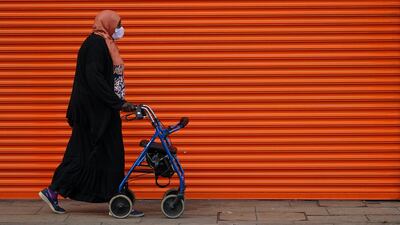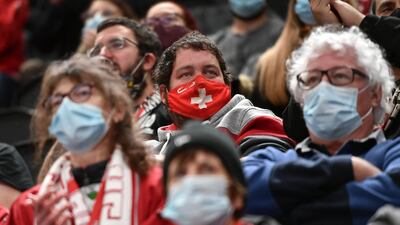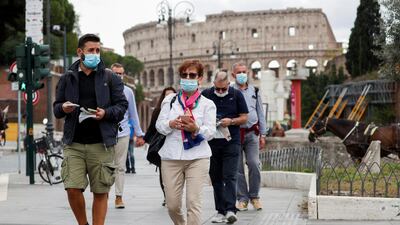
The UK should have focused on mask-wearing instead of hand-washing at the start of the pandemic, scientists believe.
Government guidance in March suggested keeping good hand hygiene was one of the best ways to protect people from coronavirus as the disease rolled through Europe.
Advertising campaigns in the UK stressed the importance of hand-washing for 20 seconds or longer and keeping them away from the face where the infection could enter the respiratory tract.
However, scientists have since downplayed the risks of “fomites” - contaminated surfaces such as door knobs or elevator buttons.
University of Leicester respiratory expert Dr Julian Tang said there was undue emphasis on the risk of picking up the virus from surfaces, adding that the main risk came from respiratory transmission.
He told the Guardian: "What we've always said is that the virus transmits by all routes. There might be some transmission by hand and fomites and we're not opposed to hand-washing, but the emphasis is wrong.
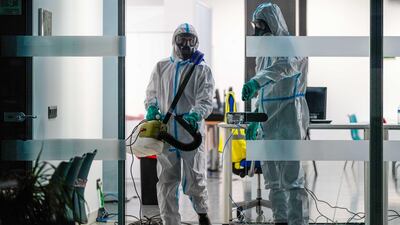
“A lot of money has been spent, and time has been spent, deep-cleaning surfaces, when the main risk is probably people talking to each other.
“If we had put that investment into masks earlier on, if we had put all the effort on hand-washing and deep-cleaning into universal mask-wearing early on, we’d almost certainly not have such a massive epidemic in Europe and North America.”
Other scientists appeared to agree with Dr Tang’s assessment.
Monica Gandhi, a professor of medicine at the University of California, told US science magazine Nautilus the virus didn't exponentially spread through surfaces.
She said: “We now know the root of the spread is not from touching surfaces and touching your eye.
“It’s from being close to someone spewing virus from their nose and mouth, without in most cases knowing they are doing so.”
Emanuel Goldman, a professor of microbiology at Rutgers University in New Jersey, also downplayed studies that suggested the virus could live on surfaces for days.
He wrote in The Lancet: "The chance of transmission through inanimate surfaces is very small, and only in instances where an infected person coughs or sneezes on the surface, and someone else touches that surface soon after the cough or sneeze."
UK health secretary Matt Hancock said on March 4: “Washing hands regularly is the single most important thing that an individual can do.”
Government guidance changed on June 15 to make mask-wearing compulsory on public transport in England.
The advice was expanded on June 24 to make face masks compulsory in shops and supermarkets.
On September 24, it became compulsory for customers to wear face masks in pubs, restaurants, cafés and bars whenever they are not sitting at their table.
The government still advises people to wash their hands as part of a range of defences against the disease, as well as social distancing and mask-wearing.

Sustainable Development Goals
1. End poverty in all its forms everywhere
2. End hunger, achieve food security and improved nutrition and promote sustainable agriculture
3. Ensure healthy lives and promote well-being for all at all ages
4. Ensure inclusive and equitable quality education and promote lifelong learning opportunities for all
5. Achieve gender equality and empower all women and girls
6. Ensure availability and sustainable management of water and sanitation for all
7. Ensure access to affordable, reliable, sustainable and modern energy for all
8. Promote sustained, inclusive and sustainable economic growth, full and productive employment and decent work for all
9. Build resilient infrastructure, promote inclusive and sustainable industrialisation and foster innovation
10. Reduce inequality within and among countries
11. Make cities and human settlements inclusive, safe, resilient and sustainable
12. Ensure sustainable consumption and production patterns
13. Take urgent action to combat climate change and its effects
14. Conserve and sustainably use the oceans, seas and marine resources for sustainable development
15. Protect, restore and promote sustainable use of terrestrial ecosystems, sustainably manage forests, combat desertification, and halt and reverse land degradation and halt biodiversity loss
16. Promote peaceful and inclusive societies for sustainable development, provide access to justice for all and build effective, accountable and inclusive institutions at all levels
17. Strengthen the means of implementation and revitalise the global partnership for sustainable development
Guide to intelligent investing
Investing success often hinges on discipline and perspective. As markets fluctuate, remember these guiding principles:
- Stay invested: Time in the market, not timing the market, is critical to long-term gains.
- Rational thinking: Breathe and avoid emotional decision-making; let logic and planning guide your actions.
- Strategic patience: Understand why you’re investing and allow time for your strategies to unfold.
Ten tax points to be aware of in 2026
1. Domestic VAT refund amendments: request your refund within five years
If a business does not apply for the refund on time, they lose their credit.
2. E-invoicing in the UAE
Businesses should continue preparing for the implementation of e-invoicing in the UAE, with 2026 a preparation and transition period ahead of phased mandatory adoption.
3. More tax audits
Tax authorities are increasingly using data already available across multiple filings to identify audit risks.
4. More beneficial VAT and excise tax penalty regime
Tax disputes are expected to become more frequent and more structured, with clearer administrative objection and appeal processes. The UAE has adopted a new penalty regime for VAT and excise disputes, which now mirrors the penalty regime for corporate tax.
5. Greater emphasis on statutory audit
There is a greater need for the accuracy of financial statements. The International Financial Reporting Standards standards need to be strictly adhered to and, as a result, the quality of the audits will need to increase.
6. Further transfer pricing enforcement
Transfer pricing enforcement, which refers to the practice of establishing prices for internal transactions between related entities, is expected to broaden in scope. The UAE will shortly open the possibility to negotiate advance pricing agreements, or essentially rulings for transfer pricing purposes.
7. Limited time periods for audits
Recent amendments also introduce a default five-year limitation period for tax audits and assessments, subject to specific statutory exceptions. While the standard audit and assessment period is five years, this may be extended to up to 15 years in cases involving fraud or tax evasion.
8. Pillar 2 implementation
Many multinational groups will begin to feel the practical effect of the Domestic Minimum Top-Up Tax (DMTT), the UAE's implementation of the OECD’s global minimum tax under Pillar 2. While the rules apply for financial years starting on or after January 1, 2025, it is 2026 that marks the transition to an operational phase.
9. Reduced compliance obligations for imported goods and services
Businesses that apply the reverse-charge mechanism for VAT purposes in the UAE may benefit from reduced compliance obligations.
10. Substance and CbC reporting focus
Tax authorities are expected to continue strengthening the enforcement of economic substance and Country-by-Country (CbC) reporting frameworks. In the UAE, these regimes are increasingly being used as risk-assessment tools, providing tax authorities with a comprehensive view of multinational groups’ global footprints and enabling them to assess whether profits are aligned with real economic activity.
Contributed by Thomas Vanhee and Hend Rashwan, Aurifer
The specs: 2018 Volkswagen Teramont
Price, base / as tested Dh137,000 / Dh189,950
Engine 3.6-litre V6
Gearbox Eight-speed automatic
Power 280hp @ 6,200rpm
Torque 360Nm @ 2,750rpm
Fuel economy, combined 11.7L / 100km
Killing of Qassem Suleimani
SHOW COURTS ORDER OF PLAY
Centre Court (4pm UAE/12pm GMT)
Victoria Azarenka (BLR) v Heather Watson (GBR)
Rafael Nadal (ESP x4) v Karen Khachanov (RUS x30)
Andy Murray (GBR x1) v Fabio Fognini (ITA x28)
Court 1 (4pm UAE)
Steve Johnson (USA x26) v Marin Cilic (CRO x7)
Johanna Konta (GBR x6) v Maria Sakkari (GRE)
Naomi Osaka (JPN) v Venus Williams (USA x10)
Court 2 (2.30pm UAE)
Aljaz Bedene (GBR) v Gilles Muller (LUX x16)
Peng Shuai (CHN) v Simona Halep (ROM x2)
Jelena Ostapenko (LAT x13) v Camila Giorgi (ITA)
Jo-Wilfried Tsonga (FRA x12) v Sam Querrey (USA x24)
Court 3 (2.30pm UAE)
Kei Nishikori (JPN x9) v Roberto Bautista Agut (ESP x18)
Carina Witthoeft (GER) v Elina Svitolina (UKR x4)
Court 12 (2.30pm UAE)
Dominika Cibulkova (SVK x8) v Ana Konjuh (CRO x27)
Kevin Anderson (RSA) v Ruben Bemelmans (BEL)
Court 18 (2.30pm UAE)
Caroline Garcia (FRA x21) v Madison Brengle (USA)
Benoit Paire (FRA) v Jerzy Janowicz (POL)