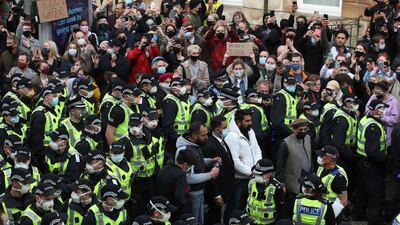
Two Indian men who were detained by immigration officials in Glasgow were released after protesters stopped the van from leaving. AP

Two men detained in Scotland by UK Home Office astonished by public response


  • English
  • Arabic

Two Indian men who were detained under UK Home Office orders in Scotland said they were “astonished and overwhelmed” after hundreds of protesters secured their release.

Protesters surrounded an immigration enforcement van on Thursday afternoon after officers took the men from a flat in the south of Glasgow.

Scottish First Minister Nicola Sturgeon said the raid, carried out on Eid Al Fitr in an area with a large Muslim population, was “staggeringly irresponsible”.

But Prime Minister Boris Johnson's spokesman said the operation was "in no way connected to Eid".

"We are tackling illegal immigration and the harms it causes," he said.
"We will continue to tackle illegal immigration."

The Home Office said the men, who were not themselves believed to be Muslim, were detained over suspected immigration offences.

Lakhvir Singh, who was apprehended with Sumit Sehdevi, praised protesters for his release.

“I’ve been astonished and overwhelmed by the support I’ve received from the people of Glasgow,” he said.

“At around 9.30am immigration enforcement carried out a raid and we were taken to security in the van. There were only five or six people at the time but word spread and then there were crowds of hundreds. We are so grateful for the support.”

Protesters shouted "let our neighbours go" and "cops go home" as a stand-off with police escalated. One man crawled underneath the van to prevent it from leaving the scene.

Police Scotland said they stepped in to ensure the release of the men on public safety grounds. The force said its officers did not assist in the removal of the asylum seekers but were on hand to monitor the protest.

Footage shared on social media showed the crowd erupting into cheers when the detainees were released.

The incident made front-page news in Scotland, with headlines including “People Power”, “Human Shields” and “Glasgow 1 Team UK 0”.

Mohammad Asif, director of the Afghan Human Rights Foundation, said the Home Office "shouldn't act like the Mafia".

"They should have a more humane way of removing people," he told Press Association.

“The Home Office does it in a very brutal way… it’s like you’ve committed murder or rape – there are different ways to remove people without taking them from their bed.”

Ms Sturgeon said the Home Office needed to ask itself “hard questions” about why the raid took place.

"Doing this on Eid, in the heart of our Muslim community, and in the midst of a serious Covid outbreak was staggeringly irresponsible – but the even deeper problem is an appalling asylum and immigration policy," she said.

The Home Office said the British government would continue to take action against those "with no right to be in the UK".

"The operation in Glasgow was conducted in relation to suspected immigration offences and the two Indian nationals complied with officers at all times,” it said.

"The UK government continues to tackle illegal migration in all its forms and our New Plan for Immigration will speed up the removal of those who have entered the UK illegally."

Scottish Justice Secretary Humza Yousaf said the Home Office’s actions were reckless.

"The UK government’s hostile environment is not welcome here. I abhor Home Office immigration policy at the best of times, but to have taken the action they have is at best completely reckless and at worst intended to provoke.”

Sabir Zazai, chief executive of the Scottish Refugee Council, said the events were shocking.

“Not close to the details on this but this is shocking, disgraceful and racist if people are raided by enforcement officers amid the pandemic on the day of Eid,” he said.

Britain’s main opposition Labour Party suspended a union official who said Home Secretary Priti Patel “should be deported” after the incident in Glasgow.

Unite general secretary Howard Beckett tweeted the now-deleted comment.

Key facilities
  • Olympic-size swimming pool with a split bulkhead for multi-use configurations, including water polo and 50m/25m training lanes
  • Premier League-standard football pitch
  • 400m Olympic running track
  • NBA-spec basketball court with auditorium
  • 600-seat auditorium
  • Spaces for historical and cultural exploration
  • An elevated football field that doubles as a helipad
  • Specialist robotics and science laboratories
  • AR and VR-enabled learning centres
  • Disruption Lab and Research Centre for developing entrepreneurial skills
What is the definition of an SME?

SMEs in the UAE are defined by the number of employees, annual turnover and sector. For example, a “small company” in the services industry has six to 50 employees with a turnover of more than Dh2 million up to Dh20m, while in the manufacturing industry the requirements are 10 to 100 employees with a turnover of more than Dh3m up to Dh50m, according to Dubai SME, an agency of the Department of Economic Development.

A “medium-sized company” can either have staff of 51 to 200 employees or 101 to 250 employees, and a turnover less than or equal to Dh200m or Dh250m, again depending on whether the business is in the trading, manufacturing or services sectors. 

Venom

Director: Ruben Fleischer

Cast: Tom Hardy, Michelle Williams, Riz Ahmed

Rating: 1.5/5

Evacuations to France hit by controversy
  • Over 500 Gazans have been evacuated to France since November 2023
  • Evacuations were paused after a student already in France posted anti-Semitic content and was subsequently expelled to Qatar
  • The Foreign Ministry launched a review to determine how authorities failed to detect the posts before her entry
  • Artists and researchers fall under a programme called Pause that began in 2017
  • It has benefited more than 700 people from 44 countries, including Syria, Turkey, Iran, and Sudan
  • Since the start of the Gaza war, it has also included 45 Gazan beneficiaries
  • Unlike students, they are allowed to bring their families to France
ALRAWABI%20SCHOOL%20FOR%20GIRLS
%3Cp%3ECreator%3A%20Tima%20Shomali%3C%2Fp%3E%0A%3Cp%3EStarring%3A%C2%A0Tara%20Abboud%2C%C2%A0Kira%20Yaghnam%2C%20Tara%20Atalla%3C%2Fp%3E%0A%3Cp%3ERating%3A%204%2F5%3C%2Fp%3E%0A
Ten tax points to be aware of in 2026

1. Domestic VAT refund amendments: request your refund within five years

If a business does not apply for the refund on time, they lose their credit.

2. E-invoicing in the UAE

Businesses should continue preparing for the implementation of e-invoicing in the UAE, with 2026 a preparation and transition period ahead of phased mandatory adoption. 

3. More tax audits

Tax authorities are increasingly using data already available across multiple filings to identify audit risks. 

4. More beneficial VAT and excise tax penalty regime

Tax disputes are expected to become more frequent and more structured, with clearer administrative objection and appeal processes. The UAE has adopted a new penalty regime for VAT and excise disputes, which now mirrors the penalty regime for corporate tax.

5. Greater emphasis on statutory audit

There is a greater need for the accuracy of financial statements. The International Financial Reporting Standards standards need to be strictly adhered to and, as a result, the quality of the audits will need to increase.

6. Further transfer pricing enforcement

Transfer pricing enforcement, which refers to the practice of establishing prices for internal transactions between related entities, is expected to broaden in scope. The UAE will shortly open the possibility to negotiate advance pricing agreements, or essentially rulings for transfer pricing purposes. 

7. Limited time periods for audits

Recent amendments also introduce a default five-year limitation period for tax audits and assessments, subject to specific statutory exceptions. While the standard audit and assessment period is five years, this may be extended to up to 15 years in cases involving fraud or tax evasion. 

8. Pillar 2 implementation 

Many multinational groups will begin to feel the practical effect of the Domestic Minimum Top-Up Tax (DMTT), the UAE's implementation of the OECD’s global minimum tax under Pillar 2. While the rules apply for financial years starting on or after January 1, 2025, it is 2026 that marks the transition to an operational phase.

9. Reduced compliance obligations for imported goods and services

Businesses that apply the reverse-charge mechanism for VAT purposes in the UAE may benefit from reduced compliance obligations. 

10. Substance and CbC reporting focus

Tax authorities are expected to continue strengthening the enforcement of economic substance and Country-by-Country (CbC) reporting frameworks. In the UAE, these regimes are increasingly being used as risk-assessment tools, providing tax authorities with a comprehensive view of multinational groups’ global footprints and enabling them to assess whether profits are aligned with real economic activity. 

Contributed by Thomas Vanhee and Hend Rashwan, Aurifer

Dr Afridi's warning signs of digital addiction

Spending an excessive amount of time on the phone.

Neglecting personal, social, or academic responsibilities.

Losing interest in other activities or hobbies that were once enjoyed.

Having withdrawal symptoms like feeling anxious, restless, or upset when the technology is not available.

Experiencing sleep disturbances or changes in sleep patterns.

What are the guidelines?

Under 18 months: Avoid screen time altogether, except for video chatting with family.

Aged 18-24 months: If screens are introduced, it should be high-quality content watched with a caregiver to help the child understand what they are seeing.

Aged 2-5 years: Limit to one-hour per day of high-quality programming, with co-viewing whenever possible.

Aged 6-12 years: Set consistent limits on screen time to ensure it does not interfere with sleep, physical activity, or social interactions.

Teenagers: Encourage a balanced approach – screens should not replace sleep, exercise, or face-to-face socialisation.

Source: American Paediatric Association

((Disclaimer))

The Liechtensteinische Landesbank AG (“Bank”) assumes no liability or guarantee for the accuracy, balance, or completeness of the information in this publication. The content may change at any time due to given circumstances, and the Liechtensteinische Landesbank AG is under no obligation to update information once it has been published. This publication is intended for information purposes only and does not constitute an offer, a recommendation or an invitation by, or on behalf of, Liechtensteinische Landesbank (DIFC Branch), Liechtensteinische Landesbank AG, or any of its group affiliates to make any investments or obtain services. This publication has not been reviewed, disapproved or approved by the United Arab Emirates (“UAE”) Central Bank, Dubai Financial Services Authority (“DFSA”) or any other relevant licensing authorities in the UAE. It may not be relied upon by or distributed to retail clients. Liechtensteinische Landesbank (DIFC Branch) is regulated by the DFSA and this advertorial is intended for Professional Clients (as defined by the DFSA) who have sufficient financial experience and understanding of financial markets, products or transactions and any associated risks.

Details

Through Her Lens: The stories behind the photography of Eva Sereny

Forewords by Jacqueline Bisset and Charlotte Rampling, ACC Art Books

UAE currency: the story behind the money in your pockets
