
Passengers said social distancing needs to be improved at UK airports after travellers from high-risk countries mixed freely at the border on the first day of hotel quarantine on Monday.
Travellers who arrived from the so-called red list of 33 countries – which includes the UAE, South Africa and all of South America – were escorted through terminals and on to buses before they were driven to surrounding hotels for the 10-day quarantine.
The programme is designed to prevent new variants of coronavirus from entering the UK, but passengers at London Heathrow Airport said that red-list passengers were “funnelled through the same area” as other travellers before they were separated.
Jorge Elch, who arrived from the Maldives via Frankfurt, told The National he was worried about becoming infected himself after flying with six red-list travellers.
He said passengers were separated only when their travel documents were checked by border officers.
“You get off the flight at the same time as someone from a red-list area,” he said.
“Everybody is funnelled through the same area. It doesn’t make sense to me.”
After clearing customs, red-list travellers are escorted by security officers through the terminal and on to coaches waiting in the airport car park.
One woman in Terminal 2 was accompanied by four security guards while she was shown out of the terminal. Other passengers, however, were escorted by only one guard.
Most travellers arriving at the airport were from lower-risk countries, with only a handful from each flight directed to the hotels. The security presence at the airport was noticeably stronger than in previous weeks.
Heathrow Airport said on Sunday that passengers could experience delays of up to five hours, but on Monday passengers said they queued for no longer than an hour.
Another passenger, arriving from Cameroon, said many people arrived at the border without a Covid-19 test package. Passengers are required to pay £210 ($291) before they arrive so they can receive a test on days two and eight of their quarantine.
"Loads of people don't understand the requirements to come back," he told The National. "I said to them [border officers] that they really need to make it clear what's needed because every second person didn't have the right documents and they were put in a different area."
Olivia Moore, who arrived from Paris, agreed that getting the right paperwork was “a bit of a hassle”.
“It’s taking longer than usual because people don’t understand what they need,” she said.
“It gets easier once you get your head around it.”
British businessman Wayne Kelly said border officers told him he faces a fine after landing at Heathrow from a trip to Dubai without booking a hotel slot.
All travellers from red-list countries are supposed to book a place on the government website before they arrive. The price for one adult for 11 nights is £1,750.
"The first I realised I was going to be in this trouble was when I got off the plane," he told the Daily Mail.

“Now I’ve got this nightmare of being put into a hotel when I’ve actually got a home in Birmingham with my family.
“I was in Dubai last month and when I got back I quarantined at home with no problem. I should be allowed to do that again.”
Fatima, a passenger from Dubai who arrived with her two children, said she understood why UK authorities introduced hotel quarantine.
“We knew that we would have to quarantine and don’t have a problem with this. This is a lovely hotel and I think it will be a nice stay,” she said, declining to give her surname.
“It took quite a long time but they’ve been looking after us very well.”
Zari Tadayon, from London, faces spending her birthday in isolation after flying in from Dubai via Frankfurt.
Asked how she felt about spending 10 days in isolation, she said: “I feel horrible because I live here, I have my own individual home, and I have some medical issues which I was hoping they would consider.
“I’m not prepared. I didn’t bring books and stuff.”
The UK recorded another 230 coronavirus deaths and 9,755 new infections on Monday.
Prime Minister Boris Johnson said England’s path out of lockdown would be “cautious but irreversible”, with the plan for ending restrictions expected to be announced next Monday.
“There are still 23,000 or so Covid patients in the NHS – more than at the April peak last year – there are still sadly too many people dying of this disease; and rates of infection, although they are coming down, are still comparatively high.
“So we have got to be very prudent and what we want to see is progress that is cautious but irreversible. I think that is what the public – people up and down the country – want to see.”
Meanwhile, Health Secretary Matt Hancock said the hotel quarantine system had been operating well since coming into force at 4am.
He said the government was working with airports and border police to ensure everyone understood how the system would work.
Asked how red-list passengers were being kept away from everyone else, he told Times Radio: “You go down a separate channel at the gates and, once you’ve been through the gates, which are manned by the Border Force, there is then a security operation supported by the police so that people are gathered, go and pick up their luggage and then go to the hotels.”
Heathrow Airport said the new measures were a success on Monday but repeated concerns about a shortage of Border Force staff.
“Queues at the border are currently less than an hour long, but this isn’t about one day,” a spokeswoman said.
“We will continue to monitor and seek assurance from our Border Force colleagues that they maintain adequate resources and effective processes to avoid unacceptable waiting times and compromising the safety of passengers.”
Nadine Houghton, national officer for the GMB trade union, which represents hotel staff, said its members needed better-quality personal protective equipment.
“We will not sit back while our members are asked to do potentially unsafe work. There must be thorough negotiations on risk assessments and ensuring proper PPE is being provided. This isn’t just about the safety of workers, it’s about preventing new variants from spreading at a time when we are beginning to turn the tide on the virus,” she said.
Paul Charles, chief executive of The PC Agency travel consultancy, urged the government to spell out when hotel quarantine would end.
The tourism industry on Monday launched its Save Our Summer campaign, calling for a travel plan to be published by May 1.
“Hotel quarantine is not a medium or longer-term strategy and we would prefer to see regular testing,” he said.
“The vaccine is starting to work its magic, the infection and mortality rate is starting to come down, so we think May is a very reasonable date.”
In pictures – hotel quarantine begins in the UK
-
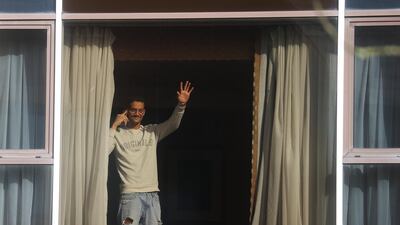
A man waves from the window of the Radisson Blu Hotel at Heathrow Airport, as Britain introduces hotel quarantine programme. Reuters -
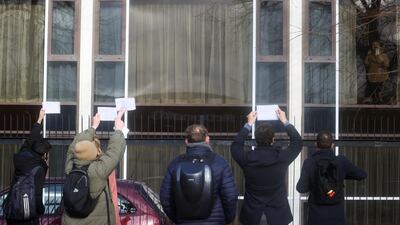
Journalists show messages to a passenger staying at the Radisson Blu Hotel at Heathrow Airport. Reuters -
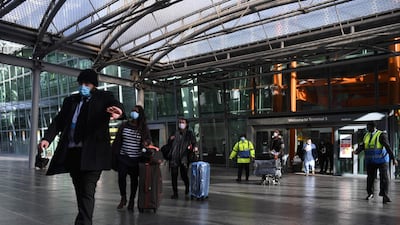
Passengers are escorted to a coach at Heathrow Airport to be driven to a mandatory hotel quarantine in west London. AFP -
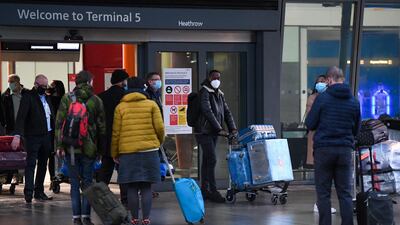
Passengers are guided towards a coach after arriving at Heathrow Airport in London. Some passengers traveling to the UK will face tougher quarantine measures, including enforced stays in hotels. Bloomberg -
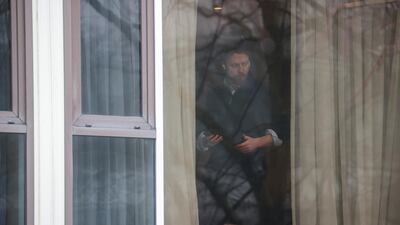
A man looks through a window of the Radisson Blu Hotel at Heathrow Airport. Reuters -
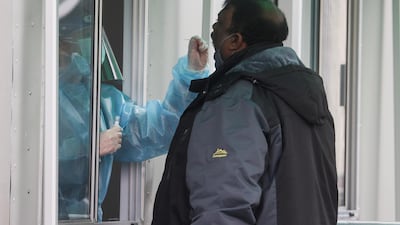
A health care worker takes a swab sample from a man to test for coronavirus at a mobile testing site at Heathrow Airport. Reuters -
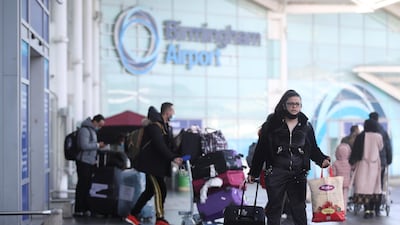
A passenger arrives at Birmingham Airport on Monday morning. Reuters -

A guest gestures from a window of the Radisson Blu Edwardian hotel, a location used for travelers quarantine, at London Heathrow Airport. Bloomberg -
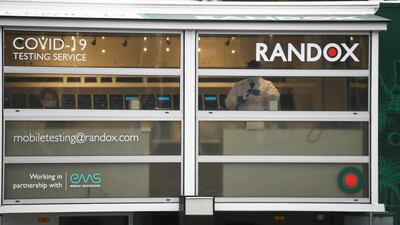
A mobile Covid-19 testing service at the rear of the Radisson Blu Edwardian hotel. Bloomberg -
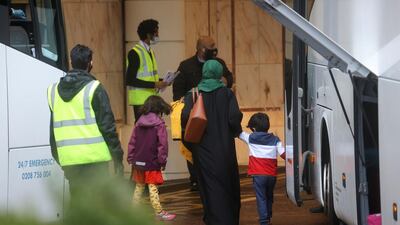
Passengers arrive at the Radisson Blu hotel at Heathrow Airport. Reuters -
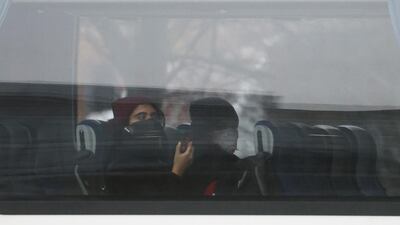
Passengers are driven in a bus to the Radisson Blu hotel at Heathrow Airport. Reuters -
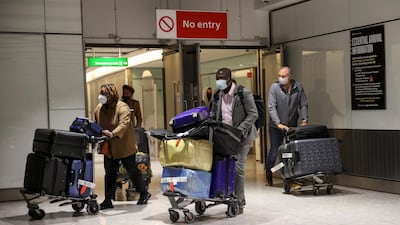
Travellers arrive at Heathrow Airport on Monday morning. Reuters -
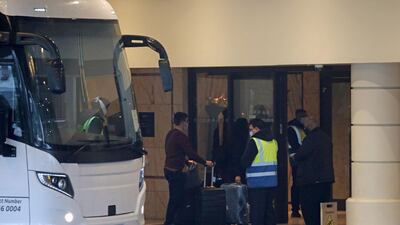
A coach delivers passengers to the Radisson Blu Edwardian Hotel, near Heathrow Airport, where they will remain during a 10 day quarantine period. AP Photo -
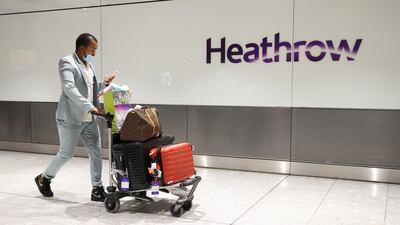
New regulations now in force require anyone who has been in a 'high-risk' location to enter England through a designated port and have pre-booked a package to stay at one of the Government's managed quarantine facilities. Reuters -
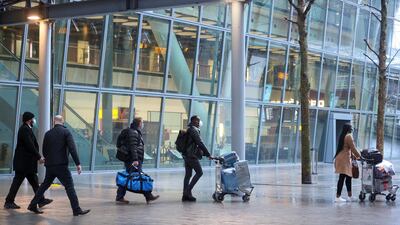
Travellers walk outside Heathrow Airport. Reuters



