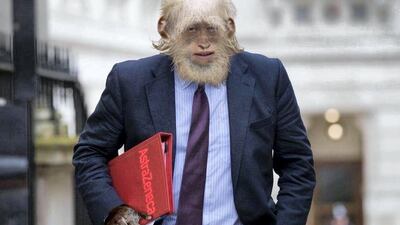
A Russian disinformation campaign depicts Boris Johnson as a monkey in an attempt to sow doubt about the UK's coronavirus jab.

Russia launches ‘deplorable and dangerous’ smear campaign against Oxford vaccine trial


  • English
  • Arabic

The head of the Oxford University vaccine trial says a bizarre Russian smear campaign designed to undermine the work of British scientists is “a risk for all of us”.

The disinformation campaign is designed to spread fear about the UK’s coronavirus jab by claiming it is a “chimpanzee vaccine”.

Pictures, memes and video clips depicting the vaccine as dangerous were created in Russia to be spread on social media networks.

The images depict Boris Johnson mocked up as a monkey with the caption: “I like my bigfoot vaccine”.

Another unsettling meme shows a chimpanzee in an AstraZeneca lab coat brandishing a syringe.

And America’s Uncle Sam character appears in another image with the caption: “I want you to take monkey vaccine”.

The campaign, which targets the Oxford-AstraZeneca vaccine partnership, claims the British-made jab could turn people into monkeys because it uses a chimpanzee virus as a vector.

Russia is launching the campaign in countries where it hopes to sell its own Sputnik V vaccine, it was reported.

The fake news push comes after Britain's MI5 chief Ken McCallum warned hostile powers were trying to sabotage the country's vaccine trials.

Speaking on BBC Radio 4's Today programme, Oxford vaccine director Prof Andrew Pollard said fear campaigns about vaccines in a time of crisis were a "risk for all of us".

He said: “Anything that undermines trust in the public health approach we’re taking could be extremely dangerous.

“Vaccines are such an important cornerstone for children.

“Anything that drives that wider view in societies around the world that there is something unsafe about them, really risks their health.”

Head of the Oxford University vaccine trial Andrew Pollard dismissed a Russian disinformation campaign as "extremely dangerous".

Foreign Secretary Dominic Raab called the disinformation campaign “deplorable”.

“The UK is world-famous for the quality of our research,” he told the BBC. “Any attempt to spread lies about the vaccine … is utterly deplorable.”

Prof Pollard scoffed at the claim the vaccine was designed for chimpanzees.

He explained that the Oxford vaccine was based on the common cold virus from a variety of species.

“That virus, to our bodies, looks the same - it’s the same family of viruses, whether they’re human or chimpanzee viruses,” Prof Pollard said.

“We don’t actually have any chimpanzees at all in the process of making a vaccine.”

The Russian campaign began about a month ago after a volunteer in the trial fell ill.

Countries including Brazil and India, where Russia is marketing its own vaccine, have been targeted by the campaign.

The memes were recently featured on a top Russian news programme.

A spokesman for the Kremlin denied it was behind the campaign, telling The Times: "The suggestion that the Russian state may conduct any kind of propaganda against the AstraZeneca vaccine is itself an example of disinformation."

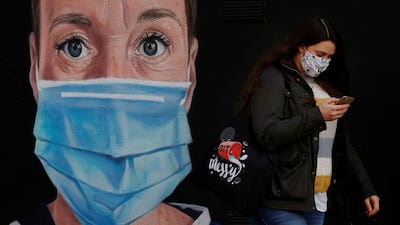
  • A woman wears a face mask as she walks past a mural of a nurse in Manchester. Reuters
    A woman wears a face mask as she walks past a mural of a nurse in Manchester. Reuters
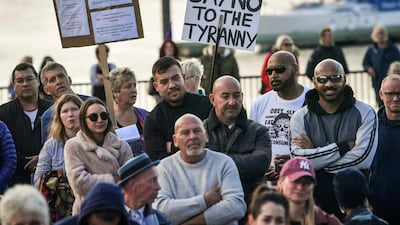
  • People attend an anti-lockdown protest outside the Senedd Cymru in Cardiff Bay, Wales. AP Photo
    People attend an anti-lockdown protest outside the Senedd Cymru in Cardiff Bay, Wales. AP Photo
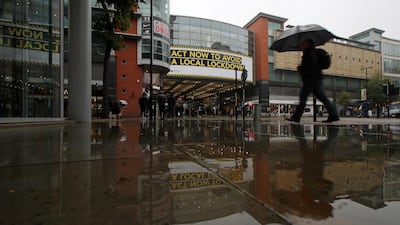
  • A sign appealing to the public to follow guidelines in Manchester. Reuters
    A sign appealing to the public to follow guidelines in Manchester. Reuters
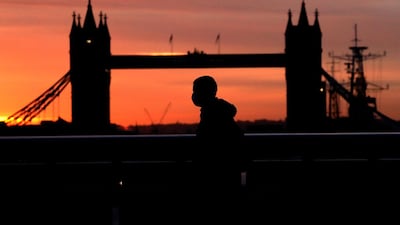
  • A person wearing a face mask walks across London Bridge, with Tower Bridge in the background, at sunrise in London. AP Photo
    A person wearing a face mask walks across London Bridge, with Tower Bridge in the background, at sunrise in London. AP Photo
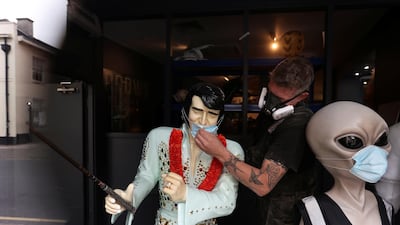
  • A worker adjusts a face mask on a mannequin at a shop in Nottingham. Reuters
    A worker adjusts a face mask on a mannequin at a shop in Nottingham. Reuters
  • A man wearing a face mask walks along the River Mersey in Liverpool. Reuters
    A man wearing a face mask walks along the River Mersey in Liverpool. Reuters
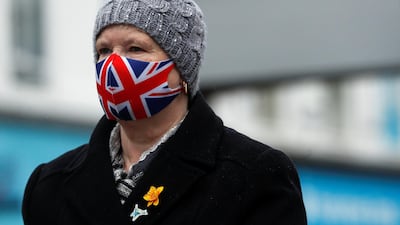
  • A person wears a Union Jack face mask in Newcastle Upon Tyne. Reuters
    A person wears a Union Jack face mask in Newcastle Upon Tyne. Reuters
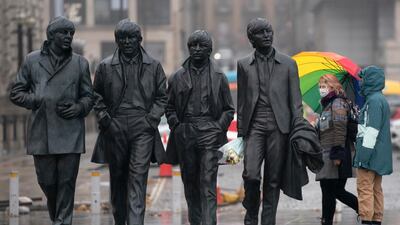
  • Members of the public wearing face masks stand near a statue of The Beatles in Liverpool. AP Photo
    Members of the public wearing face masks stand near a statue of The Beatles in Liverpool. AP Photo
Groom and Two Brides

Director: Elie Semaan

Starring: Abdullah Boushehri, Laila Abdallah, Lulwa Almulla

Rating: 3/5

Countries recognising Palestine

France, UK, Canada, Australia, Portugal, Belgium, Malta, Luxembourg, San Marino and Andorra


Which honey takes your fancy?

Al Ghaf Honey

The Al Ghaf tree is a local desert tree which bears the harsh summers with drought and high temperatures. From the rich flowers, bees that pollinate this tree can produce delicious red colour honey in June and July each year

Sidr Honey

The Sidr tree is an evergreen tree with long and strong forked branches. The blossom from this tree is called Yabyab, which provides rich food for bees to produce honey in October and November. This honey is the most expensive, but tastiest

Samar Honey

The Samar tree trunk, leaves and blossom contains Barm which is the secret of healing. You can enjoy the best types of honey from this tree every year in May and June. It is an historical witness to the life of the Emirati nation which represents the harsh desert and mountain environments

Points Classification after Stage 1

1. Geraint Thomas (Britain / Team Sky) 20

2. Stefan Kueng (Switzerland / BMC Racing) 17

3. Vasil Kiryienka (Belarus / Team Sky) 15

4. Tony Martin (Germany / Katusha) 13

5. Matteo Trentin (Italy / Quick-Step) 11

6. Chris Froome (Britain / Team Sky) 10

7. Jos van Emden (Netherlands / LottoNL) 9

8. Michal Kwiatkowski (Poland / Team Sky) 8

9. Marcel Kittel (Germany / Quick-Step) 7

10. Edvald Boasson Hagen (Norway / Dimension Data) 6

MATCH INFO

World Cup 2022 qualifier

UAE v Indonesia, Thursday, 8pm

Venue: Al Maktoum Stadium, Dubai

Global state-owned investor ranking by size

1.

United States

2.

China

3.

UAE

4.

Japan

5

Norway

6.

Canada

7.

Singapore

8.

Australia

9.

Saudi Arabia

10.

South Korea

Key figures in the life of the fort

Sheikh Dhiyab bin Isa (ruled 1761-1793) Built Qasr Al Hosn as a watchtower to guard over the only freshwater well on Abu Dhabi island.

Sheikh Shakhbut bin Dhiyab (ruled 1793-1816) Expanded the tower into a small fort and transferred his ruling place of residence from Liwa Oasis to the fort on the island.

Sheikh Tahnoon bin Shakhbut (ruled 1818-1833) Expanded Qasr Al Hosn further as Abu Dhabi grew from a small village of palm huts to a town of more than 5,000 inhabitants.

Sheikh Khalifa bin Shakhbut (ruled 1833-1845) Repaired and fortified the fort.

Sheikh Saeed bin Tahnoon (ruled 1845-1855) Turned Qasr Al Hosn into a strong two-storied structure.

Sheikh Zayed bin Khalifa (ruled 1855-1909) Expanded Qasr Al Hosn further to reflect the emirate's increasing prominence.

Sheikh Shakhbut bin Sultan (ruled 1928-1966) Renovated and enlarged Qasr Al Hosn, adding a decorative arch and two new villas.

Sheikh Zayed bin Sultan (ruled 1966-2004) Moved the royal residence to Al Manhal palace and kept his diwan at Qasr Al Hosn.

Sources: Jayanti Maitra, www.adach.ae

Milestones on the road to union

1970

October 26: Bahrain withdraws from a proposal to create a federation of nine with the seven Trucial States and Qatar. 

December: Ahmed Al Suwaidi visits New York to discuss potential UN membership.

1971

March 1:  Alex Douglas Hume, Conservative foreign secretary confirms that Britain will leave the Gulf and “strongly supports” the creation of a Union of Arab Emirates.

July 12: Historic meeting at which Sheikh Zayed and Sheikh Rashid make a binding agreement to create what will become the UAE.

July 18: It is announced that the UAE will be formed from six emirates, with a proposed constitution signed. RAK is not yet part of the agreement.

August 6:  The fifth anniversary of Sheikh Zayed becoming Ruler of Abu Dhabi, with official celebrations deferred until later in the year.

August 15: Bahrain becomes independent.

September 3: Qatar becomes independent.

November 23-25: Meeting with Sheikh Zayed and Sheikh Rashid and senior British officials to fix December 2 as date of creation of the UAE.

November 29:  At 5.30pm Iranian forces seize the Greater and Lesser Tunbs by force.

November 30: Despite  a power sharing agreement, Tehran takes full control of Abu Musa. 

November 31: UK officials visit all six participating Emirates to formally end the Trucial States treaties

December 2: 11am, Dubai. New Supreme Council formally elects Sheikh Zayed as President. Treaty of Friendship signed with the UK. 11.30am. Flag raising ceremony at Union House and Al Manhal Palace in Abu Dhabi witnessed by Sheikh Khalifa, then Crown Prince of Abu Dhabi.

December 6: Arab League formally admits the UAE. The first British Ambassador presents his credentials to Sheikh Zayed.

December 9: UAE joins the United Nations.

How it works

Booklava works on a subscription model. On signing up you receive a free book as part of a 30-day-trial period, after which you pay US$9.99 (Dh36.70) per month to gain access to a library of books and discounts of up to 30 per cent on selected titles. You can cancel your subscription at any time. For more details go to www.booklava.com