
The slow response to a coronavirus lockdown by a number of leading countries led to exceptionally high deaths rates, new research by The National has shown.
Governments from Britain, France, Italy and Iran held back for weeks as deaths rose before imposing blanket shutdown measures. By comparison The National consistently found countries that went into full restriction measures before they had suffered a single fatality have a very low death toll.
Experts said the research was “important evidence” in tackling the disease.
In a sample of 20 countries, those which failed to put in strict measures early experienced unusually high mortality rates. Britain suffered 396 deaths before lockdown, while Iran experienced 1,433.
By comparison, South Africa, the UAE and Baltic States went into lockdown with no deaths. That mattered when it came to progression of the disease over the following weeks and months.
South Africa’s death rate per head of population is one in 243,000, UAE’s is one in 48,000 while America has a death rate of one in 3,800 people out of its population of 329 million compared to Britain’s one death in 1,900 out of its 66 million population.
Britain (359) also had almost four times more deaths than America (96) when it went into lockdown.
Both South Korea and Germany, the two countries considered to have tackled the disease most successfully, entered lockdown with one and eight deaths respectively. South Korea’s death rate is 100 times lower than Britain’s with one death per 196,000 and Germany is five times lower at one death per 10,500.
Another statistic with an apparent legacy is the time taken from the first confirmed Covid-19 death to lockdown. Out of the 20 countries examined, America took the longest, waiting 39 days, France 31 days, Spain 30 and Britain 18.
The statistic recording the time taken from first confirmed Covid-19 infection to lockdown also has striking aspects. America took the longest to shutdown – in terms of its major states – at 55 days from the first diagnosed case, Britain was second at 52 days and Spain third at 43 days.
South Africa’s implemented very strict lockdown on the same date as Britain, March 23, but this was three days before it experienced its first Covid-19 death. At 58 million it has a similar population to Britain, albeit younger, but has deaths per capita of 1:243,000 which is 130 times lower than the UK.
Despite having the highest number of deaths on lockdown day, and the third highest delay of 28 days from first Covid-19 death to lockdown, Iran’s figures show that it has a death per capita ratio of 1:12,000, on a par with Germany. Like several other countries on the list, including Russia, China and India, it is not clear that the full data on deaths and infections has yet been released.
The overwhelming evidence suggests that lockdown saved many lives and early lockdowns saved many more.
"There is no doubt that lockdown has saved thousands and thousands of lives," said Dr Ilan Kelman, Professor of Disasters and Health at University College London. "The National's data suggests a link between better lockdown and lower death rates, with the explanation being clear that physical distancing stops infections, so we have both correlation and causation.
“This analysis is important evidence in supporting the effectiveness of lockdown approaches in reducing coronavirus-related deaths. This is exactly the direction which our continuing analyses must be heading.”
-

A medical worker takes a swab sample from a man in a neighborhood in Wuhan, in China’s central Hubei province. AFP -

Pupils observe social distancing rules in the playground in Edegem, near Antwerp. AFP -

A driver checks social distancing markers on the seats of his tram, before leaving the garage in Sarajevo, Bosia. AFP -
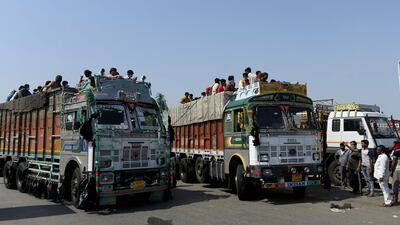
Migrant workers on the outskirts of Hyderabad travel on a lorry to return to their hometowns. AFP -

Children wait in lines at a crèche in Langa, near Cape Town. AFP -

Men wearing protective overalls and mask sanitise St Peter's Basilica in The Vatican. AFP -

Tube commuters wearing PPE travel during the evening 'rush hour' on the Circle Line, in central London. AFP -

Swiss Guards wearing a face mask give a salute as they stand guard at an entrance of The Vatican. AFP -
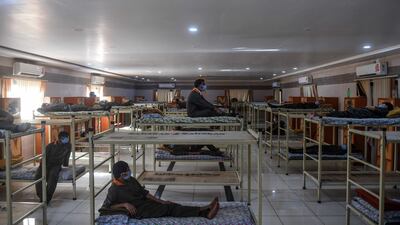
Labourers take a break in their quarters maintaining social distancing at DH Cube Industries, a heavy manufacturing factory, at Vasna Buzarg village, some 40km from Ahmedabad. AFP -

A traffic police officer rides a self-balancing scooter in Chennai. AFP -
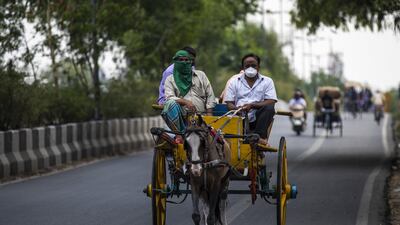
A horse drawn carriage takes passengers along a road during a partial lockdown imposed due to the coronavirus in New Delhi, India. Bloomberg -
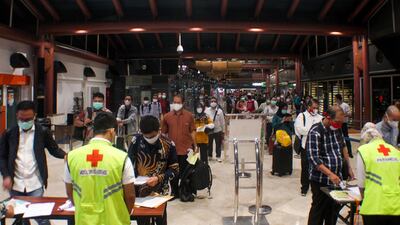
Airport health officials at a check point at Soekarno-Hatta Jakarta International airport in Tangerang. AFP -

A man wearing a face masks, as a preventive measure against the spread of the new coronavirus, COVID-19, walks by a graffiti reading "Hunger", in Caracas. AFP -

Police officers are seen during a raid at Santo Domingo neighborhood amid the new COVID-19, coronavirus pandemic, in Medellin, Colombia. AFP


Herd immunity strategy
Prof Julian Peto, of the London School of Hygiene and Tropical Medicine, believed the evidence of Brtian’s high death count of 359 on March 23 lockdown, showed a political decision had been made to follow herd immunity. But this was then reversed with the possibility of the health service being overwhelmed and a high death toll.
He is among several experts who believe that with a vaccine potentially two years away the route back to economic stability is through herd immunity. “Everyone knows this but they are afraid of alarming the public. It’s a question of whether the public can stomach the number of deaths or whether they can stomach irreparably damaging the economy.”
The statistician pointed to Sweden where there has been no lockdown but it has a significantly lower per capita death count than Britain with 1:2,700. It is suggested that Sweden might reach an initial herd immunity of 60 per cent by the end of this month.
“I believe the British government is heading towards herd immunity because they realise you cannot prevent the pandemic and that the Swedish model has worked,” Prof Peto added.
*The National used open source data to compile the figures from Johns Hopkins University, Worldometer.info, OurWorldInData.org and Gov.Uk.
Information on first recorded Covid-19 infections, deaths and lockdown dates was gathered from Wikipedia and other media.
For the majority of 20 countries, the lockdown date is generally given as the day schools shut.

