The UK government has warned rebelling mayors it will use its power to impose the toughest coronavirus restrictions on their cities with or without their support.
The stronger stance comes a day after Greater Manchester Mayor Andy Burnham accused Prime Minister Boris Johnson of trying to make the north of England a “sacrificial lamb” for the wealthier south.
In a defiant speech yesterday, Mr Burnham refused to accept Tier 3 restrictions for Manchester, saying the prime minister’s plan treated the city “as canaries in the coal mine for an experimental regional lockdown strategy”.
He said a national circuit-breaker lockdown would be fairer.
However, Foreign Secretary Dominic Raab described Mr Burnham’s position as “crazy”.
He told the BBC: “Ultimately we need to take action - we can't have a situation as we have seen in Manchester where Andy Burnham is effectively trying to hold the government over a barrel over money and politics.
“Obviously, in the last resort the government has the powers to proceed in any event.”
Amid a surge in Covid-19 cases - with 138 more UK deaths reported on Thursday - Mr Johnson is holding out against a second full national lockdown, instead announcing a three-tier system of restrictions targeting virus hotspots.
But Labour has thrown its weight behind a call for a short, so-called circuit breaker lockdown that was recommended by the government’s own scientific advisers last month.
The scientists are still pushing for this to break the chain of coronavirus transmission, potentially timing nationwide curbs to coincide with the late October half-term school holidays.
But even they believe it may be too late for a national lockdown to bring virus cases back down to the lower levels seen in August.
Ministers fear that would further cripple an economy already battered by the pandemic.
Jeremy Farrar, a senior member of the government’s Sage panel of scientific advisers, warned that divisions risk hampering efforts to bring the virus under control.
'Worst of all worlds'
“This fragmentation, and frankly making this either a north-south or a party political issue, that’s a very dangerous route to go on,” he told the BBC. “We’ve got to come together as a country.”
Dr Farrar proposed a national lockdown as soon as possible and warned that the restrictions in place at the moment would fail to control the pandemic, while still damaging the economy.
“I think we’re in the worst of all worlds here,” he said.

For now, Mr Johnson is persisting with his regional approach to stemming the spread of the virus.
On Thursday, Health Secretary Matt Hancock announced that new rules in London will take effect from midnight on Friday and into Saturday.
As well as the ban on household mixing, people will be discouraged from using public transport.
The tougher restrictions were advocated by London Mayor Sadiq Khan, who told the city’s assembly on Thursday: “We have a difficult winter ahead.”
But in Manchester, local leaders rejected plans to place their region in the highest tier of virus restrictions, without more compensation for businesses forced to close, and support for their workers.
Mr Johnson has the authority to impose new measures without the agreement of local leaders but he is trying to negotiate first.
“It is wrong to place some of the poorest parts of England in a punishing lockdown without proper support for the people and businesses affected,” Mr Burnham said.
“Let’s make it a one-nation policy, not make the north the sacrificial lamb.”
Mr Burnham, of the Labour Party, was joined in speaking out against the proposed restrictions by influential Tory MP Graham Brady, whose constituency of Altrincham and Sale West lies within the affected area.
“It would be a very foolish thing to do,” Brady told Times Radio on Thursday.
“If you try to do these things without consent, people lose patience very quickly.”
Another Conservative MP from the region, William Wragg, complained in the House of Commons about a meeting with ministers earlier in the day.
“I may as well have talked to a wall, quite frankly,” he said.
-
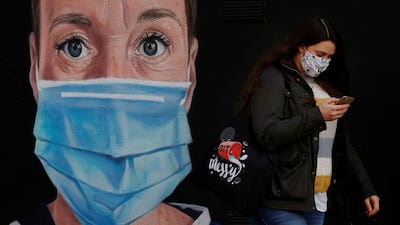
A woman wears a face mask as she walks past a mural of a nurse in Manchester. Reuters -
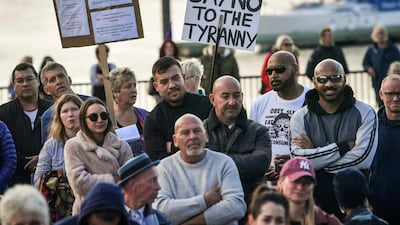
People attend an anti-lockdown protest outside the Senedd Cymru in Cardiff Bay, Wales. AP Photo -
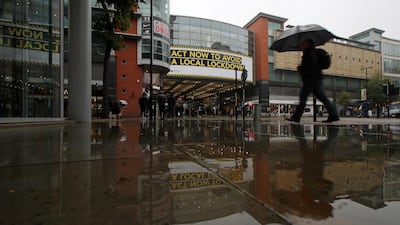
A sign appealing to the public to follow guidelines in Manchester. Reuters -
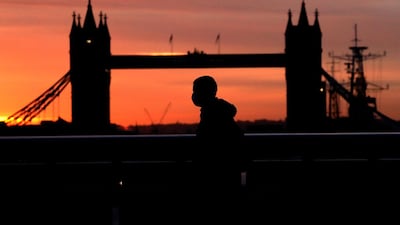
A person wearing a face mask walks across London Bridge, with Tower Bridge in the background, at sunrise in London. AP Photo -
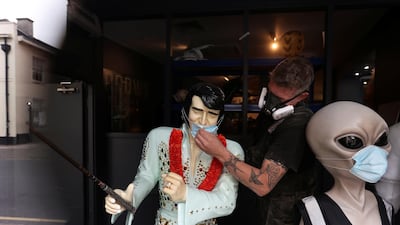
A worker adjusts a face mask on a mannequin at a shop in Nottingham. Reuters -

A man wearing a face mask walks along the River Mersey in Liverpool. Reuters -
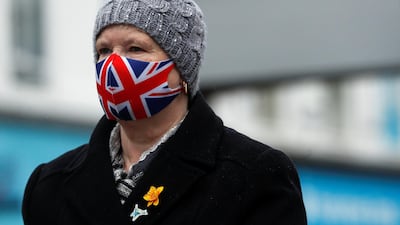
A person wears a Union Jack face mask in Newcastle Upon Tyne. Reuters -
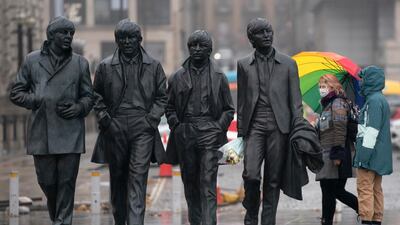
Members of the public wearing face masks stand near a statue of The Beatles in Liverpool. AP Photo



