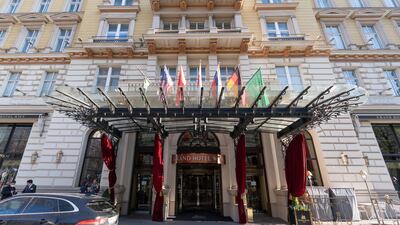
Iran is holding talks with world powers at a Vienna hotel. AP

'Positive momentum' in Iran nuclear talks as first week of discussions ends


Tim Stickings
  • English
  • Arabic

Russia said on Friday there was “positive momentum” in talks on the Iran nuclear deal as diplomats broke up for the weekend after four days of discussions on a possible US return to the pact.

Talks between Iran and the remaining parties to the deal – Britain, France, Germany, Russia and China – resumed on Friday after a week in which European diplomats shuttled between the Iranians and a US delegation based in a separate hotel.

Mikhail Ulyanov, Russia's ambassador to the International Atomic Energy Agency, said diplomats had "noted with satisfaction the progress made" by two expert groups who are considering ways to bring Tehran and Washington back in line with the deal.

"For a long time we spoke about the need to restore the [deal], but only now have we started to elaborate practical steps in this direction," Mr Ulyanov said.

"The commission will reconvene next week in order to maintain the positive momentum."

Iran's foreign minister, Javad Zarif, demanded on Friday that the US "return to full compliance first" by lifting sanctions before Iran will reciprocate by accepting limits on its nuclear activity.

Mr Zarif called for all sanctions imposed by former US president Donald Trump to be eliminated, regardless of whether they were directly linked to Iran's nuclear programme.

But a senior State Department official told reporters on Friday that Mr Zarif's position would essentially result in a dead end for the negotiations.
"If Iran sticks to the position that every sanction that has been imposed since 2017 has to be lifted, then there will be no deal," said the senior State Department official. "Then we are heading toward an impasse."
"The way we've explained it is that sanctions inconsistent with the [nuclear deal] and the benefits that are supposed to accrue from it, if we lift those, that is coming back into compliance with the [deal]. Therefore, Iran should reciprocate by coming into compliance with its nuclear commitments."
The senior State Department official noted that the lack of face-to-face communication between the Americans and Iranians made it difficult to hammer out exactly which sanctions the Biden administration would be open to lifting.
But the official did indicate that the Biden administration could be prepared to lift some additional Trump administration penalties that formed the crux of its so-called Iran sanctions wall meant to deter a Democratic administration from re-entering the deal.
"It's not as easy a process as it may sound because the Trump administration went out of its way to make it difficult for a successor administration to rejoin the [deal]," said the official.

"They re-labelled things using terrorism designations, which had originally been designated on nuclear grounds."
"We have to go through the painstaking effort of looking through the sanctions to see which need to be lifted for the purposes of rejoining the [deal] and which need to be kept."

As the talks opened, China’s representative in Vienna, Wang Qun, backed Iran's stance.

“We, in China, have a saying to the effect that the one who ties the knot should be the one to undo it,” he said.

Tehran's deputy foreign minister Abbas Araghchi told Iran's Press TV on Friday that the negotiations were "moving forward" and were "very constructive and useful".

“But it is too early to say whether we are moving forward in a positive direction,” he said.

“The atmosphere of the meetings are constructive, but we are still far from the point where we can hope for a positive trend, although we are not disappointed.”

Iran said that delegates from the remaining parties to the deal would meet again in person on Wednesday.

Enrique Mora, the EU official who chaired the talks, said he would continue his “separate contacts” with the US when talks resume in Vienna next week.

“Participants emphasised their resolve to further pursue the ongoing joint diplomatic efforts,” an EU statement said.

US envoy Robert Malley, who has been negotiating in Vienna on behalf of President Joe Biden, has returned to the US and is expected to travel back to Veinna for another round of talks next week.

US State Department spokesman Ned Price said on Thursday the talks being held in Vienna were constructive.

Iran is the pace car for progress

"We would also, however, hasten to not allow expectations to outpace where we are," Mr Price said.

Mr Biden's administration has maintained the sanctions it inherited from Mr Trump after the US withdrawal from the pact in 2018.

Iran responded to the sanctions by flouting the restrictions it agreed to under the deal, including the amount of enriched uranium it can stockpile.

The deal’s ultimate goal is to prevent Tehran from developing a nuclear bomb, something it insists it does not want to do.

Talks are expected to continue for weeks.

"Given the technical complexity of the nuclear aspects and legal intricacies of sanctions lifting, it would be very optimistic to think a few weeks," a European diplomatic source told Reuters.

Some diplomats hope agreement can be reached before Iran's June 18 presidential election, or else talks risk being pushed back until later in the year.

"Iran is the pace car for progress. If Tehran decides to push forward swiftly before the June presidential elections, the US will almost certainly be receptive," said Henry Rome, an analyst with the research company Eurasia Group.

"That would require Iran to compromise on its sanctions and sequencing demands.

"If Tehran is unsatisfied with the US position, or if supreme leader Ali Khamenei is wary about the political consequences of a diplomatic breakthrough in the midst of a presidential campaign, Tehran will tap the brakes."


COMPANY PROFILE
Name: Kumulus Water
 
Started: 2021
 
Founders: Iheb Triki and Mohamed Ali Abid
 
Based: Tunisia 
 
Sector: Water technology 
 
Number of staff: 22 
 
Investment raised: $4 million 
Building boom turning to bust as Turkey's economy slows

Deep in a provincial region of northwestern Turkey, it looks like a mirage - hundreds of luxury houses built in neat rows, their pointed towers somewhere between French chateau and Disney castle.

Meant to provide luxurious accommodations for foreign buyers, the houses are however standing empty in what is anything but a fairytale for their investors.

The ambitious development has been hit by regional turmoil as well as the slump in the Turkish construction industry - a key sector - as the country's economy heads towards what could be a hard landing in an intensifying downturn.

After a long period of solid growth, Turkey's economy contracted 1.1 per cent in the third quarter, and many economists expect it will enter into recession this year.

The country has been hit by high inflation and a currency crisis in August. The lira lost 28 per cent of its value against the dollar in 2018 and markets are still unconvinced by the readiness of the government under President Recep Tayyip Erdogan to tackle underlying economic issues.

The villas close to the town centre of Mudurnu in the Bolu region are intended to resemble European architecture and are part of the Sarot Group's Burj Al Babas project.

But the development of 732 villas and a shopping centre - which began in 2014 - is now in limbo as Sarot Group has sought bankruptcy protection.

It is one of hundreds of Turkish companies that have done so as they seek cover from creditors and to restructure their debts.

Milestones on the road to union

1970

October 26: Bahrain withdraws from a proposal to create a federation of nine with the seven Trucial States and Qatar. 

December: Ahmed Al Suwaidi visits New York to discuss potential UN membership.

1971

March 1:  Alex Douglas Hume, Conservative foreign secretary confirms that Britain will leave the Gulf and “strongly supports” the creation of a Union of Arab Emirates.

July 12: Historic meeting at which Sheikh Zayed and Sheikh Rashid make a binding agreement to create what will become the UAE.

July 18: It is announced that the UAE will be formed from six emirates, with a proposed constitution signed. RAK is not yet part of the agreement.

August 6:  The fifth anniversary of Sheikh Zayed becoming Ruler of Abu Dhabi, with official celebrations deferred until later in the year.

August 15: Bahrain becomes independent.

September 3: Qatar becomes independent.

November 23-25: Meeting with Sheikh Zayed and Sheikh Rashid and senior British officials to fix December 2 as date of creation of the UAE.

November 29:  At 5.30pm Iranian forces seize the Greater and Lesser Tunbs by force.

November 30: Despite  a power sharing agreement, Tehran takes full control of Abu Musa. 

November 31: UK officials visit all six participating Emirates to formally end the Trucial States treaties

December 2: 11am, Dubai. New Supreme Council formally elects Sheikh Zayed as President. Treaty of Friendship signed with the UK. 11.30am. Flag raising ceremony at Union House and Al Manhal Palace in Abu Dhabi witnessed by Sheikh Khalifa, then Crown Prince of Abu Dhabi.

December 6: Arab League formally admits the UAE. The first British Ambassador presents his credentials to Sheikh Zayed.

December 9: UAE joins the United Nations.

Gender pay parity on track in the UAE

The UAE has a good record on gender pay parity, according to Mercer's Total Remuneration Study.

"In some of the lower levels of jobs women tend to be paid more than men, primarily because men are employed in blue collar jobs and women tend to be employed in white collar jobs which pay better," said Ted Raffoul, career products leader, Mena at Mercer. "I am yet to see a company in the UAE – particularly when you are looking at a blue chip multinationals or some of the bigger local companies – that actively discriminates when it comes to gender on pay."

Mr Raffoul said most gender issues are actually due to the cultural class, as the population is dominated by Asian and Arab cultures where men are generally expected to work and earn whereas women are meant to start a family.

"For that reason, we see a different gender gap. There are less women in senior roles because women tend to focus less on this but that’s not due to any companies having a policy penalising women for any reasons – it’s a cultural thing," he said.

As a result, Mr Raffoul said many companies in the UAE are coming up with benefit package programmes to help working mothers and the career development of women in general. 

The%20specs%3A%202024%20Mercedes%20E200
%3Cp%3E%3Cstrong%3EEngine%3A%20%3C%2Fstrong%3E2.0-litre%20four-cyl%20turbo%20%2B%20mild%20hybrid%0D%3Cbr%3E%3Cstrong%3EPower%3A%20%3C%2Fstrong%3E204hp%20at%205%2C800rpm%20%2B23hp%20hybrid%20boost%0D%3Cbr%3E%3Cstrong%3ETorque%3A%20%3C%2Fstrong%3E320Nm%20at%201%2C800rpm%20%2B205Nm%20hybrid%20boost%0D%3Cbr%3E%3Cstrong%3ETransmission%3A%20%3C%2Fstrong%3E9-speed%20auto%0D%3Cbr%3E%3Cstrong%3EFuel%20consumption%3A%20%3C%2Fstrong%3E7.3L%2F100km%0D%3Cbr%3E%3Cstrong%3EOn%20sale%3A%20%3C%2Fstrong%3ENovember%2FDecember%0D%3Cbr%3E%3Cstrong%3EPrice%3A%20%3C%2Fstrong%3EFrom%20Dh205%2C000%20(estimate)%3C%2Fp%3E%0A