
Britain approved the coronavirus vaccine developed by the University of Oxford and AstraZeneca and plans to begin usingthe treatment early in the new year.
Hopes are high that approval is a turning point in the UK's battle against the pandemic as a more infectious strain of the virus takes hold and record case numbers are reported.
The UK regulator, the Medicines and Healthcare Products Regulatory Authority (MHRA), approved the vaccine to be given in two standard doses over a four-to-12-week regime.
The dose begins to provide immunity 22 days after the first injection and the MHRA advice said efficacy at that point was around 70 per cent.
The Oxford vaccine is easier for providers to deliver because it does not need to be stored at ultra-low temperatures. It is also cheaper, costing less than $5 per dose.
Health Secretary Matt Hancock said the decision would allow the country to rapidly expand its vaccination programme, with the administration of 100 million doses to begin on January 4.
The Oxford inoculation adds to the UK's vaccine arsenal after the first Pfizer/BioNTech shots were given to patients on December 8.
“This vaccine means we can accelerate that delivery plan so we can bring this pandemic to an end faster than we previously would have been able to,” Mr Hancock said.
“I’ve now got a very high degree of confidence we can be out of this by the spring.”
AstraZeneca chief executive Pascal Soriot said the company had the capacity to deliver two million doses per week to the UK, which is the first country in the world to approve the vaccine.
Mr Hancock said the UK still had difficult months ahead. He confirmed more districts would be dragged into the toughest tier of safety restrictions, and said details would be announced later on Wednesday.
On Tuesday, a record 53,135 new Covid cases were reported in the UK.
“We’ve got to stick with this, we’ve got to hold our nerve, we’ve got to act as though we’ve got the virus,” Mr Hancock said.
Meanwhile, Prime Minister Boris Johnson hailed the approval as “truly fantastic news” and a triumph for British science.
“We will now move to vaccinate as many people as quickly as possible,” he tweeted.
The Oxford-AstraZeneca vaccine is on average 70 per cent effective at protecting people from the virus.
But the figure was 62 per cent when people were given two full doses of the jab and 90 per cent when they were first given a half-dose and then a full one.
UK speeds up vaccine launch
In a major change to the vaccine delivery, the government said the National Health Service would now allow a longer interval between patients receiving the first and second dose.
People receiving the Oxford vaccine or the Pfizer/BioNTech shot will now receive their first dose followed by a second dose up to 12 weeks later, increasing the number of people who will receive the initial layer of protection in the first round of inoculations.
-
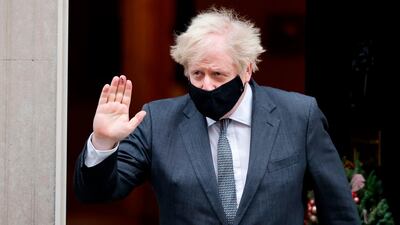
Britain's Prime Minister Boris Johnson wearing a protective face covering gestures as he leaves 10 Downing Street in London. AFP -
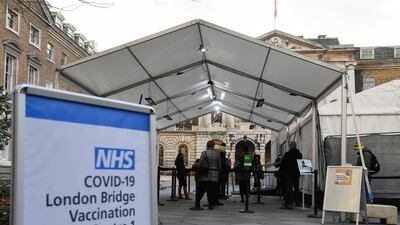
People queue as they wait to receive a Covid-19 vaccine at London Bridge vaccination centre. Reuters -
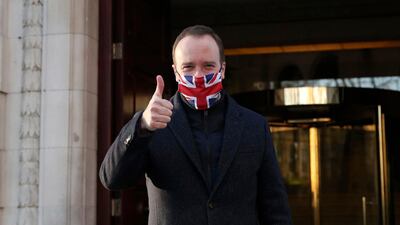
Heath Secretary Matt Hancock gives a thumbs up as he leaves Millbank in Westminster, central London, after the news that a Covid-19 vaccine from Oxford University and AstraZeneca has been approved for use in Britain. AP Photo -
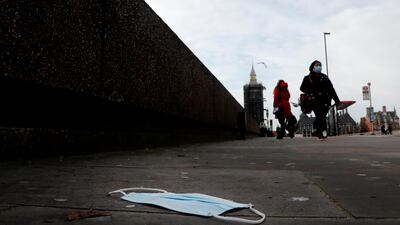
A mask on the pavement near the entrance of a hospital on Westminster Bridge in London. AP Photo -
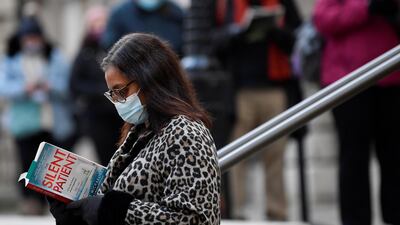
People queue andf wait to receive a Covid-19 vaccine at London Bridge vaccination centre. Reuters -

People walk during the sunset ahead of the start of tier 4 restrictions in Newcastle. Reuters -

A cyclist wearing a protective face covering rides over London Bridge. AFP -
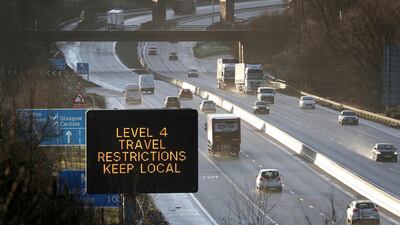
A traffic information board advises drivers to keep their travel to local trips as traffic moves along the M80 motorway near Banknock, Scotland. AP Photo -

A NHS notice warns that Coronavirus is spreading at University College Hospital in central London. EPA -
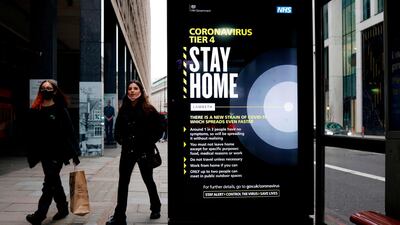
People, some wearing a mask because of the coronavirus pandemic, walk past a bus stop with a government message urging people to stay home in London. AFP -
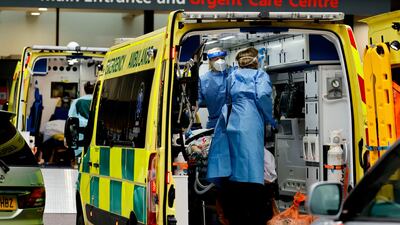
Paramedics prepare to remove a patient from an ambulance parked outside Guy's Hospital in London. AFP -

A woman tries to make a snowman in the snow at Campsie Fells, Glasgow. EPA -
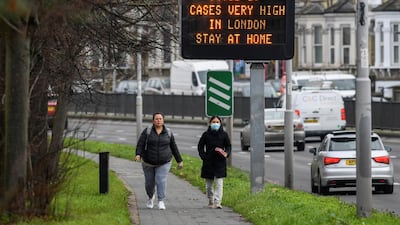
People walk past a roadside public health information sign in London. Reuters -
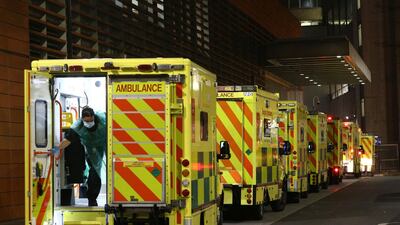
A row of ambulances are parked outside the Royal London Hospital in London. AP Photo


“The JCVI has advised the priority should be to give as many people in at-risk groups their first dose, rather than providing the required two doses in as short a time as possible,” the Department of Health said.
“Everyone will still receive their second dose and this will be within 12 weeks of their first. The second dose completes the course and is important for longer-term protection.”
MHRA chief Dr June Raine said the change of strategy meant "even more people are now eligible for vaccination". She said clinicians had "carefully, methodically and rigorously reviewed all the data on safety, effectiveness and quality".
"No corners whatsoever have been cut," she said.
Andrew Pollard, head of the Oxford programme, said the vaccine was also effective against new strains of coronavirus.
“There’s no evidence the vaccines won’t work against the variant but we can’t be complacent about this variant or future variants,” he said.

Britain and South Africa in particular are grappling with new variants of the coronavirus, which the government and scientists say are more contagious. Many countries have responded by banning passenger flights and blocking trade.
AstraZeneca and other developers said they are studying the effects of the new variant but expect that their shots will be effective against it.
Regulatory endorsement is a welcome boost for AstraZeneca and the Oxford team, after they were accused of a lack of clarity about the results of late-stage trials.
How does the Oxford vaccine work?
It is made from a weakened version of a common cold virus, known as an adenovirus, from chimpanzees that is harmless to human beings.
The genetic instructions for the spike protein of coronavirus, which it needs to invade cells, are transferred to the vaccine.
When injected into a person’s body, it triggers an immune response, effectively training the body to recognise the virus and develop the antibodies to destroy it.
Having been through a practice run, the body is primed to fight the real thing.

