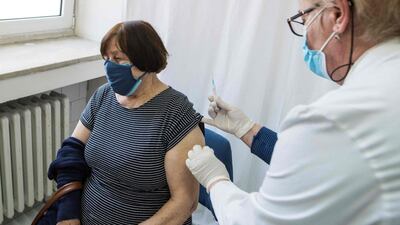
There is “no evidence” to support restricting the use of the Oxford/AstraZeneca Covid-19 vaccine in any population, the European Medicines Agency said on Wednesday.
The EU's drug regulating agency said it had found no specific risk factors connecting the vaccine to reports of blood clotting.
But it said: "A causal link with the vaccine is not proven but is possible, and further analysis is continuing."
The watchdog reiterated the view it gave in a keenly anticipated statement on March 18, which said that the "benefits [of the vaccine] in protecting people from Covid-19 with the associated risks of death and hospitalisation outweigh the possible risks".
Some EU countries have restricted access to the vaccine over reports of blood clotting.
On Tuesday, Germany stopped general use of AstraZeneca's product in people under age 60 because of a perceived risk of rare blood clots.
It remains suspended in Denmark and Norway.
The German medicines regulator found 31 cases of a type of rare blood clot among the nearly 2.7 million people who had received the vaccine in Germany.
"According to the current scientific knowledge, there is no evidence that would support restricting the use of this vaccine in any population," said agency chief Emer Cooke.
Ms Cooke said that the assessment was based on 62 cases of unusual blood clots, including 14 deaths, reported to the agency by March 22.
AstraZeneca has renamed its Covid-19 vaccine in Europe as the pharmaceutical company struggles to reassure the public that the drug is safe.
The British-Swedish company said the drug would now be marketed under the new name Vaxzevria but the product itself remains unchanged.
The European medicines regulator approved the new name and has updated its guidance to reflect the change.
-

Medical staff members carry a patient suffering from Covid-19 on a stretcher after arriving on a plane at Vannes airport during a transfer operation from Lille to Vannes, France. Reuters -

People gather in the Vauban park in Lille, northern France. AP Photo -

A medical worker prepares to tend to Covid-19 patients in the Amiens Picardie hospital, north of Paris. AP Photo -

A French and a Spanish police officer talk at the French-Spanish border in Behobie, south-west France. AP Photo -

Schoolchildren exercise in the playground at the private primary school Jeanne D'Arc in Saint-Maur-des-Fosses, near Paris. Reuters -

People enjoy sunny and warm weather on the beach of the Promenade des Anglais in Nice. Reuters -

People queue to undergo a PCR test at a medical analysis laboratory in Paris. AFP -

A health worker prepares an antigenic coronavirus test before testing a patient, under a tent at the Opera square in Paris. AFP -
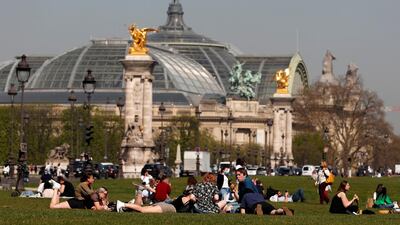
People enjoy warm weather near the Invalides in Paris. Reuters


Meanwhile, WHO experts have deemed two Chinese coronavirus shots to be safe and effective after reviewing partial data, providing a potential boost to countries from Australia to Europe struggling with vaccine supply.
Fewer than 600 million injections have been given out across the world, three months after vaccination programmes began in earnest in Western countries and leaders began hailing the drugs as the only safe way out of punishing lockdowns.
Another vaccine maker, Pfizer/BioNTech, was pushing ahead with its plans to ramp up production and distribution, saying on Wednesday that new data from the US showed its shot was 100 per cent effective in adolescents aged 12 to 15.
The firm said it wanted to start vaccinating children in this age group in the US before the start of the next school year.
The US has already distributed almost 150 million vaccine doses, far more than any other country. But it has also suffered more than 550,000 deaths, the highest death toll in the world.
Globally, the virus has killed more than 2.8 million people since it was first discovered in the Chinese city of Wuhan in late 2019.
Large parts of Europe are battling high infection rates, with most of the continent still living under lockdowns or other restrictions.
French President Emmanuel Macron, who has repeatedly vowed not to reintroduce a national lockdown, has come under increasing pressure as cases have escalated over the last few weeks.
He is expected to announce tougher measures, possibly including school closures, later Wednesday.

