


Iran’s unacceptable behaviour is disrupting the Middle East and Tehran will be held to account if it continues along the path of aggression, the region’s most senior British general has said.
The country’s military activities have led to a “destabilisation” of the Middle East and Iran faces further international isolation if it continues, said Lt Gen Sir John Lorimer.
"We have long said that that behaviour is unacceptable and must not be repeated," he told The National in an extensive interview. "From our perspective Iran faces a choice – if you continue in this way or increase or ratchet up this approach you will face growing isolation from the international community."
He added: “The Gulf is critical and our strategic aim remains to help de-escalate tensions. But we have to still hold Iran to account in terms of its destabilising regional activity.”
As the most senior British military commander for the region, Lt Gen Lorimer’s warning will carry weight in the ongoing struggle with Tehran.
As a major trading hub the Gulf’s security is critical to the global economy, he said, particularly in the post-pandemic recovery. But Iran’s actions of firing rockets at American bases and fomenting militias in Iraq as well as attacking Saudi Arabia last September risks economic hardship.
“We’ve been pretty clear for some time over Iran’s destabilising activity in the region, including its political, financial and military support to a number of militant and proscribed groups including militias in Iraq. We haven’t been quiet about it.”
Iran’s continuing nuclear weapons programme as well as its funding of militant groups such as Hezbollah has led to strict economic sanctions that have harmed its economy alongside the recent slide in oil prices and impact of Covid-19.
-

Iranian President Hassan Rouhani, right, and the head of Atomic Energy Organization of Iran Ali Akbar Salehi inspect the nuclear technology on the occasion of Iran National Nuclear Technology Day in Tehran in 2019. EPA -
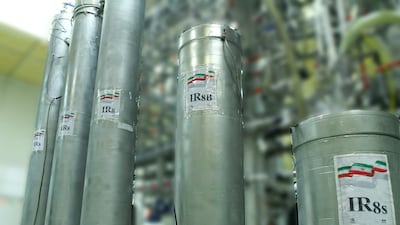
IR-8 centrifuges at Natanz nuclear power plant, some 300 kilometres south of capital Tehran. AFP -
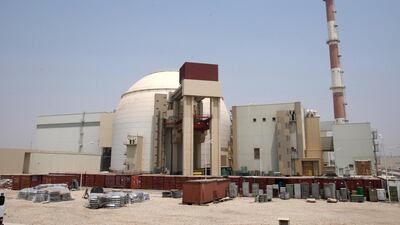
The Iranian nuclear power plant in Bushehr in 2010. EPA -

Salehi speaks with media while visiting Natanz enrichment facility, in central Iran in 2019. Atomic Energy Organization of Iran via AP -
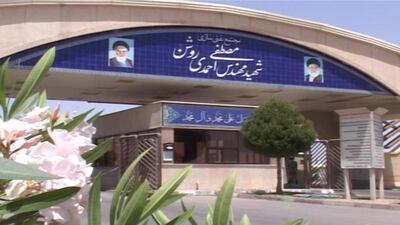
The gate of Natanz nuclear power plant in Natanz , Isfahan province, in 2019. EPA -
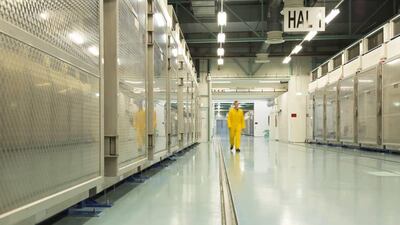
Inside of the Iran's Fordow nuclear facility, in Fordow, Qom province in 2019. EPA -
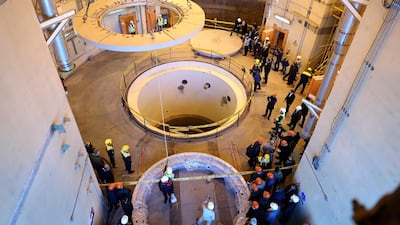
Technicians work at the Arak heavy water reactor's secondary circuit, as officials and media visit the site, near Arak, Iran in 2019. Atomic Energy Organization of Iran via AP -
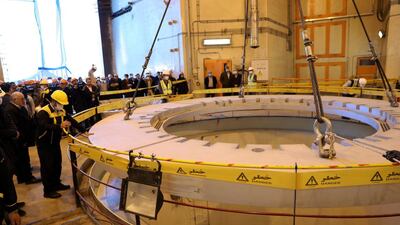
Members of the media and officials tour the water nuclear reactor at Arak in 2019. WANA via Reuters -
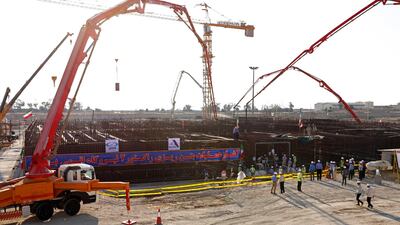
Concrete is poured for the base of the second nuclear power reactor at Bushehr plant in 2019. Atomic Energy Organization of Iran via AP


If it continued along a warlike path “it would end up isolated from the rest of the world”, Lt Gen Lorimer said, and added: “Or it can come in and find a solution to the problem, it can work with us and others to find a solution to de-escalate the problem. Is it easy? No. But it’s a really important issue for the region and more widely.”
'Diplomatic door is open'
-
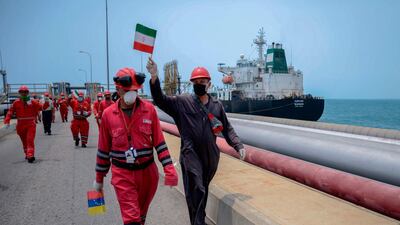
A worker of the Venezuelan state oil company PDVSA waves an Iranian flag as the Iranian-flagged oil tanker Fortune docks at the El Palito refinery in Puerto Cabello, in the northern state of Carabobo, Venezuela. AFP -
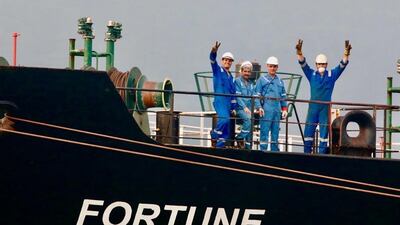
Workers on the 'Fortune' the Iranian ship with gasoline in Puerto Cabello, Venezuela. EPA -
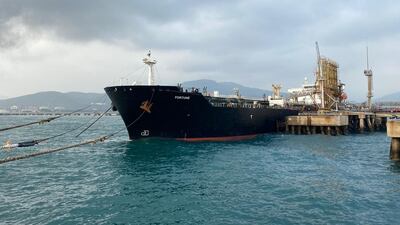
Iranian-flagged oil tanker Fortune docked at the El Palito refinery after its arrival to Puerto Cabello, in the northern state of Carabobo, Venezuela. AFP -

A worker of the state-oil company Pdvsa holds an Iranian flag during the arrival of the Iranian tanker ship "Fortune" at El Palito refinery in Puerto Cabello, Venezuela. Reuters -
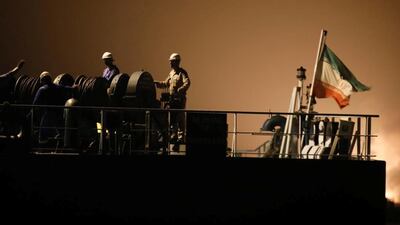
Crew of the Iranian tanker ship "Fortune" are seen at the deck during the arrival at El Palito refinery in Puerto Cabello, Venezuela. Reuters -
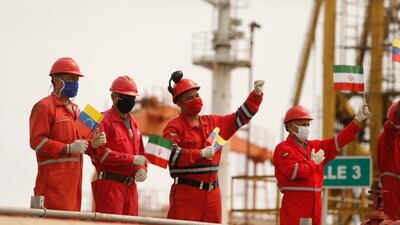
Workers of the state-oil company Pdvsa holding Iranian and Venezuelan flags greet during the arrival of the Iranian tanker ship "Fortune" at El Palito refinery in Puerto Cabello, Venezuela. Reuters -
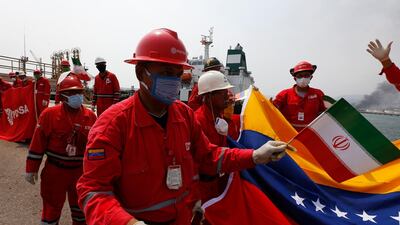
A Venezuelan oil worker holding a small Iranian flag attends a ceremony for the arrival of Iranian oil tanker Fortune at the El Palito refinery near Puerto Cabello, Venezuela. AP Photo -
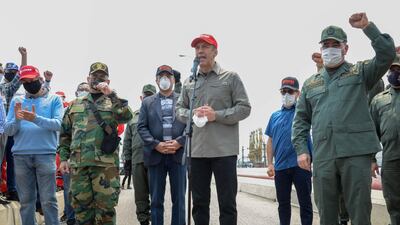
The Venezuelan industry minister Tareck El Aissami (C), speaks next to Venezuela's defence Minister Vladimir Padrino(R) after the Iranian oil tanker Fortune docked at the El Palito refinery in Puerto Cabello, in the northern state of Carabobo, Venezuela. AFP -

A worker of the Venezuelan state oil company PDVSA looks at the oil tanker Fortune as it docks at the El Palito refinery in Puerto Cabello in the northern state of Carabobo, Venezuela. AFP -
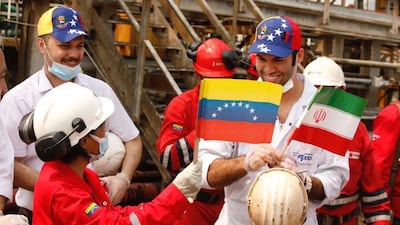
Workers with the flags of Venezuela and Iran waiting for Venezuela Minister of Petroleum Tareck el Aissami in Puerto Cabello, Venezuela during his visit to the 'Fortune' Iranian ship. EPA -
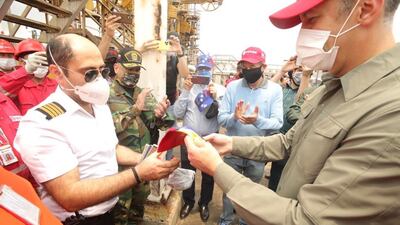
Venezuela Minister of Petroleum Tareck el Aissami in Puerto Cabello, Venezuela during his visit to the 'Fortune' Iranian ship. EPA


Regional concerns about Iran’s military activity have grown as the country stockpiles precision-guided missiles that can hit targets such as oil installations and airbases with an accuracy of within 30 metres.
Lt Gen Lorimer said: “If Iran wants to be isolated, to continue on the trajectory it is on, or comes in and realises that if it wants to be part of international community, it needs to stop what it’s doing and negotiate with us for a peaceful way forward.”
The officer, a fluent Arabic speaker who commanded a British brigade in Iraq in 2005, said the “diplomatic door is open” for Iran to negotiate a peaceful solution.
“I know that is just words and it’s really tough and made tougher by the virus. But we hope we will get some kind of negotiation that will ensure the region is stabilised and leads to some kind of peaceful negotiation.”

