
Iceland has honoured its first glacier lost to climate change with a dedicated ceremony – as scientists said about 400 others on the subarctic island risk the same fate.
A bronze plaque was unveiled on Sunday to commemorate Okjokull, which translates to “Ok Glacier”, in the presence of local researchers and their peers at Rice University in the United States who initiated the project.
Glaciologists stripped Okjokull, in the west of Iceland, of its glacier status in 2014, a first for Iceland, as it failed to meet the requirements to be termed a glacier because of its size and lack of movement.
Iceland’s Prime Minister Katrin Jakobsdottir and Environment Minister Gudmundur Ingi Gudbrandsson attended the event.
-

A geological map from 1901 estimated that Okjökull spanned an area of about 38 square kilometres. In 1978, aerial photography showed the glacier was 3 square kilometres in size. In 2019, less than 1 square kilometre remains. NASA / AP -
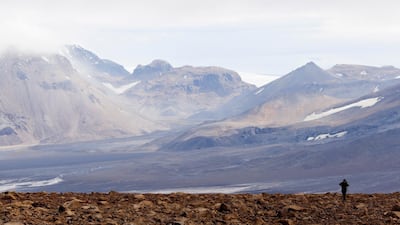
A hiker makes their way to where Okjokull glacier will be commemorated after it was lost to climate change, in in west-central Iceland. EPA -

Icelandic Author Andri Snaer Magnason (centre) holds a speech before the installation of the plaque commemorating the loss of Iceland's Okjokull glacier to climate change, during a public ceremony in Borgarfjordur, Iceland. EPA -
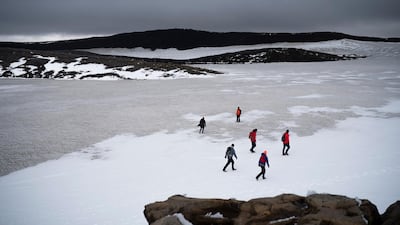
People walk on snow atop the Ok volcano crater on their way to a ceremony by the area which once was the Okjokull glacier, in Iceland. AP -

Activist Gunnhildur Frida Hallgrimsdottir (centre) reads a poem as people make their way to an event to commemorate the loss of Iceland's Okjoekull glacier to climate change, in west-central Iceland. EPA -

Icelandic prime minister Katrin Jakobsdottir speaks during an event to commemorate the loss of Iceland's Okjokull glacier to climate change, in west-central Iceland. EPA -

A monument is unveiled at the site of Okjokull, Iceland's first glacier lost to climate change in the west of Iceland. AFP -

Icelandic prime minister Katrin Jakobsdottir speaks to the media during an event to commemorate the loss of Iceland's Okjokull glacier to climate change, in west-central Iceland. EPA -

People attend and event for Okjokull glacier, which is being commemorated after it was lost to climate change, in in west-central Iceland. EPA -

Hikers makes their way to where Okjokull glacier, which will be commemorated after it was lost to climate change, in in west-central Iceland. EPA -
Hikers makes their way to where Okjokull glacier will be commemorated after it was lost to climate change, in in west-central Iceland. EPA -
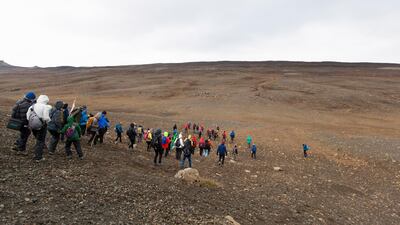
Hikers at the start of their two-hour long ascent to install the plaque commemorating the loss of Iceland's Okjokull glacier to climate change, in Borgarfjordur, Iceland. EPA -
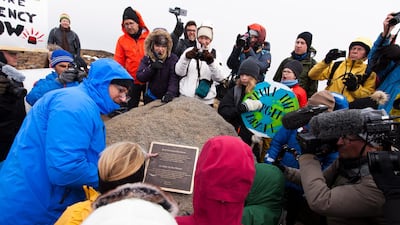
Anthropologists from Rice University in Texas Dominic Boyer (left) and Cymene Howe (C-TOP with purple jacket) during the installation of the plaque commemorating the loss of Iceland's Okjokull glacier to climate change, during a public ceremony in Borgarfjordur, Iceland. EPA -

Andri Snaer Magnason (right), Icelandic writer and author of the plaque text speaks at the unveiling of a monument at site of Okjokull, Iceland's first glacier lost to climate change in the west of Iceland. AFP -

People look at the snow at the old glacier after a monument was unveiled at site of Okjokull, Iceland's first glacier lost to climate change in the west of Iceland. AFP -
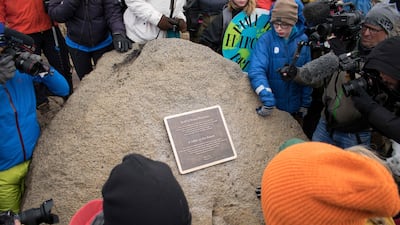
A monument is unveiled at the site of Okjokull, Iceland's first glacier lost to climate change in the west of Iceland. AFP -
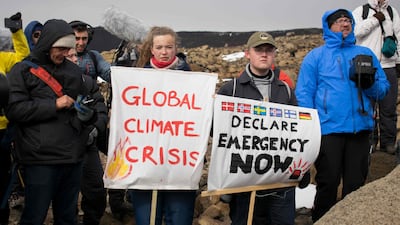
People hold up signs as a monument was unveiled at the site of Okjokull, Iceland's first glacier lost to climate change in the west of Iceland. AFP -
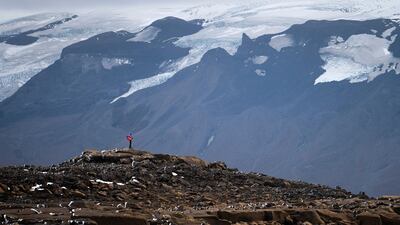
A man stops on his way to the top of what once was the Okjokull glacier, in Iceland. AP


“This will be the first monument to a glacier lost to climate change anywhere in the world,” Professor Cymene Howe, associate professor of anthropology at Rice University, said in July.
The plaque bears the inscription “A letter to the future” and is intended to raise awareness about the decline of glaciers and the effects of climate change.
It reads: “In the next 200 years all our glaciers are expected to follow the same path. This monument is to acknowledge that we know what is happening and what needs to be done. Only you know if we did it.”

The plaque is also labelled “415 ppm CO2,” referring to the record level of carbon dioxide measured in the atmosphere last May.
In an opinion article for the New York Times published the day before the memorial's unveiling, Prime Minister Jakobsdottir lamented the devastating effect climate change was having on her country's natural resources.
"In just a few decades, Iceland may no longer be characterised by the iconic Snaefellsjokull, famously known as the entrance to Earth in Jules Verne's Journey to the Center of the Earth," she wrote.
“In short: The ice is leaving Iceland.”
“Memorials everywhere stand for either human accomplishments, like the deeds of historic figures, or the losses and deaths we recognise as important,” researcher Prof Howe said.
“By memorialising a fallen glacier, we want to emphasise what is being lost – or dying – the world over, and also draw attention to the fact that this is something that humans have ‘accomplished’, although it is not something we should be proud of.”
Prof Howe noted that the conversation about climate change can be abstract, with many dire statistics and sophisticated scientific models that can feel incomprehensible.
“Perhaps a monument to a lost glacier is a better way to fully grasp what we now face,” she said, highlighting “the power of symbols and ceremony to provoke feelings”.
Iceland loses about 11 billion tonnes of ice per year, and scientists fear all of the island country’s 400-plus glaciers will be gone by 2200, said Prof Howe and her Rice University colleague Dominic Boyer.
In 1890, Okjokull’s ice covered 16 square kilometres but by 2012, it measured just 0.7 square kilometres, a 2017 report from the University of Iceland stated.
In 2014, “we made the decision that this was no longer a living glacier, it was only dead ice, it was not moving,” Oddur Sigurdsson, a glaciologist with the Icelandic Meteorological Office, told AFP.
To have the status of a glacier, the mass of ice and snow must be thick enough to move by its own weight. For that to happen, the mass must be approximately 40 to 50 metres thick, he said.
According to a study published by the International Union for Conservation of Nature in April, almost half of the world’s heritage sites could lose their glaciers by 2100 if greenhouse gas emissions continue at the current rate.
Mr Sigurdsson said he feared “that nothing can be done to stop it”.
“The inertia of the climate system is such that, even if we could stop introducing greenhouse gases into the atmosphere right now, it will keep on warming for century and a half or two centuries before it reaches equilibrium.”

