British and French naval vessels were patrolling Jersey waters on Thursday after about 50 French boats descended on the main port to mount a protest flotilla in a dispute over post-Brexit fishing rights.
By mid-afternoon, it appeared the protest had ended as the fishing boats moved away from the harbour.
Britain sent two Royal Navy patrol boats to the channel island of Jersey after France suggested it could cut power supplies there if its fishermen are not given full access to fishing waters under post-Brexit trading terms. Some of the fishing crews set off flares while HMS Severn and HMS Tamar were on watch nearby.
Footage also emerged appearing to show a French trawler ramming a British vessel.
The French navy dispatched two patrol vessels to the area on Thursday morning. A European Commission spokeswoman called for calm but said the UK had failed to provide sufficient notice for new arrangements to be assessed.
Boris Johnson spoke to Jersey's government after the island attempted to introduce a licensing system that reflected the switch to post-Brexit controls over its territorial waters.
“The Prime Minister reiterated his unequivocal support for Jersey and confirmed that the two Royal Navy Offshore Patrol Vessels would remain in place to monitor the situation as a precautionary measure,” a Downing Street statement said.
“They agreed to stay in touch as the situation develops.”
Jersey has issued new rules that require the installation of monitoring equipment to obtain licences that preserve EU fishing rights after Brexit.
A representative for the Normandy regional fishing committee, which helped to organise Thursday's protest, said they were not seeking to impede access to Jersey ports.
"The objective is to express our unhappiness about the restrictive measures that were imposed," Hugo Lehuby said.
"This is not a blockade," he told Reuters. "It's not our objective to smash stuff up."
Annick Girardin, the French maritime minister, said she was "disgusted" to learn that Jersey had issued 41 licences with unilaterally imposed conditions, including the time French fishing vessels could spend in the island's waters.
-
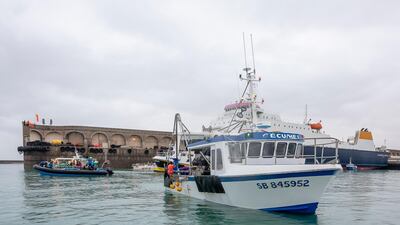
French fishermen angry over the loss of access to waters off their coast have gathered their boats in protest off the English Channel island of Jersey. AP Photo -
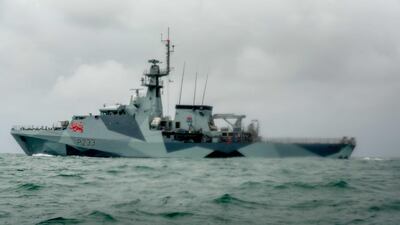
HMS Tamar is deployed as French fishing boats sail into harbour in St Helier. Getty Images -
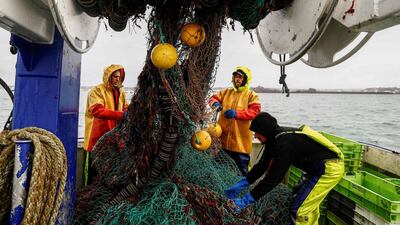
French fishermen gather in a net on their vessel near the port of Saint Helier. AFP -

A flare is lit as French fishing boats protest in front of the port of Saint Helier. AFP -
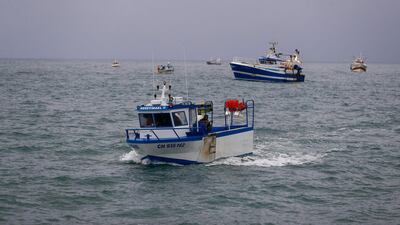
Around 50 French fishing boats gathered to protest at the main port of Jersey. AFP -

French fishermen hang a banner on their boat. AFP


"In the deal there are retaliatory measures. Well, we're ready to use them," Ms Girardin told France's National Assembly on Tuesday.
"Regarding Jersey, I remind you of the delivery of electricity along underwater cables ... even if it would be regrettable if we had to do it, we'll do it if we have to."
With a population of 108,000, Jersey imports 95 per cent of its power from France, with diesel generators and gas turbines providing backup, according to energy news agency S&P Global Platts.
Jersey's government said France and the EU had expressed unhappiness with the conditions placed on fishing licences.
External Relations Minister Ian Gorst said the island had issued permits in accordance with the post-Brexit trade terms.
Mr Gorst said they stipulated that any new licence must reflect how much time a vessel spent in Jersey's waters before Brexit.
"We are entering a new era and it takes time for all to adjust," he said. "Jersey has consistently shown its commitment to finding a smooth transition to the new regime."
The rocky island is 23 kilometres off the northern French coast and 140km south of Britain's shores.
The French threat is the latest flare-up over fishing rights between the two countries.
Last month, France-based vessel operators, angered by delays to licences, set up burning barricades to block lorries carrying UK-landed fish as they arrived in Boulogne-sur-Mer, Europe's largest seafood-processing centre.
More on Brexit
UK says its seabed is more valuable for environment than oil
UK’s shellfish fishermen fear losing their homes over post-Brexit export ban
UK shellfish industry dealt ‘devastating blow’ after EU upholds trade ban

