A 90-year-old grandmother from Northern Ireland became the first person in the world to receive the Pfizer/BioNTech Covid-19 vaccine outside trial conditions.
Margaret Keenan received the shot at her local hospital in Coventry in England on Tuesday at 6.31am.
The UK was the first country in the world to approve the Pfizer vaccine after the regulator completed rigorous reviews.
Tuesday – called V-Day by Health Secretary Matt Hancock – is the beginning of the biggest inoculation programme in the country's history.
Nurse May Parsons administered the vaccine in front of the world's media at University Hospital Coventry.
Ms Keenan said: "I feel so privileged to be the first person vaccinated against Covid-19, it's the best early birthday present I could wish for because it means I can finally look forward to spending time with my family and friends in the new year after being on my own for most of the year.
"I can't thank May and the NHS staff enough who have looked after me tremendously, and my advice to anyone offered the vaccine is to take it – if I can have it at 90 then you can have it too."

The second person to receive the vaccine was William Shakespeare, from Warwickshire in England.
The 81-year-old also had the injection at University Hospital Coventry, 20 miles from Stratford-Upon-Avon, the birthplace of his namesake, England's greatest dramatist and poet.
Mr Shakespeare's shot inspired Twitter users, who joked "The Taming of the Flu", "The Two Gentlemen of Corona". Some asked if Ms Keenan was patient 1A, then was Shakespeare "Patient 2B or not 2B?".

Mr Hancock appeared to tear up during a live interview when told Mr Shakespeare received the vaccine.
"It's been such a tough year for so many people and there's William Shakespeare putting it so simply for everybody," he told ITV's Good Morning Britain.
"I've still got this worry, we can't blow it now ... but there's so much work that's gone into this, it makes you proud to be British."
Prime Minister Boris Johnson paid tribute to NHS staff, the scientists behind the vaccine and all the volunteers involved in trials.
"We will beat this together," he wrote on Twitter, before visiting St Thomas' Hospital in London to witness a vaccination.
UK Vaccine Taskforce chairwoman Kate Bingham said securing vaccines was a "daunting challenge".
She told BBC Radio 4's Today programme: "If you think about what we knew about Covid-19 in May, we knew very little.
"We knew no vaccine had been developed against any human coronavirus, so it was a daunting challenge."
Britain has ordered more than 350 million vaccine doses from seven different developers.
About 100 million of those doses are to be supplied by Oxford University/AstraZeneca, whose shot is yet to be approved.

Ms Bingham said the portfolio of different vaccines should be enough for the UK should there be a delay to the Oxford vaccine.
"We’ve got plans for not having the Oxford vaccine but I am optimistic the Oxford vaccine will get approved," she said.
First in line to receive the initial batch of 800,000 doses are people aged 80 and over, care-home workers and frontline NHS staff, who are considered at higher risk.
The government also wants to prioritise elderly residents in care homes but is running into technical challenges administering doses away from hospitals, given the need for ultra-low storage temperatures.
'Turning point'
Medical staff will contact people to arrange appointments, and most will have to wait until next year before there is enough vaccine to expand the scheme.
NHS England chief Simon Stevens said: "There's every chance that we will look back on ... [Tuesday] as marking a decisive turning point in the battle against coronavirus," he said.
Among those older Britons scheduled to be vaccinated next is Hari Shukla, of Newcastle.
“When I received the telephone call, I was very excited I got the opportunity of joining in and taking part in that,″ he said. “So we are very, very pleased and happy and excited as well.″
Another elderly woman, Gill Rogers, 86, from Brighton, said she was looking forward to shopping and taking the bus again after being selected to take the vaccine.
Ms Roger's husband died in a care home in late-April and she has been grieving alone ever since.
"That's been quite hard," she told the BBC, her voice cracking.
Ms Rogers said she had spent most of the year on her own, keeping out of shops as much as possible and avoiding public transport altogether.
She immediately said yes when she received a call during the weekend offering her an early appointment to get the vaccine.
"I shan't be so careful, I shan't be so worried, I will go in shops more and with luck I might get on to public transport," she said.
Asked whether she had had any doubts about the safety of the vaccine, she answered: "No. None at all."
She said she knew there were people who had concerns, and she agreed to an interview because she thought talking about her own situation might help them overcome those doubts.
"That's why I contacted you, because I thought there might be people who it would help to have it, who wouldn't have had it perhaps," she said.
Buckingham Palace refused to comment on reports that the Queen, 94, and Prince Philip, 99, would be vaccinated as a public example of its safety.
“Our goal is totally to protect every member of the population, Her Majesty, of course, as well,” Dr June Raine, chief executive of Britain’s Medicines and Healthcare products Regulatory Agency, told the BBC.
The vaccine can not arrive soon enough for the UK, which has recorded more than 61,000 Covid-related deaths – more than any other country in Europe.
The 800,000 doses are only a fraction of what is needed. The government is targeting more than 25 million people, or about 40 per cent of the population, in the first phase of its vaccination programme, which gives first priority to those at highest risk from the disease.
After those over 80 and nursing home workers, the scheme will be expanded as supply increases, with the vaccine offered on the basis of age, starting with the oldest people.
In England, the vaccine will be available at 50 hospitals, with more expected to offer it as the rollout expands. Northern Ireland, Scotland and Wales are making their own plans under the UK’s system of devolution.
Logistical issues are slowing the distribution of the Pfizer vaccine because it has to be stored at minus 70°C.
Meanwhile, a World Health Organisation official warned that only public health measures, not vaccines, would prevent a third wave of the virus.
"Vaccines are a great tool, they will be very helpful, but the effect of the vaccine in providing some kind of immune barrier is still far off," Dr Margaret Harris said.
"The things that must be done to prevent an increase, an uptick, a surge or whatever you want to call it are the public health measures."
-
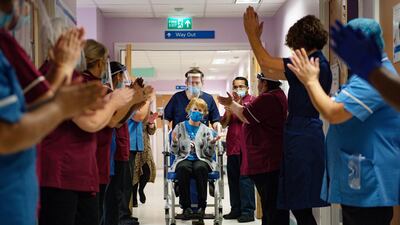
Margaret Keenan, 90, is applauded by staff as she returns to her ward after becoming the first person in the United Kingdom to receive the Pfizer-BioNtech Covid-19 vaccine at University Hospital, Coventry. EPA -
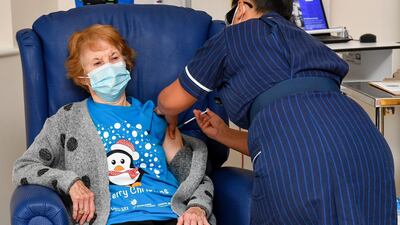
Margaret Keenan receives the vaccine, administered by nurse May Parson. EPA -
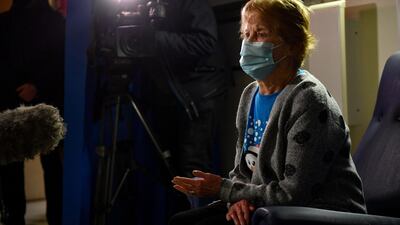
Margaret Keenan speaks to the media at University Hospital in Coventry. AFP -
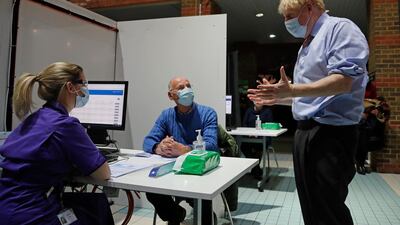
British Prime Minister Boris Johnson gestures as he speaks to staff at Guy's Hospital in London. AP Photo -
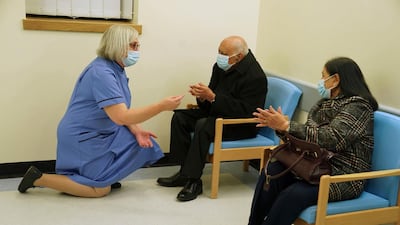
Retired nurse Suzanne Medows speaks to race relations campaigner Dr Hari Shukla, 87, and his wife Ranju, before he receives the Pfizer-BioNTech Covid-19 vaccine at the Royal Victoria Infirmary in Newcastle. AP Photo -
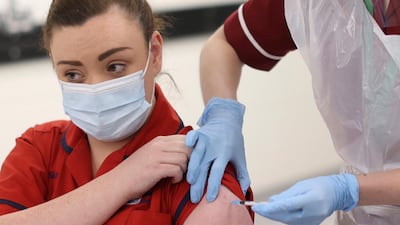
Sister Joanna Sloan receives the Pfizer-BioNTech Covid-19 vaccine, as the first person in Northern Ireland at the Royal Victoria Hospital, in Belfast. AP Photo -
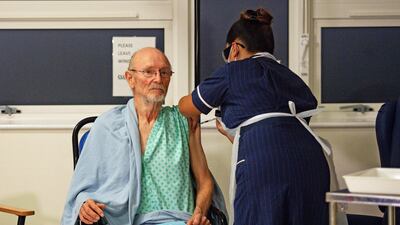
"Bill" William Shakespeare, 81, receives the Pfizer-BioNTech Covid-19 vaccine, at University Hospital, Coventry. AP Photo -
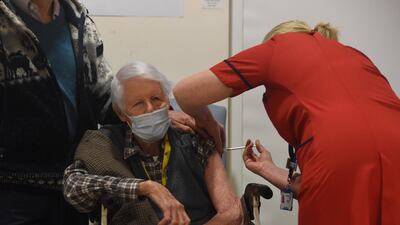
Michael Tibbs, 99 is given the Pfizer-BioNtech Covid-19 vaccine at Queen Alexandra Hospital in Portsmouth. Getty Images -

Michael Tibbs and his son Philip enjoy a cup of tea after Michael received the Pfizer-BioNtech Covid-19 vaccine at Queen Alexandra Hospital. Getty Images -

"I've had my covid vaccination" stickers at the Royal Victoria Infirmary in Newcastle. Getty Images -

A nurse holds a phial of the Pfizer-BioNTech Covid-19 vaccine at Guy's Hospital in London. Reuters -
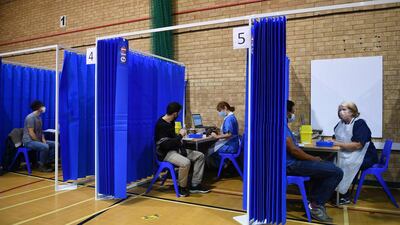
Medical personnel prepare to administer the Pfizer-BioNTech Covid-19 vaccine to recipients at a health centre in Cardiff. AFP -
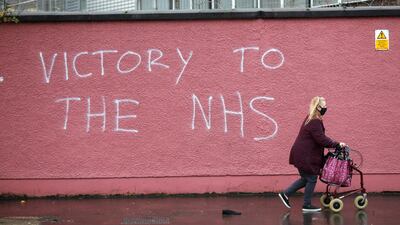
A woman walks past graffiti with the words Victory to the NHS on a wall at the Royal Victoria Hospital in West Belfast, Northern Ireland. AP Photo



