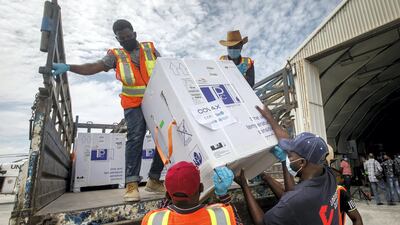
AstraZeneca Covid-19 vaccine doses provided by the Covax initiative arrive in Mogadishu, Somalia. AP

Gordon Brown: failure to rein in pandemic is a ‘man-made catastrophe’


  • English
  • Arabic

Former UK prime minister Gordon Brown warned world leaders that the pandemic is becoming a “man-made catastrophe” as inoculation rates struggle to gather pace in poor countries.

The call for immediate action came as the foreign ministers of the world's leading economies gathered in London on Tuesday for the first face-to-face meeting of the G7 in more than two years.

The Access to Covid-19 Tools Accelerator programme – which aims to find, develop and distribute coronavirus shots, tests and therapeutics to poor nations – is $19 billion short of this year’s $22bn target.

The World Health Organisation said an additional $35bn to $45bn would be needed next year to ensure most adults around the world are immunised.

Mr Brown said the G7 could secure a “historic breakthrough” on tackling the pandemic collectively.

“This is a man-made catastrophe,” he said. “By our failure to extend vaccination more rapidly to every country, we are choosing who lives and who dies. I say the world is already too deeply divided between rich and the poor to allow a new unbridgeable divide to become entrenched by the vaccinated, who live, and the unvaccinated, who are dying.”

WHO chief Tedros Adhanom Ghebreyesus urged the G7 to take decisive action at its June summit, to be hosted by British Prime Minister Boris Johnson in Cornwall, south-west England.

"The G7 countries are the world's economic and political leaders. They are also home to many of the world's vaccine producers," Dr Tedros said.

"We will only solve the vaccine crisis with the leadership of these countries."

Based on national income, wealth and benefits from the resumption of trade, Mr Brown said that the US should pay 27 per cent of the cost of vaccinating the populations of poor nations; Europe 23 per cent; Japan six per cent; Britain five per cent; and Canada – plus South Korea and Australia, also attending the G7 – two per cent each.

Former UK prime minister Gordon Brown warned that the pandemic would persist unless poorer countries are vaccinated. Getty

He said he detected a change in Washington's attitude towards vaccine licensing agreements and temporary intellectual property rights waivers, which could expand production capacity.

Nearly 1.2 billion Covid-19 vaccine doses have been administered worldwide, but only 0.2 per cent in the 29 lowest-income countries, home to nine per cent of the global population.

The Covax global vaccine-sharing programme is competing with rich countries striking their own deals with manufacturers.

The main supplier to Covax is the Serum Institute of India, which is producing AstraZeneca vaccines.

But increased demand for doses in India, where the pandemic is raging, has interrupted Covax supplies.

Bruce Aylward, the WHO lead on Covax, said Covax had missed out on 100 million anticipated doses, and acknowledged there was still no fixed date for when the institute would resume deliveries.

Dr Tedros said that more new Covid-19 cases were reported in the past two weeks than during the first six months of the pandemic, with India then Brazil making up most of them.

Covax announced on Monday that it struck a deal to buy 500 million doses of the Covid-19 vaccine developed by Moderna, with 34 million doses of the two-shot vaccine due in the final quarter of 2021 and 466 million next year.

Under Covax, the cost of vaccines for the 92 poorest countries is covered by donors.

More than 49 million Covid-19 vaccine doses have been shipped worldwide under the initiative.

UK Trade Secretary Liz Truss said on Tuesday that Britain was looking into boosting Covax supplies.

“Nobody is safe until everybody is safe,” she said.

More on coronavirus:

DIVINE%20INTERVENTOIN
%3Cp%3EStarring%3A%20Elia%20Suleiman%2C%20Manal%20Khader%2C%20Amer%20Daher%3C%2Fp%3E%0A%3Cp%3EDirector%3A%20Elia%20Suleiman%3C%2Fp%3E%0A%3Cp%3ERating%3A%204.5%2F5%3C%2Fp%3E%0A
6 UNDERGROUND

Director: Michael Bay

Stars: Ryan Reynolds, Adria Arjona, Dave Franco

2.5 / 5 stars

Dust and sand storms compared

Sand storm

  • Particle size: Larger, heavier sand grains
  • Visibility: Often dramatic with thick "walls" of sand
  • Duration: Short-lived, typically localised
  • Travel distance: Limited 
  • Source: Open desert areas with strong winds

Dust storm

  • Particle size: Much finer, lightweight particles
  • Visibility: Hazy skies but less intense
  • Duration: Can linger for days
  • Travel distance: Long-range, up to thousands of kilometres
  • Source: Can be carried from distant regions
BMW M5 specs

Engine: 4.4-litre twin-turbo V-8 petrol enging with additional electric motor

Power: 727hp

Torque: 1,000Nm

Transmission: 8-speed auto

Fuel consumption: 10.6L/100km

On sale: Now

Price: From Dh650,000

The%20Color%20Purple
%3Cp%3E%3Cstrong%3EDirector%3A%20%3C%2Fstrong%3EBlitz%20Bazawule%3Cbr%3E%3Cstrong%3EStarring%3A%20%3C%2Fstrong%3EFantasia%20Barrino%2C%20Taraji%20P%20Henson%2C%20Danielle%20Brooks%2C%20Colman%20Domingo%3Cbr%3E%3Cstrong%3ERating%3A%3C%2Fstrong%3E%204%2F5%3C%2Fp%3E%0A
UPI facts

More than 2.2 million Indian tourists arrived in UAE in 2023
More than 3.5 million Indians reside in UAE
Indian tourists can make purchases in UAE using rupee accounts in India through QR-code-based UPI real-time payment systems
Indian residents in UAE can use their non-resident NRO and NRE accounts held in Indian banks linked to a UAE mobile number for UPI transactions

Paatal Lok season two

Directors: Avinash Arun, Prosit Roy 

Stars: Jaideep Ahlawat, Ishwak Singh, Lc Sekhose, Merenla Imsong

Rating: 4.5/5

Mercer, the investment consulting arm of US services company Marsh & McLennan, expects its wealth division to at least double its assets under management (AUM) in the Middle East as wealth in the region continues to grow despite economic headwinds, a company official said.

Mercer Wealth, which globally has $160 billion in AUM, plans to boost its AUM in the region to $2-$3bn in the next 2-3 years from the present $1bn, said Yasir AbuShaban, a Dubai-based principal with Mercer Wealth.

Within the next two to three years, we are looking at reaching $2 to $3 billion as a conservative estimate and we do see an opportunity to do so,” said Mr AbuShaban.

Mercer does not directly make investments, but allocates clients’ money they have discretion to, to professional asset managers. They also provide advice to clients.

“We have buying power. We can negotiate on their (client’s) behalf with asset managers to provide them lower fees than they otherwise would have to get on their own,” he added.

Mercer Wealth’s clients include sovereign wealth funds, family offices, and insurance companies among others.

From its office in Dubai, Mercer also looks after Africa, India and Turkey, where they also see opportunity for growth.

Wealth creation in Middle East and Africa (MEA) grew 8.5 per cent to $8.1 trillion last year from $7.5tn in 2015, higher than last year’s global average of 6 per cent and the second-highest growth in a region after Asia-Pacific which grew 9.9 per cent, according to consultancy Boston Consulting Group (BCG). In the region, where wealth grew just 1.9 per cent in 2015 compared with 2014, a pickup in oil prices has helped in wealth generation.

BCG is forecasting MEA wealth will rise to $12tn by 2021, growing at an annual average of 8 per cent.

Drivers of wealth generation in the region will be split evenly between new wealth creation and growth of performance of existing assets, according to BCG.

Another general trend in the region is clients’ looking for a comprehensive approach to investing, according to Mr AbuShaban.

“Institutional investors or some of the families are seeing a slowdown in the available capital they have to invest and in that sense they are looking at optimizing the way they manage their portfolios and making sure they are not investing haphazardly and different parts of their investment are working together,” said Mr AbuShaban.

Some clients also have a higher appetite for risk, given the low interest-rate environment that does not provide enough yield for some institutional investors. These clients are keen to invest in illiquid assets, such as private equity and infrastructure.

“What we have seen is a desire for higher returns in what has been a low-return environment specifically in various fixed income or bonds,” he said.

“In this environment, we have seen a de facto increase in the risk that clients are taking in things like illiquid investments, private equity investments, infrastructure and private debt, those kind of investments were higher illiquidity results in incrementally higher returns.”

The Abu Dhabi Investment Authority, one of the largest sovereign wealth funds, said in its 2016 report that has gradually increased its exposure in direct private equity and private credit transactions, mainly in Asian markets and especially in China and India. The authority’s private equity department focused on structured equities owing to “their defensive characteristics.”

