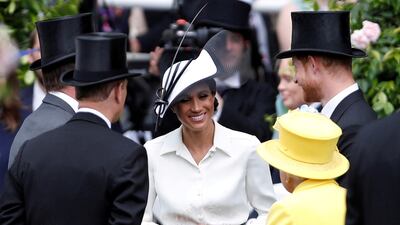
The Harry and Meghan Markle interview has sparked interest in royal insight. Reuters

Fake Marquess fools UK newspaper with support for Meghan Markle


Simon Rushton
  • English
  • Arabic

One of Britain's major online news organisations has been fooled by a fake black British peer, who came out to support Meghan Markle.
With only a Twitter page and some cheek, a woman describing herself as the 11th Marquess of Annaville was allowed to write for the Independent.
Her opinion appeared to be noteworthy and offered a view not often heard. The Independent went with the headline: "I'm a black British member of the aristocracy – I know what Meghan said was true".
Since Meghan Markle and Harry's Oprah interview the British media has been hungry for views and stories about life inside royal circles and the problems the couple faced.
Organisations have found Harry and Meghan to be very 'clickable' and are keen to give readers more.
Unfortunately, the 11th Marquess appears to be more front and less noble, with a distinct lack of history.

And there were clues that the Marquess may be less-than-marque.

Commentators soon started questioning the writer's true position, especially as there is no record of the 11th Marquess of Annaville in publications like London Gazette, Burkes and the Roll of the Peerages.
The Independent has now dropped the her opinion and the url points only to its Opinion homepage.
The not-so-Marquess wrote: "As a member of that same aristocracy, I'm telling you that I unequivocally believe that they are telling the truth" and claims racism is "prevalent in such circles."

In an eminently-readable but ultimately un-true article she claimed racism among Britain's peerage system, which did not easily accept people of colour.
There may be a lesson for the country's media about when something appears too good to be true.


How the UAE gratuity payment is calculated now

Employees leaving an organisation are entitled to an end-of-service gratuity after completing at least one year of service.

The tenure is calculated on the number of days worked and does not include lengthy leave periods, such as a sabbatical. If you have worked for a company between one and five years, you are paid 21 days of pay based on your final basic salary. After five years, however, you are entitled to 30 days of pay. The total lump sum you receive is based on the duration of your employment.

1. For those who have worked between one and five years, on a basic salary of Dh10,000 (calculation based on 30 days):

a. Dh10,000 ÷ 30 = Dh333.33. Your daily wage is Dh333.33

b. Dh333.33 x 21 = Dh7,000. So 21 days salary equates to Dh7,000 in gratuity entitlement for each year of service. Multiply this figure for every year of service up to five years.

2. For those who have worked more than five years

c. 333.33 x 30 = Dh10,000. So 30 days’ salary is Dh10,000 in gratuity entitlement for each year of service.

Note: The maximum figure cannot exceed two years total salary figure.

How Tesla’s price correction has hit fund managers

Investing in disruptive technology can be a bumpy ride, as investors in Tesla were reminded on Friday, when its stock dropped 7.5 per cent in early trading to $575.

It recovered slightly but still ended the week 15 per cent lower and is down a third from its all-time high of $883 on January 26. The electric car maker’s market cap fell from $834 billion to about $567bn in that time, a drop of an astonishing $267bn, and a blow for those who bought Tesla stock late.

The collapse also hit fund managers that have gone big on Tesla, notably the UK-based Scottish Mortgage Investment Trust and Cathie Wood’s ARK Innovation ETF.

Tesla is the top holding in both funds, making up a hefty 10 per cent of total assets under management. Both funds have fallen by a quarter in the past month.

Matt Weller, global head of market research at GAIN Capital, recently warned that Tesla founder Elon Musk had “flown a bit too close to the sun”, after getting carried away by investing $1.5bn of the company’s money in Bitcoin.

He also predicted Tesla’s sales could struggle as traditional auto manufacturers ramp up electric car production, destroying its first mover advantage.

AJ Bell’s Russ Mould warns that many investors buy tech stocks when earnings forecasts are rising, almost regardless of valuation. “When it works, it really works. But when it goes wrong, elevated valuations leave little or no downside protection.”

A Tesla correction was probably baked in after last year’s astonishing share price surge, and many investors will see this as an opportunity to load up at a reduced price.

Dramatic swings are to be expected when investing in disruptive technology, as Ms Wood at ARK makes clear.

Every week, she sends subscribers a commentary listing “stocks in our strategies that have appreciated or dropped more than 15 per cent in a day” during the week.

Her latest commentary, issued on Friday, showed seven stocks displaying extreme volatility, led by ExOne, a leader in binder jetting 3D printing technology. It jumped 24 per cent, boosted by news that fellow 3D printing specialist Stratasys had beaten fourth-quarter revenues and earnings expectations, seen as good news for the sector.

By contrast, computational drug and material discovery company Schrödinger fell 27 per cent after quarterly and full-year results showed its core software sales and drug development pipeline slowing.

Despite that setback, Ms Wood remains positive, arguing that its “medicinal chemistry platform offers a powerful and unique view into chemical space”.

In her weekly video view, she remains bullish, stating that: “We are on the right side of change, and disruptive innovation is going to deliver exponential growth trajectories for many of our companies, in fact, most of them.”

Ms Wood remains committed to Tesla as she expects global electric car sales to compound at an average annual rate of 82 per cent for the next five years.

She said these are so “enormous that some people find them unbelievable”, and argues that this scepticism, especially among institutional investors, “festers” and creates a great opportunity for ARK.

Only you can decide whether you are a believer or a festering sceptic. If it’s the former, then buckle up.