

The EU on Friday pledged to donate 100 million vaccine doses to poorer countries as the IMF unveiled a $50 billion plan to immunise two fifths of humanity by the end of 2021.
The plans emerged at a G20 health summit in Rome with wealthy nations under pressure to share the life-saving vaccines with the world to address the imbalance in global vaccination rates.
The EU said in March that it was not ready to share doses after its vaccine drive was initially plagued by problems, but it has substantially gathered pace since then.
With more than a third of Europe’s population vaccinated at least once, European Commission chief Ursula von der Leyen announced on Friday that 100 million doses would go to lower and middle-income countries by the end of 2021.
Ms von der Leyen, who was chairing Friday’s summit, said agreements were in place for vaccine makers to supply 1.3 billion doses to those countries this year.
These were made up of a billion Pfizer doses, 200 million from Johnson & Johnson and 100 million from Moderna, she said.
The three firms told the summit they would supply 3.5 billion doses at cost or discount by the end of 2022.
At the same summit, the IMF proposed a $50 billion plan to end the pandemic with a target of vaccinating at least 40 per cent of the world’s population this year.
It aims for 60 per cent coverage by the end of 2022.
The IMF said the plan would be worth $9 trillion to the global economy by 2025 from the faster economic rebound.
Pitching the idea to the G20, IMF managing director Kristalina Georgieva said wealthy countries would reap the fruits of the economic recovery.
“Advanced economies – asked to contribute most to this effort – would likely see the highest return on public investment in modern history, capturing 40 per cent of the GDP [gross domestic product] gains and roughly $1 trillion in additional tax revenues,” she said.
Ms von der Leyen also said that the EU plans to invest $1.2 billion to build vaccine manufacturing centres in Africa.
Speaking alongside her, Italian premier Mario Draghi said: “As we prepare for the next pandemic, our priority must be to ensure that we all overcome the current one together.
“We must vaccinate the world – and do it fast.”
-

Visitors ride on a rollercoaster at Europa Park in Rust, western Germany, on the re-opening day of the park following the lifting of coronavirus restrictions. AFP -

An employee welcomes visitors as they enter Europa Park in Rust. Europa Park is one of the first major theme parks in Germany to reopen its doors to visitors. AFP -
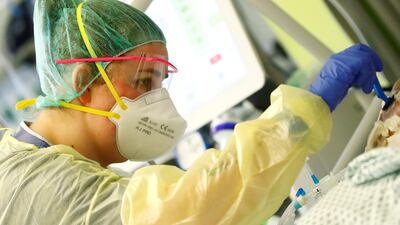
A nurse shaves a patient suffering from Covid-19 at the Intensive Care Unit of the "Klinikum Darmstadt" clinic in Darmstadt, Germany. Reuters -
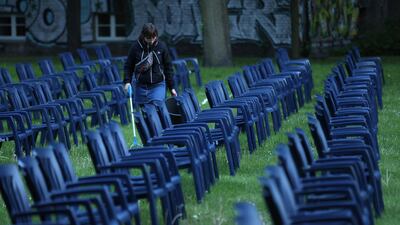
A cinema employee does a last-minute clean before people arrived to watch a film at the Freiluftkino Kreuzberg open-air cinema for the first time this year in Berlin, Germany. Getty Images -
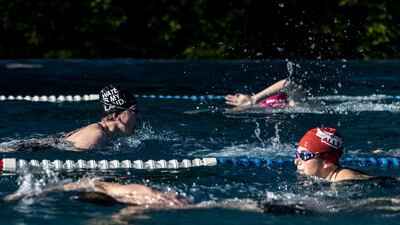
Swimmers exercise in an open air pool in Berlin, Germany. Authorities are easing lockdown measures across Germany. Getty Images -

Pedestrians walk down the Kohlmarkt shopping street in Vienna, Austria. Western Europe is beginning to loosen restrictions to contain the coronavirus. Bloomberg -

A restaurant worker waits for customers alongside an outdoor dining area in the Naschmarkt in Vienna, Austria. Bloomberg -
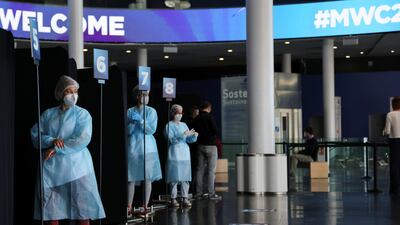
Workers wait to collect a coronavirus disease swab sample in the Fira of Barcelona, Spain. Reuters -
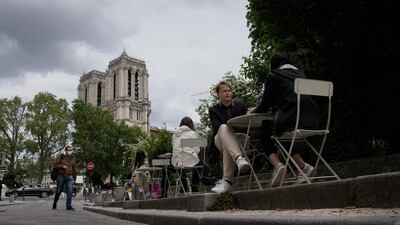
People sit outdoors at a restaurant terrace near Notre Dame cathedral in Paris, France. Cafe and restaurant terraces reopened this week after a pandemic shutdown of more than six months. AP Photo


Pressure on wealthy nations to share vaccines
About 20 heads of state and government and 12 international organisations are taking part in the Rome summit, most of them remotely.
Before the meeting, a scientific report presented to leaders said global vaccine equity was both a moral imperative and critical for pandemic control.
“Inequitable access will not only lead to preventable mortality and suffering in an even more fragmented world but also hamper critical control efforts globally,” the report said.
“High levels of infection are a breeding ground for the emergence of viral mutations, which may lead to immune escape variants resistant to current vaccines and antibody-based therapeutics.”
Rich nations are donors to the UN-backed Covax scheme to distribute vaccines around the world, but the facility faced shortfalls linked partly to the second wave of the pandemic in India.
India is the world's biggest vaccine manufacturer but is unlikely to resume major exports until at least October as it diverts supplies of the AstraZeneca doses for use at home.
Unicef predicted this week that Covax would be nearly 190 million doses short by the time G7 leaders meet in Britain next month.
The Global Alliance for Vaccines and Immunisation, one of the organisations behind Covax, said on Friday it had agreed to buy 200 million doses of Johnson & Johnson’s vaccine.
“As a one-dose vaccine, the J&J vaccine has particular relevance for places with difficult infrastructure, making it a very important addition to the portfolio,” said Gavi chief executive Seth Berkley.
While the EU is pledging to donate more doses, the summit is not expected to endorse the idea of suspending patents for Covid-19 vaccines.
The idea was recently backed by Washington but is viewed with scepticism in Brussels.
Amnesty International on Thursday urged G20 leaders to pressure pharmaceutical companies into sharing their vaccine technology.
“With thousands of people dying every day, it’s clear that profit should not be put ahead of people’s health,” said Amnesty health adviser Tamaryn Nelson.
“Some 100 countries including the USA have understood the importance of waiving intellectual property rights to boost supply of vaccines and end Covid-19. Yet, states such as Germany, Australia, the UK and across the EU are failing people around the world by refusing to do the same.”

