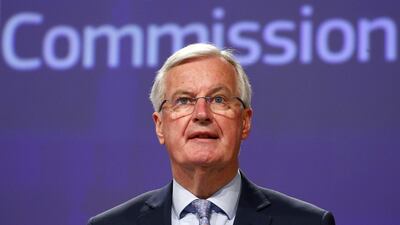
The EU's former Brexit negotiator, Michel Barnier, said on Wednesday that the reality of Britain's decision to leave the bloc was only now being felt, years after the British 2016 referendum on membership.
Mr Barnier said changes to trade barriers, limits on citizens' movement and work visas were inevitable after Britain finished its transition from the EU on January 1.
"For many people, the real consequences of the referendum are only now starting to sink in," Mr Barnier told an event in Switzerland by video link from Paris.
"The reality, which has become clear for all to see, is that Brexit means recreating trade barriers that had not existed for 47 years."
Exports of food and drink from Britain to the EU plunged by 75.5 per cent in January, Britain's Food and Drink Federation has said, attributing much of the fall to post-Brexit barriers.
The British government says UK-EU trade has been hit by the Covid-19 pandemic and problems with companies adapting to the new Customs rules, which it expects will improve with time.
Mr Barnier said British and European citizens no longer enjoyed free movement in each other's territories.
Musicians must now obtain paperwork for work permits and their equipment in the EU and Britain.
He said Brexit was a lesson for the EU, which must show its 450 million citizens that the 27-state bloc benefited all, and was not the distant, uncaring bureaucracy it was often portrayed to be by Brexit supporters.
Mr Barnier defended his record of negotiating the withdrawal agreement signed in January 2020 and the ensuing trade deal clinched on December 24, 2020.
But he questioned whether he and Britain's chief negotiator, David Frost, were on the same page.
"We managed to conclude an agreement [on trade], although I am still not entirely sure we understood each other all the time," Mr Barnier said.
He attributed that to "a certain view on Europe and sharing national sovereignty".
Mr Frost was regarded as the architect of British Prime Minister Boris Johnson's "hard Brexit" strategy to leave the bloc with a limited trade deal.
Mr Barnier, a French former conservative minister and European Commissioner, committed most of his political life to the deeper integration of European states.

The biog
Name: Younis Al Balooshi
Nationality: Emirati
Education: Doctorate degree in forensic medicine at the University of Bonn
Hobbies: Drawing and reading books about graphic design
Ten tax points to be aware of in 2026
1. Domestic VAT refund amendments: request your refund within five years
If a business does not apply for the refund on time, they lose their credit.
2. E-invoicing in the UAE
Businesses should continue preparing for the implementation of e-invoicing in the UAE, with 2026 a preparation and transition period ahead of phased mandatory adoption.
3. More tax audits
Tax authorities are increasingly using data already available across multiple filings to identify audit risks.
4. More beneficial VAT and excise tax penalty regime
Tax disputes are expected to become more frequent and more structured, with clearer administrative objection and appeal processes. The UAE has adopted a new penalty regime for VAT and excise disputes, which now mirrors the penalty regime for corporate tax.
5. Greater emphasis on statutory audit
There is a greater need for the accuracy of financial statements. The International Financial Reporting Standards standards need to be strictly adhered to and, as a result, the quality of the audits will need to increase.
6. Further transfer pricing enforcement
Transfer pricing enforcement, which refers to the practice of establishing prices for internal transactions between related entities, is expected to broaden in scope. The UAE will shortly open the possibility to negotiate advance pricing agreements, or essentially rulings for transfer pricing purposes.
7. Limited time periods for audits
Recent amendments also introduce a default five-year limitation period for tax audits and assessments, subject to specific statutory exceptions. While the standard audit and assessment period is five years, this may be extended to up to 15 years in cases involving fraud or tax evasion.
8. Pillar 2 implementation
Many multinational groups will begin to feel the practical effect of the Domestic Minimum Top-Up Tax (DMTT), the UAE's implementation of the OECD’s global minimum tax under Pillar 2. While the rules apply for financial years starting on or after January 1, 2025, it is 2026 that marks the transition to an operational phase.
9. Reduced compliance obligations for imported goods and services
Businesses that apply the reverse-charge mechanism for VAT purposes in the UAE may benefit from reduced compliance obligations.
10. Substance and CbC reporting focus
Tax authorities are expected to continue strengthening the enforcement of economic substance and Country-by-Country (CbC) reporting frameworks. In the UAE, these regimes are increasingly being used as risk-assessment tools, providing tax authorities with a comprehensive view of multinational groups’ global footprints and enabling them to assess whether profits are aligned with real economic activity.
Contributed by Thomas Vanhee and Hend Rashwan, Aurifer
Zayed Sustainability Prize
SPECS
%3Cp%3E%3Cstrong%3EEngine%3A%20%3C%2Fstrong%3E4-litre%20flat-six%0D%3Cbr%3E%3Cstrong%3EPower%3A%20%3C%2Fstrong%3E525hp%20(GT3)%2C%20500hp%20(GT4)%0D%3Cbr%3E%3Cstrong%3ETorque%3A%20%3C%2Fstrong%3E465Nm%20(GT3)%2C%20450Nm%20(GT4)%0D%3Cbr%3E%3Cstrong%3ETransmission%3A%20%3C%2Fstrong%3ESeven-speed%20automatic%0D%3Cbr%3E%3Cstrong%3EPrice%3A%20%3C%2Fstrong%3EFrom%20Dh944%2C000%20(GT3)%2C%20Dh581%2C700%20(GT4)%0D%3Cbr%3E%3Cstrong%3EOn%20sale%3A%20%3C%2Fstrong%3ENow%0D%3Cbr%3E%3C%2Fp%3E%0A
The specs
Engine: 2.0-litre 4cyl turbo
Power: 261hp at 5,500rpm
Torque: 405Nm at 1,750-3,500rpm
Transmission: 9-speed auto
Fuel consumption: 6.9L/100km
On sale: Now
Price: From Dh117,059
Business Insights
- As per the document, there are six filing options, including choosing to report on a realisation basis and transitional rules for pre-tax period gains or losses.
- SMEs with revenue below Dh3 million per annum can opt for transitional relief until 2026, treating them as having no taxable income.
- Larger entities have specific provisions for asset and liability movements, business restructuring, and handling foreign permanent establishments.
Kibsons%20Cares
%3Cp%3E%3Cstrong%3ERecycling%3Cbr%3E%3C%2Fstrong%3EAny%20time%20you%20receive%20a%20Kibsons%20order%2C%20you%20can%20return%20your%20cardboard%20box%20to%20the%20drivers.%20They%E2%80%99ll%20be%20happy%20to%20take%20it%20off%20your%20hands%20and%20ensure%20it%20gets%20reused%3C%2Fp%3E%0A%3Cp%3E%3Cstrong%3EKind%20to%20health%20and%20planet%3C%2Fstrong%3E%3Cbr%3ESolar%20%E2%80%93%2025-50%25%20of%20electricity%20saved%3Cbr%3EWater%20%E2%80%93%2075%25%20of%20water%20reused%3Cbr%3EBiofuel%20%E2%80%93%20Kibsons%20fleet%20to%20get%2020%25%20more%20mileage%20per%20litre%20with%20biofuel%20additives%3C%2Fp%3E%0A%3Cp%3E%3Cstrong%3ESustainable%20grocery%20shopping%3C%2Fstrong%3E%3Cbr%3ENo%20antibiotics%3Cbr%3ENo%20added%20hormones%3Cbr%3ENo%20GMO%3Cbr%3ENo%20preservatives%3Cbr%3EMSG%20free%3Cbr%3E100%25%20natural%3C%2Fp%3E%0A
Five famous companies founded by teens
There are numerous success stories of teen businesses that were created in college dorm rooms and other modest circumstances. Below are some of the most recognisable names in the industry:
- Facebook: Mark Zuckerberg and his friends started Facebook when he was a 19-year-old Harvard undergraduate.
- Dell: When Michael Dell was an undergraduate student at Texas University in 1984, he started upgrading computers for profit. He starting working full-time on his business when he was 19. Eventually, his company became the Dell Computer Corporation and then Dell Inc.
- Subway: Fred DeLuca opened the first Subway restaurant when he was 17. In 1965, Mr DeLuca needed extra money for college, so he decided to open his own business. Peter Buck, a family friend, lent him $1,000 and together, they opened Pete’s Super Submarines. A few years later, the company was rebranded and called Subway.
- Mashable: In 2005, Pete Cashmore created Mashable in Scotland when he was a teenager. The site was then a technology blog. Over the next few decades, Mr Cashmore has turned Mashable into a global media company.
- Oculus VR: Palmer Luckey founded Oculus VR in June 2012, when he was 19. In August that year, Oculus launched its Kickstarter campaign and raised more than $1 million in three days. Facebook bought Oculus for $2 billion two years later.
APPLE IPAD MINI (A17 PRO)
Display: 21cm Liquid Retina Display, 2266 x 1488, 326ppi, 500 nits
Chip: Apple A17 Pro, 6-core CPU, 5-core GPU, 16-core Neural Engine
Storage: 128/256/512GB
Main camera: 12MP wide, f/1.8, digital zoom up to 5x, Smart HDR 4
Front camera: 12MP ultra-wide, f/2.4, Smart HDR 4, full-HD @ 25/30/60fps
Biometrics: Touch ID, Face ID
Colours: Blue, purple, space grey, starlight
In the box: iPad mini, USB-C cable, 20W USB-C power adapter
Price: From Dh2,099
