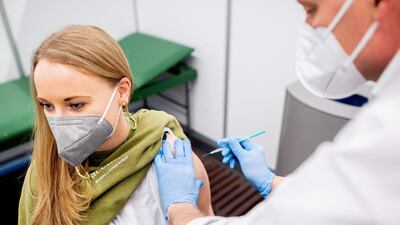

The EU is launching legal action against AstraZeneca over delayed shipments of its Covid-19 vaccine in the latest development in a months-long feud between Brussels and the company.
European leaders accuse the drugmaker of not respecting its contract with the 27-member union and failing to come up with a strategy to prevent shipment delays.
"We want to make sure there is a speedy delivery of a sufficient number of doses that European citizens are entitled to," said EU spokesman Stefan De Keersmaecker.
The EU's efforts to lead the vaccine drive across Europe were hampered by supply problems, leaving the EU trailing behind the UK and the US.
Brussels responded by imposing export controls and publishing its contract with AstraZeneca, in which the company committed to making "best reasonable efforts" to deliver 300 million doses by June.
Only 30 million were delivered in Q1 2021, and the company says it can only provide 70 million in Q2, rather than the 180 million doses it had promised.
Responding to Monday’s news, AstraZeneca said the legal action was “without merit” and said it would strongly defend itself in court.
“We welcome this opportunity to resolve this dispute as soon as possible,” said a statement by the company, which said it had fully complied with its advance purchase agreement with the EU.
AstraZeneca's CEO Pascal Soriot previously blamed some of the EU's problems on the bloc signing a contract three months later than Britain.
Mr De Keersmaecker said the EU's legal action was launched "on behalf of the 27 member states that are fully aligned in their support of this procedure".
Despite the EU's public battles to get hold of AstraZeneca doses, some European governments have struggled to persuade their citizens to take the vaccine.
The product has been the subject of a one-month back-and-forth over blood clots which EU regulators say are a very rare side-effect, but should not halt the use of the vaccine.
In the Netherlands, the head of the vaccination department at Dutch public health institute RIVM said that millions of AstraZeneca doses were likely to go unused.
Other vaccines will be so widely available that the supplies will not be needed, Jaap van Delden told Dutch newspaper AD.
-
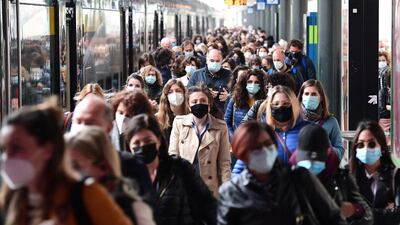
Commuters walk upon their arrival at the Cardona railway station in Milan, Italy. Restaurants, cinemas and concert halls will partially reopen across Italy on Monday. AFP -

People sit at a cafe's terrace in central Milan, Italy. AFP -

People take selfies outside the Colosseum on the day of its reopening, as much of the country becomes a 'yellow zone', in Rome, Italy. Reuters -

Students enter Visconti High School on the first day of reopening, in Rome, Italy. EPA -
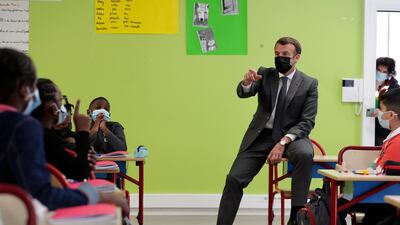
French President Emmanuel Macron talks with pupils during a visit to a school in Melun, France. Nursery and primary schools reopened on Monday across France after a three-week closure. AP Photo -

A medical staff member works in the Intensive Care Unit where patients suffering from Covid-19 are treated at the hospital in Valenciennes, France. Reuters -
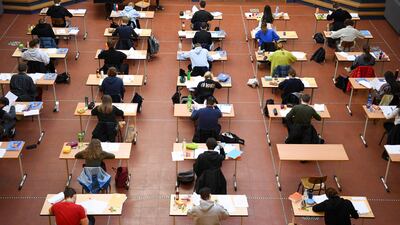
Students attend a secondary school exam, at the auditorium of Paul Natorp Gymnasium, under restrictions imposed due to Covid-19, in Berlin, Germany. Reuters -
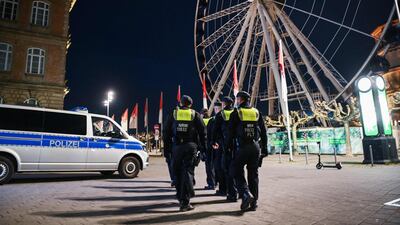
Police officers patrol at the pedestrian area in Duesseldorf, western Germany. AFP -
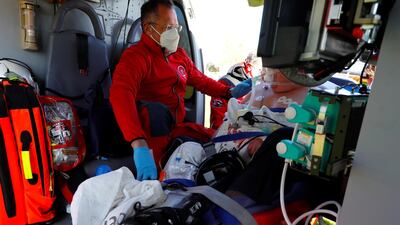
Doctor Simon Little of Johanniter air rescue attends to a patient with serious breathing problems prior to a flight from Gruenberg to a hospital in Bad Hersfeld, in Germany. Reuters -
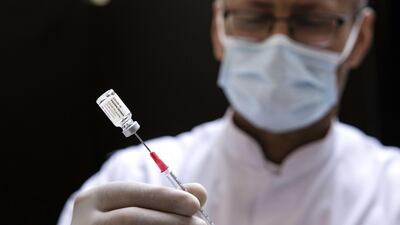
A healthcare worker prepares to vaccinate locals with the Janssen vaccine at the VUmc hospital in Amsterdam, the Netherlands. EPA


The latest AstraZeneca development came as a new poll showed the EU receiving a negative approval rating for its handling of the pandemic, with the majority of people in Germany and France unhappy with the bloc's response.
The Eurobarometer survey found that 49 per cent of EU citizens were not satisfied with the efforts of Brussels, compared with 43 per cent that were.
The EU was also in negative territory in Italy, Greece and Belgium, among other countries, while citizens in Spain and the Netherlands were evenly divided.
Some countries were content with the EU’s response. More than 60 per cent of respondents in Denmark, Lithuania and Portugal said they were satisfied.
By a narrow margin, the EU’s response was more unpopular than the efforts of national governments, which, on average, scored 43 per cent approval and 46 per cent disapproval.
Europe is one of the hardest-hit regions, with 30 million cases confirmed and scientists estimating that the true number could be three times higher.
In addition to vaccines, the EU is co-ordinating efforts to resume summer travel across Europe by issuing a "digital green certificate" to its citizens.
This would allow travellers to prove they have tested negative, received a vaccine or recovered from Covid-19 in the previous 180 days.
Meanwhile, lockdown measures are a matter for national and sometimes regional governments, leading to a patchwork of restrictions across Europe.
The third wave of the pandemic forced numerous countries, including France and Germany, to enter new lockdowns.
Experts in Italy, Belgium and Switzerland warned against a hasty move to lift restrictions after numerous countries announced plans to ease them.
EU citizens expect prolonged economic pain from Covid-19
The EU also launched an economic response to the pandemic, agreeing to a €750 billion ($908m) recovery fund to rebuild shattered economies.
Nonetheless, the Eurobarometer poll showed that 61 per cent of EU citizens believed their country’s economy will not recover from the crisis until 2023 or later.
Only 29 per cent expected a bounce back in 2022 or sooner, with 8 per cent suggesting it would never recover.
The EU also touted a more favourable result in the poll, which showed that overall trust in the EU had risen six points since last summer to 49 per cent.
Citizens in Portugal and Ireland showed the greatest trust in the EU, with scores of 78 per cent and 74 per cent, respectively.
The lowest marks came from Greece, where only 37 per cent said they trusted the union.
The Greek economy is still recovering from a decade-long financial crisis in which it frequently clashed with Brussels.
More on Covid-19
Vaccines are working: UK deaths and hospital admissions in steep decline
Facebook 'fails to clamp down on Covid-19 misinformation in Europe'

