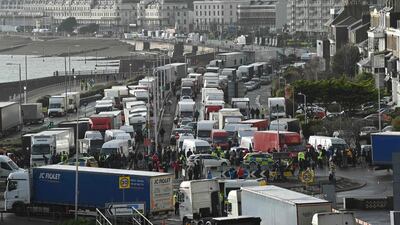

French President Emmanuel Macron was accused by senior politicians of playing politics over the lorry blockade of Britain, jeopardising good relations and the economy.
The French leader finds his position weakened in the European Union as other countries are said to regard his decision to shut the border, after a faster-spreading variant of the Covid-19 virus was identified in England, as a significant overreaction.
After a two-day impasse, a deal was struck on Tuesday night to allow traffic to move from the English port of Dover to mainland Europe. However, hauliers scuffled with police on Wednesday morning as lorries began to trickle out of the port and tensions increased throughout the day.
Hauliers will be tested for the virus before being allowed to board ferries or the cross-Channel rail service to the Continent, where cases of the new mutation were identified.
Mr Macron’s stance came as talks on a Brexit trade deal hung in the balance over agreeing fishing rights that involve the large French trawler fleet.
"I'm afraid this was an example of politics spilling into the hardship of managing this pandemic," British MP Tobias Ellwood told The National. "It is unfortunate that as negotiations reached a critical juncture, that this action should muddy the waters."
-
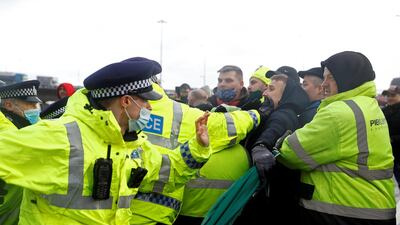
Police officers scuffle with drivers trying to stop trucks leaving the port and keep it closed until they are allowed to travel to Europe, at the Port of Dover, as EU countries impose a travel ban from the UK following the coronavirus disease (COVID-19) outbreak, in Dover, Britain, December 23, 2020. REUTERS/John Sibley -
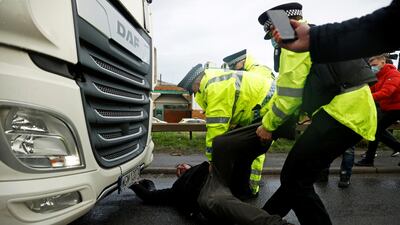
Police officers drag a person lying down in front of a lorry at the Port of Dover, as EU countries impose a travel ban from the UK following the coronavirus disease (COVID-19) outbreak, in Dover, Britain, December 23, 2020. REUTERS/John Sibley TPX IMAGES OF THE DAY -

epa08900880 Police stand at the entrance of the Port of Dover after freight lorries cannot cross by sea or through the Eurotunnel and the Port of Dover has closed to outbound traffic in Dover, Britain, 23 December 2020. France closed its border with the UK for 48 hours over concerns about the new coronavirus variant. Lorry drivers must now obtain negative coronavirus tests before they will be allowed to cross by sea and the Port of Dover remains closed to outbound traffic on the morning of 23 December 2020. EPA/FACUNDO ARRIZABALAGA -
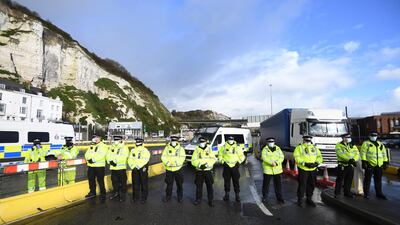
epa08900874 Police stand at the entrance of the Port of Dover after freight lorries cannot cross by sea or through the Eurotunnel and the Port of Dover has closed to outbound traffic in Dover, Britain, 23 December 2020. France closed its border with the UK for 48 hours over concerns about the new coronavirus variant. Lorry drivers must now obtain negative coronavirus tests before they will be allowed to cross by sea and the Port of Dover remains closed to outbound traffic on the morning of 23 December 2020. EPA/FACUNDO ARRIZABALAGA -

DOVER, ENGLAND - DECEMBER 23: Police officers attend to a man at the Port of Dover on December 23, 2020 in Dover, United Kingdom. Nearly 3,000 lorries were stranded around Kent after France banned all travel from the UK on Sunday, citing concerns over a new variant of covid-19. Late Tuesday, the countries reached a deal to restart freight travel for drivers with a recent negative covid-19 test. (Photo by Dan Kitwood/Getty Images) -

A person lies down in front of a lorry to stop it from leaving the Port of Dover, as EU countries impose a travel ban from the UK following the coronavirus disease (COVID-19) outbreak, in Dover, Britain, December 23, 2020. REUTERS/John Sibley -
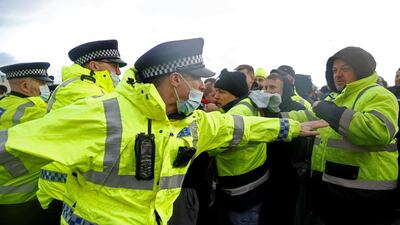
Police officers scuffle with drivers trying to stop trucks leaving the port and keep it closed until they are allowed to travel to Europe, at the Port of Dover, as EU countries impose a travel ban from the UK following the coronavirus disease (COVID-19) outbreak, in Dover, Britain, December 23, 2020. REUTERS/John Sibley -
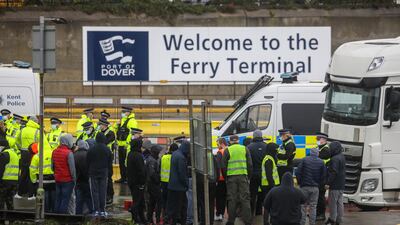
Police officers speak with truck drivers at the Port of Dover Ltd. in Dover, U.K. The European Commission called on member states to reopen critical trade and passenger transport links to the U.K. while discouraging non-essential travel, a step toward ending the chaos at Britain's busiest port. Bloomberg -
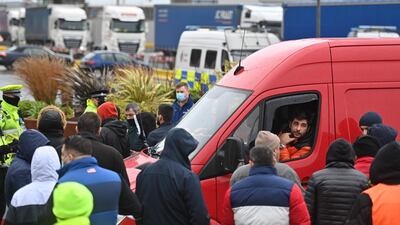
Drivers discuss by their vehicles in the road as they queue trying to enter the port of Dover in Kent, south east England, that is still cordoned after the UK and France agreed a protocol to reopen the border to accompanied freight arriving in France from the UK requiring all lorry drivers to show a negative Covid-19 test. France and Britain reopened cross-border travel after a snap 48-hour ban to curb the spread of a new coronavirus variant threatened UK supply chains. Accompanied frieght will now be allowed to cross the channel from the port of Dover but all lorry drivers will require a lateral flow test and a negative Covid-19 result before the travel. AFP -
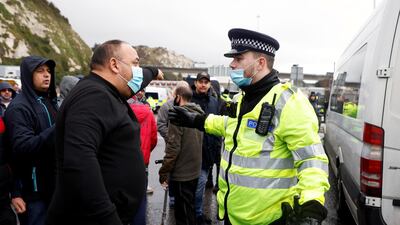
A driver talks with a police officer at the entrance of the Port of Dover, as EU countries impose a travel ban from the UK following the coronavirus disease (COVID-19) outbreak, in Dover, Britain, December 23, 2020. REUTERS/John Sibley -

Drivers talk with police officers at the entrance of the Port of Dover, as EU countries impose a travel ban from the UK following the coronavirus disease (COVID-19) outbreak, in Dover, Britain. REUTERS -
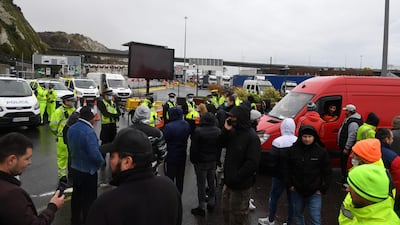
Drivers and their vehicles trying to enter the port of Dover, in Kent, south east England, block the road access as they not allowed to enter after the UK and France agreed a protocol to reopen the border to accompanied freight arriving in France from the UK. France and Britain reopened cross-border travel after a snap 48-hour ban to curb the spread of a new coronavirus variant threatened UK supply chains. Accompanied frieght will now be allowed to cross the channel from the port of Dover but all lorry drivers will require a lateral flow test and a negative Covid-19 result before the travel. AFP -
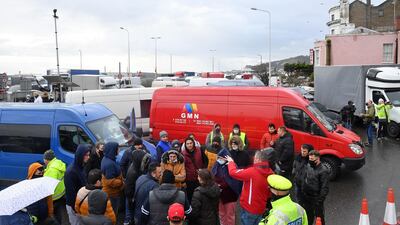
Drivers block the road by the entrance to the Port in Dover, in Kent, south east England on December 23, 2020, as they await lateral flow COVID-19 tests to arrive, before being allowed to enter, following an agreement between the UK and France to reopen the border to accompanied freight arriving in France from the UK. France and Britain reopened cross-Channel travel on Wednesday after a 48-hour ban to curb the spread of a new coronavirus variant but London has warned it could take days for thousands of trucks blocked around the port of Dover to get moving. / AFP / JUSTIN TALLIS -
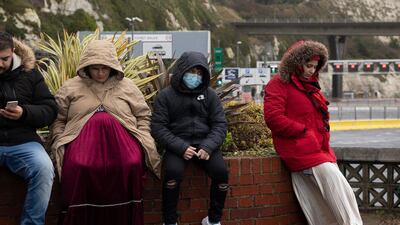
DOVER, ENGLAND - DECEMBER 23: Travellers to Europe wait at the Port of Dover on December 23, 2020 in Dover, United Kingdom. Nearly 3,000 lorries were stranded around Kent after France banned all travel from the UK on Sunday, citing concerns over a new variant of covid-19. Late Tuesday, the countries reached a deal to restart freight travel for drivers with a recent negative covid-19 test. (Photo by Dan Kitwood/Getty Images) -
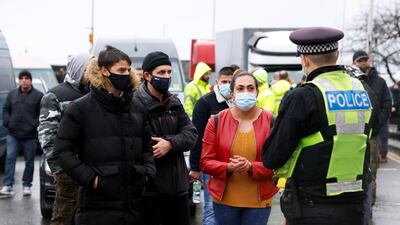
People wearing protective masks talk with a police officer at the entrance of the Port of Dover, as EU countries impose a travel ban from the UK following the coronavirus disease (COVID-19) outbreak, in Dover, Britain. REUTERS -

Police officers form a cordon at the entrance to the port in Dover, in Kent, south east England, after the UK and France agreed a protocol to reopen the border to accompanied freight arriving in France from the UK. France and Britain reopened cross-border travel after a snap 48-hour ban to curb the spread of a new coronavirus variant threatened UK supply chains. Accompanied frieght will now be allowed to cross the channel from the port of Dover but all lorry drivers will require a lateral flow test and a negative Covid-19 result before the travel. AFP -

Travellers to Europe are stopped by police officers at the Port of Dover in Dover, United Kingdom. Nearly 3,000 lorries were stranded around Kent after France banned all travel from the UK on Sunday, citing concerns over a new variant of covid-19. Late Tuesday, the countries reached a deal to restart freight travel for drivers with a recent negative covid-19 test. Getty Images -
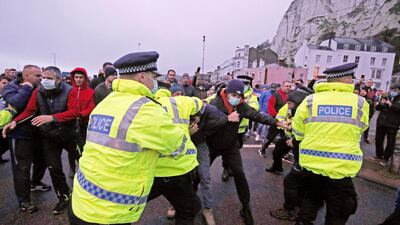
Truck drivers scuffle with police trying to hold them back at the entrance to the Port of Dover, in Kent, England. Freight from Britain and passengers with a negative virus test began arriving on French shores Wednesday, after France relaxed a two-day blockade over a new virus variant that had isolated Britain, stranded thousands of drivers and raised fears of shortages. AP -

Truck drivers discuss with police holding them back at the entrance to the Port of Dover, in Kent, England. Freight from Britain and passengers with a negative virus test began arriving on French shores Wednesday, after France relaxed a two-day blockade over a new virus variant that had isolated Britain, stranded thousands of drivers and raised fears of shortages. AP -

A woman and child stand in front of police officers at the Port of Dover on December 23, 2020 in Dover, United Kingdom. Nearly 3,000 lorries were stranded around Kent after France banned all travel from the UK on Sunday, citing concerns over a new variant of covid-19. Late Tuesday, the countries reached a deal to restart freight travel for drivers with a recent negative covid-19 test. Getty Images -
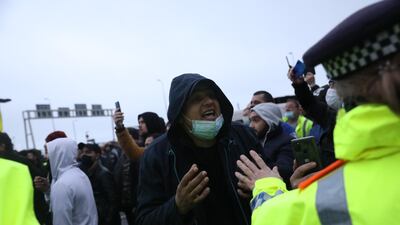
A man speaks to a police officer at the Port of Dover on December 23, 2020 in Dover, United Kingdom. Nearly 3,000 lorries were stranded around Kent after France banned all travel from the UK on Sunday, citing concerns over a new variant of covid-19. Late Tuesday, the countries reached a deal to restart freight travel for drivers with a recent negative covid-19 test. Getty Images -
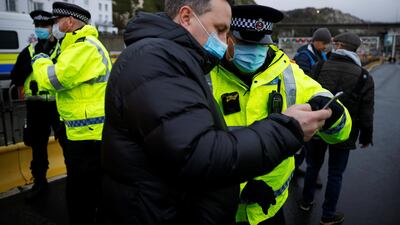
A driver talks with a police officer next the exit of the Port of Dover, as EU countries impose a travel ban from the UK following the coronavirus disease (COVID-19) outbreak, in Dover, Britain, December 23, 2020. REUTERS -

Truck drivers argue with police holding them back at the entrance to the Port of Dover, in Kent, England,. Freight from Britain and passengers with a negative virus test began arriving on French shores Wednesday, after France relaxed a two-day blockade over a new virus variant that had isolated Britain, stranded thousands of drivers and raised fears of shortages. AP -
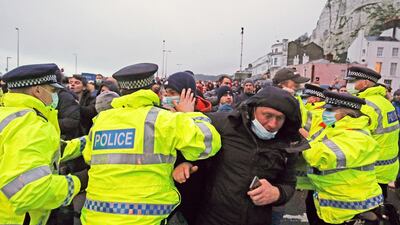
Truck drivers argue with police holding them back at the entrance to the Port of Dover, in Kent, England. Freight from Britain and passengers with a negative virus test began arriving on French shores Wednesday, after France relaxed a two-day blockade over a new virus variant that had isolated Britain, stranded thousands of drivers and raised fears of shortages. AP


Others suggest the decision was Mr Macron attempting to show toughness as a ploy ahead of the French presidential election next year.
“I think Marcon’s slightly overplayed his hand and caused a huge amount of angst that was totally unnecessary,” former MEP Richard Tice said. “It's just utter madness.”
There is also anger in Whitehall that while Britain was quick to inform the rest of the world about the new virulent strain of coronavirus, it was punished with the French blockade and flight bans to more than 50 countries.
"We are global leaders in genome research and transparency, which allowed us to be so upfront about this mutation ... but we have been penalised for our openness," a Whitehall source told The National.
With more than 4,000 lorries held up in Britain and food shortages expected as a result, there is a suggestion that the delays are an example of what could happen if there is a no-deal Brexit and World Trade Organisation rules are imposed.
“This demonstrates that the realities on the ground are very, very different when WTO might come into play,” said Mr Ellwood, chairman of the defence committee. “You could easily see that unforeseen problems will arise and this shows how quickly such a vital arterial route can be jammed.”
While some argue that the French were responsible in acting to prevent the virus spreading across Europe, the move reaffirmed the potential disruption on January 1 if there is no deal.
“This is just a tiny peek at what could happen either in the first few days or first few weeks of the transition period ending, and it would be compounded by tariffs and a no deal,” said Ian Wright of the Food and Drink Federation. “A lot of companies would have intended to stockpile in that post-Christmas period ... that may now be compromised.”
A British government source told The Times that the ban on UK freight was unnecessary. "The risk of transmission from a solitary lorry driver is very low. France was left isolated by the European Commission on this."

The view that it was a political ploy was echoed by lorry drivers stranded at the main Channel crossing in Kent. “This is all about Brexit, I don’t think it’s anything to do with the virus,” said Peter Graham, 51, from north-east England. “France are trying to blackmail us into doing a deal or saying, ‘this is what it will be like for you’ if not.”
It is expected that the government will use up to 200 British soldiers to conduct Covid-19 tests on lorry drivers as part of French demand to allow them to cross the border.
It is unclear whether the backlog will be cleared up in time for Christmas. At the port of Dover there was little sign of any tests – or much support for stranded drivers.
"They talk about some Covid test but there are no Covid tests," Blazej Pankiewicz, a driver from Torun, Poland, said in Dover, surrounded by angry drivers.
He said he was extremely sad to be missing Christmas back home with his family, which had already gathered.
"Home for Christmas? Forget it," said Laurent Beghin, a French lorry driver who delivered a cargo of paint to the UK on Sunday and was still stuck in England on Wednesday.

