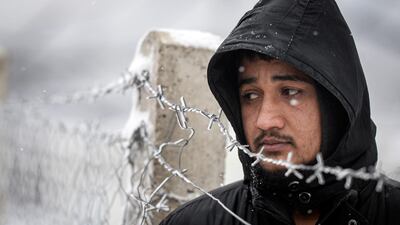
A migrant stands next to a fence during snowfall at the Lipa camp in Bosnia. AP

Deportation fears present hurdles for migrants in global vaccine race


Jamie Prentis
  • English
  • Arabic

Migrants are in danger of becoming an afterthought in the international effort to vaccinate against Covid, with UN agencies fearing many will be too scared of authorities to accept a shot.

There are also concerns around compiling data on refugees and migrants, many of whom are reluctant to engage with officials due to a lack of trust, the agencies said.

Dr Jaime Calderon, the senior migration health adviser at the International Organisation for Migration’s regional office in Vienna, says governments must take steps to ensure refugees and migrants are not left behind, and go beyond simply procuring adequate vaccine doses.

Governments should “reduce the number of administrative hurdles for migrants to access health care and vaccines by making sure it is affordable, if not free, and that no particular proof of residence, work or identity is required in order to get the shot,” he said.

"One of the concerns we have is that even if offered access to the vaccine, many migrants may not even attempt to get the shots for fear of arrest or deportation. There needs to be tangible efforts in policy, communication and implementation to build trust with all migrant communities," he told The National.

“In addition to offering guarantees that vaccination will not lead to arrest or deportation, communications need to go through channels that are adequate for reaching all migrants, with key information on how to access the vaccine and what the conditions are.”

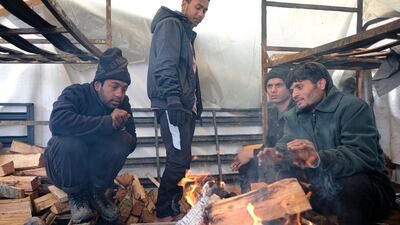
  • Migrants cook inside a makeshift shelter at the Lipa camp, outside Bihac, Bosnia. AP Photo
    Migrants cook inside a makeshift shelter at the Lipa camp, outside Bihac, Bosnia. AP Photo
  • Migrants warm themselves around a fire. A fresh spate of snowy and very cold winter weather has brought more misery for hundreds of migrants. AP Photo
    Migrants warm themselves around a fire. A fresh spate of snowy and very cold winter weather has brought more misery for hundreds of migrants. AP Photo
  • A migrant walks during snowfall at the Lipa camp. AP Photo
    A migrant walks during snowfall at the Lipa camp. AP Photo
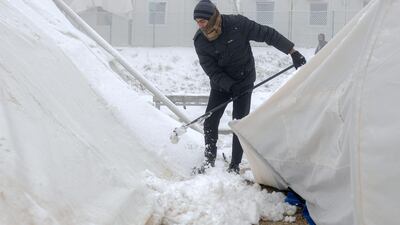
  • A migrant clears snow from makeshift tents. AP Photo
    A migrant clears snow from makeshift tents. AP Photo
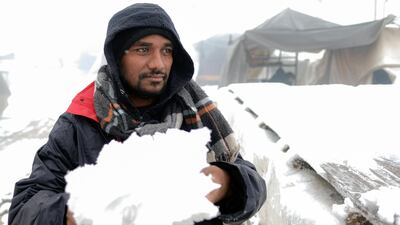
  • A migrant carries snow at the Lipa camp. AP Photo
    A migrant carries snow at the Lipa camp. AP Photo
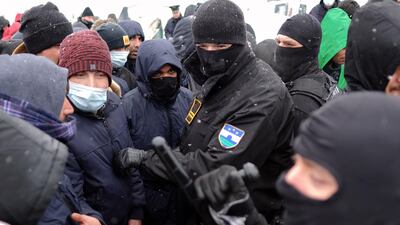
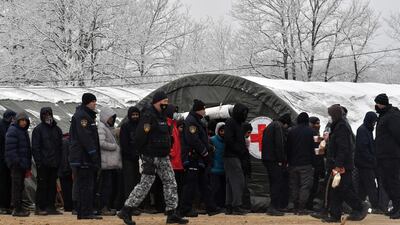
  • Bosnian police stand in front of migrants waiting in lines for food handouts during snowfall at the Lipa camp. AP Photo
    Bosnian police stand in front of migrants waiting in lines for food handouts during snowfall at the Lipa camp. AP Photo
  • Bosnian police officers watch on as migrants receive food provisions distributed by local Red Cross. AFP
    Bosnian police officers watch on as migrants receive food provisions distributed by local Red Cross. AFP
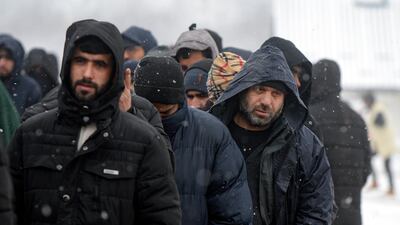
  • Migrants wait in lines for food. AP Photo
    Migrants wait in lines for food. AP Photo
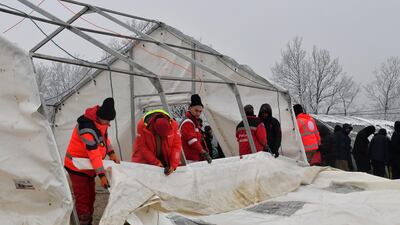
  • Workers of the local Red Cross rebuild tents and infrastructure at the Lipa camp. AFP
    Workers of the local Red Cross rebuild tents and infrastructure at the Lipa camp. AFP
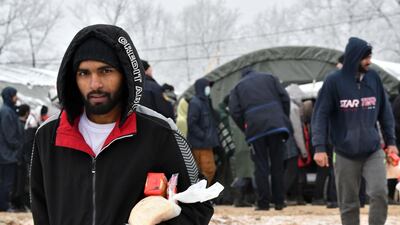
  • A migrant carries food after receiving provisions from the Red Cross. AFP
    A migrant carries food after receiving provisions from the Red Cross. AFP

On the EU’s eastern border, malnourished refugees languish in bitterly cold makeshift camps, where conditions are often far from sanitary.

Many live in remote areas and distrust local authorities, a fear entrenched because of the brutality security forces in their homelands inflicted on them in the past.

Ensuring fair distribution of Covid-19 vaccines has been a priority for the global community during the pandemic, but rich countries have nonetheless led the way in inoculations. New data suggests only 0.1 per cent of doses have been administered in the world’s 50 poorest nations.

But arguably further away from the spotlight is how to ensure that vaccines are distributed equitably within countries. UN agencies have been clear that migrants and refugees, regardless of their legal status, must be included in vaccination programmes – not only from an equity standpoint, but also to limit the spread of the virus.

Another concern is the lack of data on the impact of Covid-19 on refugee and migrant populations, said Dr Siddhartha Datta, a regional adviser in the vaccine-preventable diseases and immunisation division at the World Health Organisation’s European office.

Dr Datta raised the importance of ensuring refugees and migrants are informed about the vaccine.

He also pointed to a lack of trust in the system that both documented and undocumented migrants may have. Basic matters, such as finding out where to be vaccinated and who to speak to if they develop Covid symptoms must also be established, Dr Datta said.

“One thing which we can see in this population group is about communication, communicating to them what this vaccine does and what this vaccine doesn’t do. This is extremely important.

“This is much more complex because of the fact that there is always a language barrier between the host country that is providing this information or services to the people who are coming. We have seen that in the routine vaccination programme as well. So, the communication campaign has to be tailored to these particular population groups.

“The other factor is if they don’t see the disease happening in their own population ... the perception of the population will be low to the receipt of the vaccine.”

The Pfizer-BioNTech shot must be stored at −70°C, adding another layer of complexity, particularly when migrants and refugees live in hard-to-reach areas that lack suitable facilities or even basic sanitation.

Dr Datta says vaccines must be handled with care to ensure they do not become tainted.

“If the −70°C or −80°C fridge is not there, then what is the mechanism that [the WHO’s] member states or the ministries of health will put in place?” he said.

Some progress is being made, with Unicef agreeing to deliver eight refrigerators to Bosnia and Herzegovina for storing vaccines in ultra-cold conditions – but there is still a long way to go.

Jagan Chapagain, the secretary general of the International Federation of Red Cross and Red Crescent Societies, said any sense of health security that countries obtain through inoculation would be false if marginalised communities are not included.

In Europe, where hostility towards immigration is high, some countries have publicly stated they plan to include migrants and refugees in vaccination programmes. While the EU is in charge of procuring vaccines, it is the individual member states who deliver and develop the campaigns to inoculate their populations.

Countries bordering the bloc such as Bosnia and Serbia, which have large migrant populations, will receive some vaccines from the EU and the Covax initiative, but have also set about buying their own.

The UN has underlined the human element of ensuring migrants and refugees be vaccinated – but it is also the smart thing to do, Dr Calderon said.

  • Syrian refugees in a construction site they have been using as a shelter in the southern Lebanese city of Sidon as Lebanon enters lockdown to protect against coronavirus outbreaks, on March 17, 2020. AFP
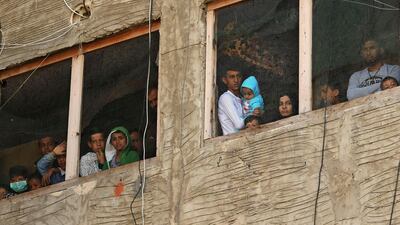
    Syrian refugees in a construction site they have been using as a shelter in the southern Lebanese city of Sidon as Lebanon enters lockdown to protect against coronavirus outbreaks, on March 17, 2020. AFP
  • Many child refugees are also living in the construction site. AFP
    Many child refugees are also living in the construction site. AFP
  • Refugees in Edirne, Turkey, near the border with Greece, wear protective face masks on March 10, 2020. Bloomberg
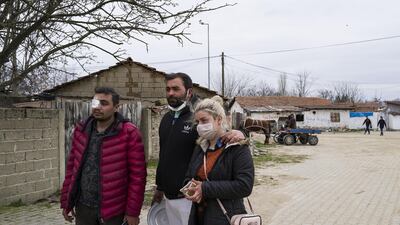
    Refugees in Edirne, Turkey, near the border with Greece, wear protective face masks on March 10, 2020. Bloomberg
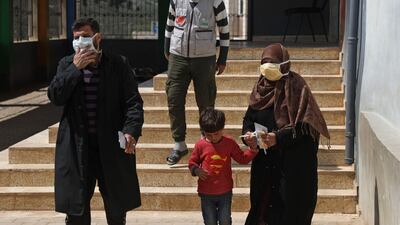
  • Afghan health workers check the temperatures of Afghan refugees returning at the Islam Qala border crossing with Iran on March 18, 2020. Tens of thousands of Afghan refugees are being expelled from Iran over the past few months. AP Photo
    Afghan health workers check the temperatures of Afghan refugees returning at the Islam Qala border crossing with Iran on March 18, 2020. Tens of thousands of Afghan refugees are being expelled from Iran over the past few months. AP Photo
  • An information poster on the coronavirus is secured to a fence among refugees from various African nations living on a city sidewalk in Cape Town, South Africa, on March 23 2020. EPA
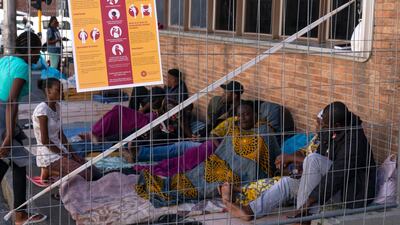
    An information poster on the coronavirus is secured to a fence among refugees from various African nations living on a city sidewalk in Cape Town, South Africa, on March 23 2020. EPA
  • A Palestinian boy sells cleaning tools and sanitisers amid concerns over the spread of coronavirus, at Beach Refugee Camp in Gaza City, Palestine, on March 22, 2020. Reuters
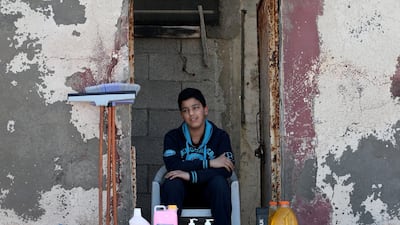
    A Palestinian boy sells cleaning tools and sanitisers amid concerns over the spread of coronavirus, at Beach Refugee Camp in Gaza City, Palestine, on March 22, 2020. Reuters
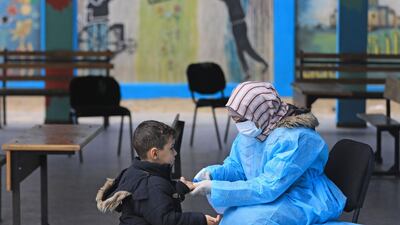
  • A Palestinian health worker checks the body temperature of a child at a United Nations Relief and Works Agency for Palestinian Refugees (UNRWA) school at Al Shati refugee camp in Gaza City, Palestine on March 18, 2020. AFP
    A Palestinian health worker checks the body temperature of a child at a United Nations Relief and Works Agency for Palestinian Refugees (UNRWA) school at Al Shati refugee camp in Gaza City, Palestine on March 18, 2020. AFP
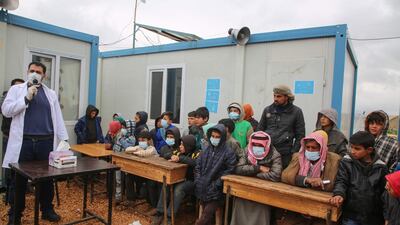
  • Displaced Syrians wear protective masks as they leave a lecture provided by staff from Turkey's Humanitarian Relief Foundation to raise awareness about the coronavirus pandemic at a refugee camp in Kafr Lusin, Syria, on March 23, 2020. AFP
    Displaced Syrians wear protective masks as they leave a lecture provided by staff from Turkey's Humanitarian Relief Foundation to raise awareness about the coronavirus pandemic at a refugee camp in Kafr Lusin, Syria, on March 23, 2020. AFP
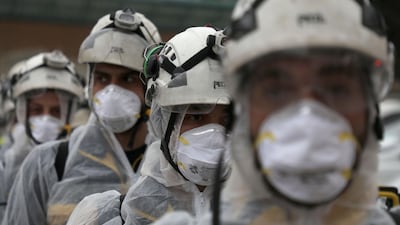
  • Members of the Syrian Civil Defence, also known as the 'White Helmets', sterilise a school in the area of Ghosn Al Zeitun in Afrin on March 18, 2020 as part of a campaign to disinfect schools against the coronavirus. AFP
    Members of the Syrian Civil Defence, also known as the 'White Helmets', sterilise a school in the area of Ghosn Al Zeitun in Afrin on March 18, 2020 as part of a campaign to disinfect schools against the coronavirus. AFP
  • A Syrian medic holds an awareness campaign on how to be protected against the coronavirus, in a camp for displaced people in Kafr Lusin, Syria, on March 18, 2020. AFP
    A Syrian medic holds an awareness campaign on how to be protected against the coronavirus, in a camp for displaced people in Kafr Lusin, Syria, on March 18, 2020. AFP

“If this pandemic has demonstrated something, it’s that no one is protected unless everyone is protected. Vaccines offer the opportunity we have been waiting for to have a chance at restarting our economies in full gear.

“But we have to use them wisely and strategically: we must vaccinate the most vulnerable first, no matter their nationality or their migration status, or we will all continue to pay a higher price than is necessary,” he said.

Dr Datta says it is a “universal truth” that infectious diseases “know no borders,” but the issue becomes even more critical for vulnerable population groups.

“These refugees or migrants, they’re moving around, they’re living in not so good conditions, the stress level is high there. The chances of getting an infection is quite high. You and I can wash our hands and have access to running water or using a mask or ensuring that you and I be separated with at least the physical distancing that we can maintain. Those conditions may not be there,” he said, referring to the informal camps many migrants live in.

“But then also, the mobility of these people in itself poses several problems,” he said.

Supplying the global community remains a pressing problem, but without including everyone in the immunisation push, pockets of unvaccinated people will be a major barrier to overcoming the virus.

“The equitable distribution of Covid-19 vaccines between and within countries is more than a moral imperative. It is the only way to solve the most pressing public health emergency of our time,” Mr Chapagain said.

“Without equal distribution, even those who are vaccinated will not be safe.”

Benefits of first-time home buyers' scheme
  • Priority access to new homes from participating developers
  • Discounts on sales price of off-plan units
  • Flexible payment plans from developers
  • Mortgages with better interest rates, faster approval times and reduced fees
  • DLD registration fee can be paid through banks or credit cards at zero interest rates

Baby Driver

Director: Edgar Wright

Starring: Ansel Elgort, Kevin Spacey, Jamie Foxx, Lily James

Three and a half stars

Tamkeen's offering
  • Option 1: 70% in year 1, 50% in year 2, 30% in year 3
  • Option 2: 50% across three years
  • Option 3: 30% across five years 
COMPANY%20PROFILE
%3Cp%3E%3Cstrong%3ECompany%3A%3C%2Fstrong%3E%20Eco%20Way%3Cbr%3E%3Cstrong%3EStarted%3A%3C%2Fstrong%3E%20December%202023%3Cbr%3E%3Cstrong%3EFounder%3A%3C%2Fstrong%3E%20Ivan%20Kroshnyi%3Cbr%3E%3Cstrong%3EBased%3A%3C%2Fstrong%3E%20Dubai%2C%20UAE%3Cbr%3E%3Cstrong%3EIndustry%3A%3C%2Fstrong%3E%20Electric%20vehicles%3Cbr%3E%3Cstrong%3EInvestors%3A%3C%2Fstrong%3E%20Bootstrapped%20with%20undisclosed%20funding.%20Looking%20to%20raise%20funds%20from%20outside%3Cbr%3E%3C%2Fp%3E%0A
The President's Cake

Director: Hasan Hadi

Starring: Baneen Ahmad Nayyef, Waheed Thabet Khreibat, Sajad Mohamad Qasem 

Rating: 4/5

Who was Alfred Nobel?

The Nobel Prize was created by wealthy Swedish chemist and entrepreneur Alfred Nobel.

  • In his will he dictated that the bulk of his estate should be used to fund "prizes to those who, during the preceding year, have conferred the greatest benefit to humankind".
  • Nobel is best known as the inventor of dynamite, but also wrote poetry and drama and could speak Russian, French, English and German by the age of 17. The five original prize categories reflect the interests closest to his heart.
  • Nobel died in 1896 but it took until 1901, following a legal battle over his will, before the first prizes were awarded.
Ten tax points to be aware of in 2026

1. Domestic VAT refund amendments: request your refund within five years

If a business does not apply for the refund on time, they lose their credit.

2. E-invoicing in the UAE

Businesses should continue preparing for the implementation of e-invoicing in the UAE, with 2026 a preparation and transition period ahead of phased mandatory adoption. 

3. More tax audits

Tax authorities are increasingly using data already available across multiple filings to identify audit risks. 

4. More beneficial VAT and excise tax penalty regime

Tax disputes are expected to become more frequent and more structured, with clearer administrative objection and appeal processes. The UAE has adopted a new penalty regime for VAT and excise disputes, which now mirrors the penalty regime for corporate tax.

5. Greater emphasis on statutory audit

There is a greater need for the accuracy of financial statements. The International Financial Reporting Standards standards need to be strictly adhered to and, as a result, the quality of the audits will need to increase.

6. Further transfer pricing enforcement

Transfer pricing enforcement, which refers to the practice of establishing prices for internal transactions between related entities, is expected to broaden in scope. The UAE will shortly open the possibility to negotiate advance pricing agreements, or essentially rulings for transfer pricing purposes. 

7. Limited time periods for audits

Recent amendments also introduce a default five-year limitation period for tax audits and assessments, subject to specific statutory exceptions. While the standard audit and assessment period is five years, this may be extended to up to 15 years in cases involving fraud or tax evasion. 

8. Pillar 2 implementation 

Many multinational groups will begin to feel the practical effect of the Domestic Minimum Top-Up Tax (DMTT), the UAE's implementation of the OECD’s global minimum tax under Pillar 2. While the rules apply for financial years starting on or after January 1, 2025, it is 2026 that marks the transition to an operational phase.

9. Reduced compliance obligations for imported goods and services

Businesses that apply the reverse-charge mechanism for VAT purposes in the UAE may benefit from reduced compliance obligations. 

10. Substance and CbC reporting focus

Tax authorities are expected to continue strengthening the enforcement of economic substance and Country-by-Country (CbC) reporting frameworks. In the UAE, these regimes are increasingly being used as risk-assessment tools, providing tax authorities with a comprehensive view of multinational groups’ global footprints and enabling them to assess whether profits are aligned with real economic activity. 

Contributed by Thomas Vanhee and Hend Rashwan, Aurifer

Our family matters legal consultant

Name: Hassan Mohsen Elhais

Position: legal consultant with Al Rowaad Advocates and Legal Consultants.

MATCH INFO

Syria v Australia
2018 World Cup qualifying: Asia fourth round play-off first leg
Venue: Hang Jebat Stadium (Malacca, Malayisa)
Kick-off: Thursday, 4.30pm (UAE)
Watch: beIN Sports HD

* Second leg in Australia scheduled for October 10

The Settlers

Director: Louis Theroux

Starring: Daniella Weiss, Ari Abramowitz

Rating: 5/5

Essentials
The flights

Return flights from Dubai to Windhoek, with a combination of Emirates and Air Namibia, cost from US$790 (Dh2,902) via Johannesburg.
The trip
A 10-day self-drive in Namibia staying at a combination of the safari camps mentioned – Okonjima AfriCat, Little Kulala, Desert Rhino/Damaraland, Ongava – costs from $7,000 (Dh25,711) per person, including car hire (Toyota 4x4 or similar), but excluding international flights, with The Luxury Safari Company.
When to go
The cooler winter months, from June to September, are best, especially for game viewing. 

Our legal consultant

Name: Hassan Mohsen Elhais

Position: legal consultant with Al Rowaad Advocates and Legal Consultants.

THE BIO

Bio Box

Role Model: Sheikh Zayed, God bless his soul

Favorite book: Zayed Biography of the leader

Favorite quote: To be or not to be, that is the question, from William Shakespeare's Hamlet

Favorite food: seafood

Favorite place to travel: Lebanon

Favorite movie: Braveheart

Tearful appearance

Chancellor Rachel Reeves set markets on edge as she appeared visibly distraught in parliament on Wednesday. 

Legislative setbacks for the government have blown a new hole in the budgetary calculations at a time when the deficit is stubbornly large and the economy is struggling to grow. 

She appeared with Keir Starmer on Thursday and the pair embraced, but he had failed to give her his backing as she cried a day earlier.

A spokesman said her upset demeanour was due to a personal matter.

A%20QUIET%20PLACE
%3Cp%3E%3Cstrong%3EStarring%3A%3C%2Fstrong%3E%20Lupita%20Nyong'o%2C%20Joseph%20Quinn%2C%20Djimon%20Hounsou%3C%2Fp%3E%0A%3Cp%3E%3Cstrong%3EDirector%3A%20%3C%2Fstrong%3EMichael%20Sarnoski%3C%2Fp%3E%0A%3Cp%3E%3Cstrong%3ERating%3A%3C%2Fstrong%3E%204%2F5%3C%2Fp%3E%0A


Manchester City 4
Otamendi (52) Sterling (59) Stones (67) Brahim Diaz (81)

Real Madrid 1
Oscar (90)

The biog

Alwyn Stephen says much of his success is a result of taking an educated chance on business decisions.

His advice to anyone starting out in business is to have no fear as life is about taking on challenges.

“If you have the ambition and dream of something, follow that dream, be positive, determined and set goals.

"Nothing and no-one can stop you from succeeding with the right work application, and a little bit of luck along the way.”

Mr Stephen sells his luxury fragrances at selected perfumeries around the UAE, including the House of Niche Boutique in Al Seef.

He relaxes by spending time with his family at home, and enjoying his wife’s India cooking. 

It Was Just an Accident

Director: Jafar Panahi

Stars: Vahid Mobasseri, Mariam Afshari, Ebrahim Azizi, Hadis Pakbaten, Majid Panahi, Mohamad Ali Elyasmehr

Rating: 4/5

THE SPECS

Engine: 3.5-litre supercharged V6

Power: 416hp at 7,000rpm

Torque: 410Nm at 3,500rpm

Transmission: 6-speed manual

Fuel consumption: 10.2 l/100km

Price: Dh375,000 

On sale: now 

Company Fact Box

Company name/date started: Abwaab Technologies / September 2019

Founders: Hamdi Tabbaa, co-founder and CEO. Hussein Alsarabi, co-founder and CTO

Based: Amman, Jordan

Sector: Education Technology

Size (employees/revenue): Total team size: 65. Full-time employees: 25. Revenue undisclosed

Stage: early-stage startup 

Investors: Adam Tech Ventures, Endure Capital, Equitrust, the World Bank-backed Innovative Startups SMEs Fund, a London investment fund, a number of former and current executives from Uber and Netflix, among others.

UAE central contracts

Full time contracts

Rohan Mustafa, Ahmed Raza, Mohammed Usman, Chirag Suri, Mohammed Boota, Sultan Ahmed, Zahoor Khan, Junaid Siddique, Waheed Ahmed, Zawar Farid

Part time contracts

Aryan Lakra, Ansh Tandon, Karthik Meiyappan, Rahul Bhatia, Alishan Sharafu, CP Rizwaan, Basil Hameed, Matiullah, Fahad Nawaz, Sanchit Sharma

What is blockchain?

Blockchain is a form of distributed ledger technology, a digital system in which data is recorded across multiple places at the same time. Unlike traditional databases, DLTs have no central administrator or centralised data storage. They are transparent because the data is visible and, because they are automatically replicated and impossible to be tampered with, they are secure.

The main difference between blockchain and other forms of DLT is the way data is stored as ‘blocks’ – new transactions are added to the existing ‘chain’ of past transactions, hence the name ‘blockchain’. It is impossible to delete or modify information on the chain due to the replication of blocks across various locations.

Blockchain is mostly associated with cryptocurrency Bitcoin. Due to the inability to tamper with transactions, advocates say this makes the currency more secure and safer than traditional systems. It is maintained by a network of people referred to as ‘miners’, who receive rewards for solving complex mathematical equations that enable transactions to go through.

However, one of the major problems that has come to light has been the presence of illicit material buried in the Bitcoin blockchain, linking it to the dark web.

Other blockchain platforms can offer things like smart contracts, which are automatically implemented when specific conditions from all interested parties are reached, cutting the time involved and the risk of mistakes. Another use could be storing medical records, as patients can be confident their information cannot be changed. The technology can also be used in supply chains, voting and has the potential to used for storing property records.

MOUNTAINHEAD REVIEW

Starring: Ramy Youssef, Steve Carell, Jason Schwartzman

Director: Jesse Armstrong

Rating: 3.5/5

Results

6.30pm Madjani Stakes Rated Conditions (PA) I Dh160,000 1,900m I Winner: Mawahib, Tadhg O’Shea (jockey), Eric Lemartinel (trainer)

7.05pm Maiden Dh150,000 1,400m I Winner One Season, Antonio Fresu, Satish Seemar

7.40pm: Maiden Dh150,000 2,000m I Winner Street Of Dreams, Pat Dobbs, Doug Watson

8.15pm Dubai Creek Listed Dh250,000 1,600m I Winner Heavy Metal, Royston Ffrench, Salem bin Ghadayer

8.50pm The Entisar Listed Dh250,000 2,000m I Winner Etijaah, Dane O’Neill, Doug Watson

9.25pm The Garhoud Listed Dh250,000 1,200m Winner Muarrab, Dane O’Neill, Ali Rashid Al Raihe

10pm Handicap Dh160,000 1,600m Winner Sea Skimmer, Patrick Cosgrave, Helal Al Alawi

Specs

Engine: Dual-motor all-wheel-drive electric

Range: Up to 610km

Power: 905hp

Torque: 985Nm

Price: From Dh439,000

Available: Now


The specs

Engine: 2.0-litre 4cyl turbo

Power: 261hp at 5,500rpm

Torque: 405Nm at 1,750-3,500rpm

Transmission: 9-speed auto

Fuel consumption: 6.9L/100km

On sale: Now

Price: From Dh117,059

GAC GS8 Specs

Engine: 2.0-litre 4cyl turbo

Power: 248hp at 5,200rpm

Torque: 400Nm at 1,750-4,000rpm

Transmission: 8-speed auto

Fuel consumption: 9.1L/100km

On sale: Now

Price: From Dh149,900