
Britain’s Health Secretary Matt Hancock has clashed with a leading scientist who said the government’s delay in implementing lockdown to contain the coronavirus outbreak “cost a lot of lives” and that easing the lockdown now would risk a second peak.
Professor John Edmunds, a member of the government's Scientific Advisory Group for Emergencies (Sage), expressed regret on Sunday that the government did not act sooner.
“I wish had gone into lockdown earlier. I think that’s cost a lot of lives unfortunately,” he said.
Speaking about the easing of the lockdown, Prof Edmunds, an epidemiologist at the London School of Hygiene and Tropical Medicine, said: “If we relax, this epidemic will come back really fast.”
In a significant shift in government approach to Covid-19, Prime Minister Boris Johnson has ordered ministers to lift Britain’s lockdown as quickly as possible to protect against the possible loss of 3.5 million jobs.
But many leading scientists have said that the infection rate is still too high to fully relax social distancing measures. Prof Edmunds warned that the virus reproduction rate – or R value – was still close to one in some parts of the UK, despite being under one on average nationwide. If the R rate is 1 or above, it means that the virus is spreading on average to one other person per sufferer.
Mr Hancock hit back at the professor’s comments on Sunday, insisting: “We took the right decisions at the right time.” He denied that the lockdown had been imposed too late and declined to dispute whether the timing it was implemented had “cost lives”.
“There are others [on Sage] who make different scientific arguments,” he said, without naming any when challenged to do so.
“I’m sure, taking into account everything we knew at that moment, my view is that we took the right decisions at the right time.”
He added: “There’s a broad range on Sage of scientific opinion and we were guided by the science, which means guided by the balance of that opinion – as expressed to ministers through the chief medical officer and the chief scientific adviser. That’s the right way for it to have been done.”
-
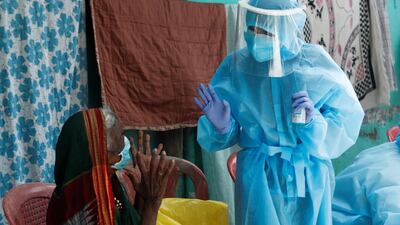
A healthcare worker speaks to a resident about Covid-19 at a check up camp in Dharavi, one of Asia's largest slums, Mumbai, India. Reuters -
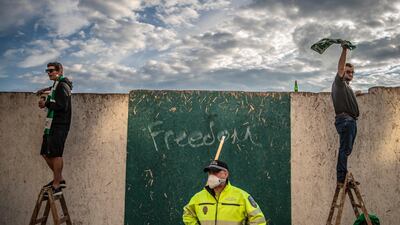
Fans of Bohemians Prague stand on ladders as they prepare to watch the Czech first league soccer match between Bohemians Prague and Sparta Prague behind fence in Prague, Czech. EPA -
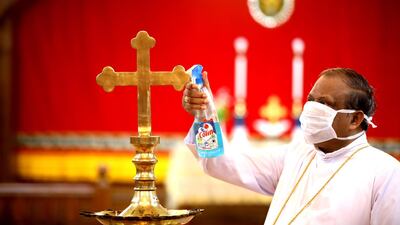
A Christian priest cleans the church area as places of worship were allowed to re-open with strict guidelines from 8 June, in, Bhopal, India. EPA -

An employee wearing a protective face mask checks the temperature of a visitor at the entrance at a restaurant along a pedestrian street in central Tbilisi. Cafes and restaurants re-opened in Georgia's capital last week. AFP -
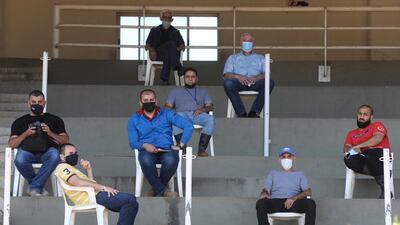
Hostlers and horse coaches wear face masks as they practice social distancing during a horse race at Beirut Hippodrome, as Lebanon re-opened its horse racing tracks, in Beirut, Lebanon. Reuters -

Musicians perform next to Spanish artist Diego Velazquez's paintings as the Prado museum reopens in Madrid, Spain. Reuters -

People enjoy a water slide in Yongin, South Korea. Reuters -
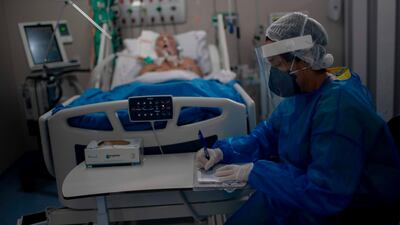
A nurse works at the Intensive Care Unit ward where patients infected with coronavirus are being treated at the Doctor Ernesto Che Guevara Public Hospital in Marica city, state of Rio de Janeiro, Brazil. AFP -
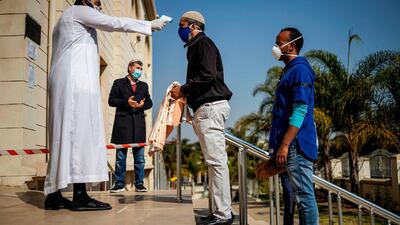
A man has his temperature checked at the entrance of the Nizamiye Mosque ahead of the Friday prayer in Midrand, Johannesburg. AFP


Britain has been one of the hardest hit countries from coronavirus in the world, with 40,542 people dying from Covid-19 and 286,194 positive cases.
In the last 24 hours, it confirmed 1,326 new cases of coronavirus and 77 more deaths.
This week, the British government plans to announce relaxing measures to allow cafes, pubs and restaurants to use outside areas. Non-essential shops and places of worship will open for private prayer on June 15.
Restrictions on weddings and funerals will go, so that up to 10 people to attend indoors from early July.

