
Dealing with a pandemic as serious and as widespread as Covid-19 requires scientific collaboration, a medical director at Sanofi has told The National.
The Paris-based pharmaceutical firm, which worked on a vaccine for SARS, another type of coronavirus, is planning to leverage its previous experience with that candidate to work on two different vaccines to Covid-19.
Sanofi is part of the greatest race for a vaccine the world has ever seen, driven by the urgency of the Covid-19 pandemic, which has claimed the lives of more than 163,000 people so far and infected over 2.3 million.
Millions have been praying for a vaccine and at least 78 candidates for the virus are known to be in development, four of which have reached human trials — two each from China and the United States.
“Dealing with a pandemic as daunting as Covid-19 requires collaboration,” said Lilya Ziad, Country Medical Chair for Gulf and KSA at Sanofi.
“Viruses mutate and can sometimes be harmless or sometimes be dangerous, like Covid-19. A vaccine needs to be tailor-made to that strain. Developing a vaccine from scratch takes years, but we can leverage what we have learned from previous efforts and potentially shorten the development timeline,” she added.
-
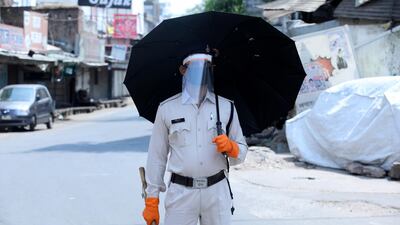
An Indian policeman patrols the streets during coronavirus lockdown in Bhopal, India. EPA -

A sign encouraging people to stay at home is displayed on a busstop along Victoria Street, central London. AFP -

A man wears a protective face mask whilst travelling on the London Underground. Reuters -

A man plays the guitar outside his apartment next to a deserted canal in Venice, Italy. Reuters -
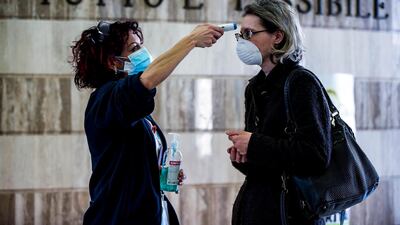
A woman has her temperature checked at the entrance of the IFO Regina Elena and San Gallicano hospital in Rome, Italy. EPA -
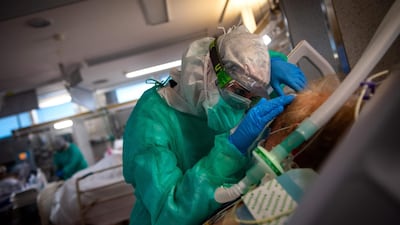
A healthcare worker attends to a Covid-19 patient at the Intensive Unit Care of the Povisa Hospital in Vigo, northwestern Spain. AFP -

The 30 Rockefeller Plaza tower in Manhattan is seen illuminated in blue as part of the "Light It Blue" initiative to honor healthcare workers in New York. Reuters -

A Buddhist monk collects alms at an outdoor market in Bangkok, Thailand. AFP -
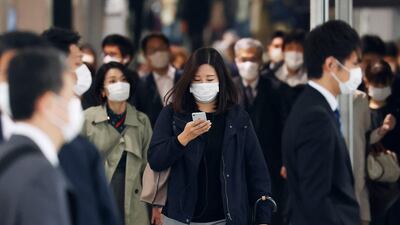
Commuters make their way at Nagoya station in Japan. Kyodo News via AP -

A first responder in a dinosaur costume greets healthcare workers during a shift change along with Bothell firefighters at the Evergreen Health Medical Center, in Kirkland, Washington, USA. Reuters -
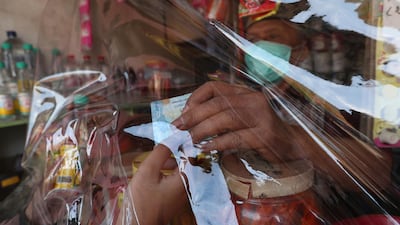
A shop owner receives money from a customer behind a sheet of protective plastic at a convenience store in South Tangerang on the outskirts of Jakarta, Indonesia. AP Photo -
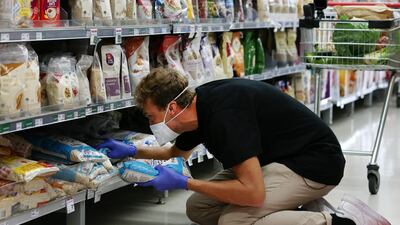
Volunteer Rupert Stobo shops at the grocery store for someone in need in Auckland, New Zealand. Getty Images -

A member of the military stands guard as Venezuelans board a bus back to their homes after being quarantined at the Colombian border in Urena, Tachira, Venezuela. EPA -

Sydney FC A-League player Anthony Caceres trains by himself at Bondi Beach on April 17, 2020 in Sydney, Australia. Getty Images -

A man is seen lying on the floor near of empty boxes that will be used to distribute food for free in Jakarta, Indonesia. Reuters -
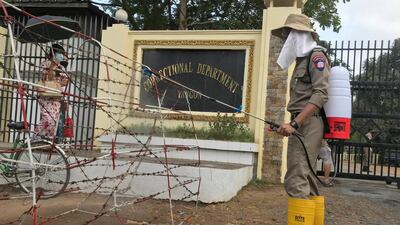
A health worker sprays disinfectant as people gather outside Insein prison waiting for the release of prisoners in Yangon, Myanmar. Reuters -

A person waits for a flight at the Tom Bradley Terminal at Los Angeles International Airport in Los Angeles. AFP -
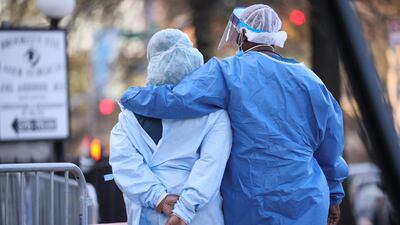
Medical workers walk during a short break at Maimonides Medical Center in the Brooklyn borough of New York, USA. Reuters


GSK recombinant DNA candidate
On Tuesday, Sanofi announced that it will join forces with GlaxoSmithKline to work on a vaccine for Covid-19. Sanofi will contribute its S-protein Covid-19 antigen, which is based on DNA technology. This technology has produced an exact genetic match to proteins found on the surface of the virus and helped produce Sanofi’s licensed recombinant influenza product in the US.
GSK will contribute its adjuvant technology. The use of an adjuvant can reduce the amount of vaccine protein required per dose, allowing more vaccine doses to be produced and therefore contributing to protect more people – helpful in a pandemic. An adjuvant is added to some vaccines to enhance the immune response, and has been shown to create a stronger and longer lasting immunity against infections than the vaccine alone. It can also improve the likelihood of delivering an effective vaccine that can be manufactured at scale.
The combination of a protein-based antigen together with an adjuvant, is a well-established technique that has been used in a number of vaccines – including those diphtheria, tetanus and Sanofi’s flu vaccine.
The companies plan to the carry out the first phase of clinical trials in the second half of 2020 and, if successful, aim to complete the development required for availability by the second half of 2021.
“Research and materials can be produced relatively quickly for clinical testing because we have a licensed vaccine based on this platform, and we have the capacity to manufacture large quantities of the vaccine candidate,” Ms Ziad said.
This is not the first time GSK and Sanofi have worked together. They had been working on a trial of an experimental HIV vaccine, but it was abandoned in February after an interim analysis of the data suggested it was no more effective than placebo at preventing infections. Sanofi is hoping its latest collaboration will see more success.
Translate Bio mRNA candidate
A virus particle is spherical in shape, with dozens of spikes on its surface. When it attacks a human by entering through the eyes, mouth or nose, these spikes will attach to a protein called ACE2, found on the surface of cells in the respiratory tract.
Once the spike has latched onto the protein, it injects a its own RNA, a genetic material similar to DNA that transforms instructions from it and forms proteins for the body.
But the virus essentially tricks the infected cell, which reads its own RNA instructions as if they were its own. The cell then produces millions of copies of the virus before it breaks down. This cycle repeats until the body is able to battle the virus or the person succumbs to it.
RNA is key to Sanofi’s other candidate for Covid-19 with Massachusetts-based clinical-stage messenger RNA (mRNA) therapeutics company Translatebio. It hopes to be clinic ready as soon by the end of this year and available on the market by the end of 2021.
Translate Bio has begun to produce multiple mRNA constructs and will use its mRNA platform to discover, design, and manufacture a number of SARS-CoV-2 vaccine candidates. Sanofi will use its previous vaccine experience and support from its external research networks to advance vaccine candidates for potential further development.
“Build-out is underway of dedicated manufacturing space through a contract manufacturing partner to accommodate two 250-gram batches per month. Depending on the final human dose, the mRNA platform of Translate Bio has excellent promise to meet the future demands for a pandemic response,” Ms Ziad said.
A European authority
The US-based Biomedical Advanced Research and Development Authority (BARDA) was established to protect the public from chemical, biological, radiological, and nuclear (CBRN) threats, as well as from pandemic influenza and emerging infectious diseases. There is currently no European equivalent to BARDA but Sanofi is calling on policymakers to form one to work with the industry and help accelerate developing a treatment for Covid-19 and other illnesses.
Sanofi is also cooperating with the Coalition for Epidemic Preparedness Innovations (CEPI), which launched in early 2017 in Davos and the Bill and Melinda Gates Foundation to try to augment the response to the pandemic.
“We are in weekly contact with the European Commission and EMA to help them monitor the impact of Covid-19 on the supply of medicines and vaccines in Europe,” Ms Ziad said.
“As part of these discussions, we are urging authorities to: ensure the free circulation of medicinal products, grant priority access to masks and sanitizers to the pharmaceutical industry (in addition to health staff) to ensure the supply of medicinal products, and limit demands for mandatory stock building to ensure access to critical medicines to all.”
In the short-term, Sanofi is looking into treatment options.
“While a vaccine could be more than a year away, we are currently investigating two Sanofi products for the management of COVID-19 - Plaquenil and Kevzara, with the appropriate regulatory authorities.”

