Anger at Italy's plan for 60,000 coronavirus enforcement volunteers


Simon Rushton
  • English
  • Arabic

Plans to recruit 60,000 volunteers to help people to follow social distancing orders have become a flashpoint within Italy’s governing coalition.

Prime Minster Giuseppe Conte was forced to emphasise that civic assistants "will not be in charge of public service and their activity will have nothing to do with the activities traditionally assigned to the police force”.

There is great concern among Italian politicians and scientists that without social distancing measures, the country, one of the worst-hit, could suffer another spike in Covid-19 deaths as it takes steps to reopen.

There is also concern that the civic assistants are not the answer to the challenges that come with social distancing and wearing face masks.

The Five Star Movement, the smaller party in Italy's ruling coalition, and government departments expressed anger after the plan was made public.

Industry Minister Stefano Buffagni, from Five Star, wrote on Facebook that his group had not been consulted and that he was "absolutely against" the plan.

The interior ministry said it was not consulted on the plan for civic assistants.

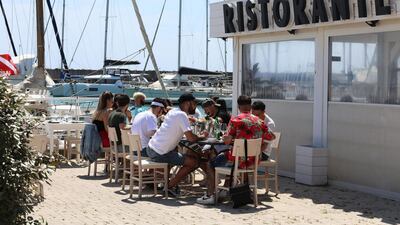
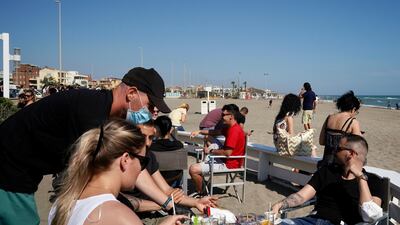
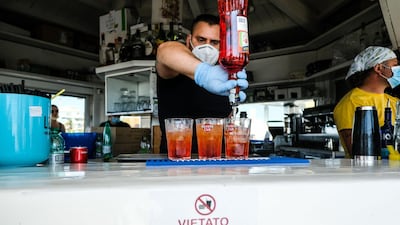
Italy allowed bars and restaurants to open up last week, the most recent phase in reopening the country's economy.

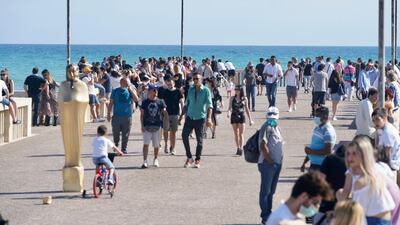
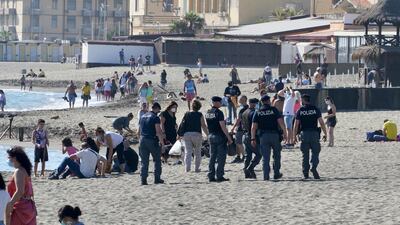
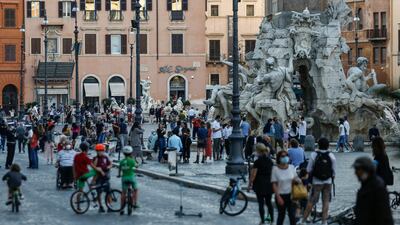
In Naples, Rome, and other cities at the weekend, people crowded beaches, bridges and squares.

“The appeal to common sense hasn’t worked,” said Francesco Lupoli, the mayor of Pulsano in southeastern Apulia region.

On Monday, Milan was among the cities imposing new restrictions, banning the sale of takeaway alcohol after 7pm, and a mayor in Puglia closed a beach after what he called “the invasion of last weekend”.

Announcing the plan for up to 60,000 volunteer civic assistants, Minister for Regional Affairs Francesco Boccia said they would enforce anti-coronavirus orders.

“It is to the volunteers that we want to entrust our communities in this new and complex phase: the one in which we try to live with the virus and we learn to defend ourselves, even by returning to a life less compressed by the prohibitions.

“We can only get out of this emergency by being united and collaborating, with a sense of responsibility.”

On Monday, Mr Boccia said: “It is understandable and human, after two months, to want to leave one's house, but we must not forget that we are still facing the Covid-19 threat.”


Kandahar%20
%3Cp%3E%3Cstrong%3EDirector%3A%3C%2Fstrong%3E%20Ric%20Roman%20Waugh%3C%2Fp%3E%0A%3Cp%3E%3Cstrong%3EStars%3A%C2%A0%3C%2Fstrong%3EGerard%20Butler%2C%20Navid%20Negahban%2C%20Ali%20Fazal%3C%2Fp%3E%0A%3Cp%3E%3Cstrong%3ERating%3A%3C%2Fstrong%3E%202.5%2F5%3C%2Fp%3E%0A
Company%20profile
%3Cp%3E%3Cstrong%3ECompany%20name%3A%20%3C%2Fstrong%3EHakbah%0D%3Cbr%3E%3Cstrong%3EStarted%3A%20%3C%2Fstrong%3E2018%0D%3Cbr%3E%3Cstrong%3EFounder%3A%20%3C%2Fstrong%3ENaif%20AbuSaida%0D%3Cbr%3E%3Cstrong%3EBased%3A%20%3C%2Fstrong%3ESaudi%20Arabia%0D%3Cbr%3E%3Cstrong%3ESector%3A%20%3C%2Fstrong%3EFinTech%0D%3Cbr%3E%3Cstrong%3ECurrent%20number%20of%20staff%3A%20%3C%2Fstrong%3E22%20%0D%3Cbr%3E%3Cstrong%3EInitial%20investment%3A%20%3C%2Fstrong%3E%24200%2C000%0D%3Cbr%3E%3Cstrong%3EInvestment%20stage%3A%20%3C%2Fstrong%3Epre-Series%20A%0D%3Cbr%3E%3Cstrong%3EInvestors%3A%20%3C%2Fstrong%3EGlobal%20Ventures%20and%20Aditum%20Investment%20Management%0D%3Cbr%3E%3Cbr%3E%3C%2Fp%3E%0A

Mercer, the investment consulting arm of US services company Marsh & McLennan, expects its wealth division to at least double its assets under management (AUM) in the Middle East as wealth in the region continues to grow despite economic headwinds, a company official said.

Mercer Wealth, which globally has $160 billion in AUM, plans to boost its AUM in the region to $2-$3bn in the next 2-3 years from the present $1bn, said Yasir AbuShaban, a Dubai-based principal with Mercer Wealth.

Within the next two to three years, we are looking at reaching $2 to $3 billion as a conservative estimate and we do see an opportunity to do so,” said Mr AbuShaban.

Mercer does not directly make investments, but allocates clients’ money they have discretion to, to professional asset managers. They also provide advice to clients.

“We have buying power. We can negotiate on their (client’s) behalf with asset managers to provide them lower fees than they otherwise would have to get on their own,” he added.

Mercer Wealth’s clients include sovereign wealth funds, family offices, and insurance companies among others.

From its office in Dubai, Mercer also looks after Africa, India and Turkey, where they also see opportunity for growth.

Wealth creation in Middle East and Africa (MEA) grew 8.5 per cent to $8.1 trillion last year from $7.5tn in 2015, higher than last year’s global average of 6 per cent and the second-highest growth in a region after Asia-Pacific which grew 9.9 per cent, according to consultancy Boston Consulting Group (BCG). In the region, where wealth grew just 1.9 per cent in 2015 compared with 2014, a pickup in oil prices has helped in wealth generation.

BCG is forecasting MEA wealth will rise to $12tn by 2021, growing at an annual average of 8 per cent.

Drivers of wealth generation in the region will be split evenly between new wealth creation and growth of performance of existing assets, according to BCG.

Another general trend in the region is clients’ looking for a comprehensive approach to investing, according to Mr AbuShaban.

“Institutional investors or some of the families are seeing a slowdown in the available capital they have to invest and in that sense they are looking at optimizing the way they manage their portfolios and making sure they are not investing haphazardly and different parts of their investment are working together,” said Mr AbuShaban.

Some clients also have a higher appetite for risk, given the low interest-rate environment that does not provide enough yield for some institutional investors. These clients are keen to invest in illiquid assets, such as private equity and infrastructure.

“What we have seen is a desire for higher returns in what has been a low-return environment specifically in various fixed income or bonds,” he said.

“In this environment, we have seen a de facto increase in the risk that clients are taking in things like illiquid investments, private equity investments, infrastructure and private debt, those kind of investments were higher illiquidity results in incrementally higher returns.”

The Abu Dhabi Investment Authority, one of the largest sovereign wealth funds, said in its 2016 report that has gradually increased its exposure in direct private equity and private credit transactions, mainly in Asian markets and especially in China and India. The authority’s private equity department focused on structured equities owing to “their defensive characteristics.”

UAE currency: the story behind the money in your pockets