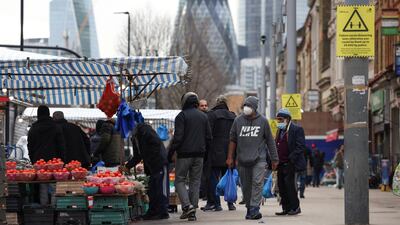
A further 1.7 million people have been asked to shield in England. Reuters

Additional 1.7m people told to shield in England under new Covid risk model


  • English
  • Arabic

An additional 1.7 million people have been asked to shield in England after scientists developed a new model to identify people at risk of serious illness from Covid-19.

It means almost four million people in the country have been asked to shield, with 2.3 million already on the list before Tuesday’s announcement.

Shielding – whereby a person should take extra precautions to protect themselves, such as avoiding crowds and staying at home as much as possible – will run until March 31 at the earliest.

Those newly identified as being at serious risk from Covid-19 will be pushed up the priority list for vaccines if they have not been offered one.

In an attempt to determine who is at higher risk of dying from Covid-19, the new model developed by Oxford University takes into account factors other than health, such as weight, age, ethnicity and postcode.

The Department of Health and Social Care said that the new group includes 800,000 adults aged between 19 and 69 who will now be prioritised for vaccines. The 900,000 others were already prioritised for inoculation.

Dr Jenny Harries, deputy chief medical officer for England, said the approach was "risk-averse" to "protect as many people as possible".

The UK recorded 10,625 new coronavirus cases and 799 deaths on Tuesday.

In the Netherlands, Prime Minister Mark Rutte called on his country to respect a night-time curfew after a court ruled the policy lacked legal basis.

The Hague District Court called the curfew a “far-reaching breach of the right to freedom of movement and privacy”.

Dutch Prime Minister Mark Rutte urged his country to keep following the night-time curfew despite a court ruling it illegal. Reuters

The court said the government, which said it would appeal against the ruling, had failed to make clear why it was necessary to use emergency powers at this stage of the pandemic.

Mr Rutte insisted that the curfew was needed to prevent a surge in infections caused by more transmissible variants.

"It would be very unwise to lift the curfew at this moment," he said. "We installed it in order to control the coronavirus as much as possible and to make it possible to regain our freedom in a safe way."

The measure, which allows only people with a pressing need to be outdoors between 9pm and 4.30am, was extended last week until March 3 at the earliest.

In Germany, Economy Minister Peter Altmaier said that he would lay out a path for easing lockdown measures to address the concerns of struggling businesses.

Frustration boiled over after authorities last week failed to reveal a strategy to reopen hotels, restaurants and shops.

Hard-hit firms also accused the government of botching aid payments and causing unnecessary delays in distributing the cash.

“The despair is growing and it’s increasingly leading to anger,” German hotel and restaurant association head Guido Zoellick said.

Meanwhile, the EU’s executive arm wants to adapt existing vaccine contracts and strike new agreements with pharmaceutical companies to protect against Covid-19 variants.

The contracts would include safeguards to avoid earlier missteps that tarnished the current vaccine distribution plan.

"Existing agreements may have to be updated to cover protection against variants," the document reads. "Based on the lessons learned, a detailed and credible plan showing capability to produce vaccines in the EU if needed."

The proposal, which is subject to change, is to be published on Wednesday.

In pictures - coronavirus across Europe

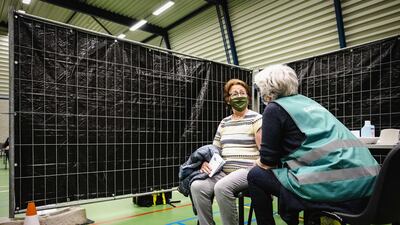
  • A healthcare worker administers a vaccine in Ameland, the Netherlands. The vaccination of the elderly and care workers has started on the Frisian Wadden Islands. EPA
    A healthcare worker administers a vaccine in Ameland, the Netherlands. The vaccination of the elderly and care workers has started on the Frisian Wadden Islands. EPA
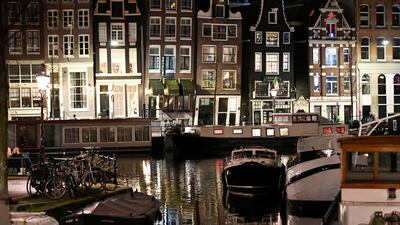
  • A general view ahead of a curfew in quiet Amsterdam, the Netherlands. Reuters
    A general view ahead of a curfew in quiet Amsterdam, the Netherlands. Reuters
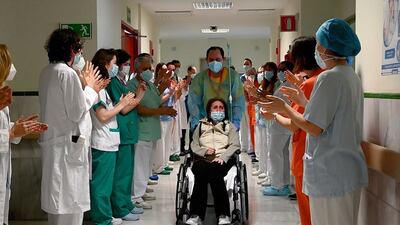
  • Elsa, a Covid-19 patient who was has been in hospital for 315 days, is applauded as she is discharged from the hospital in Madrid, Spain. EPA
    Elsa, a Covid-19 patient who was has been in hospital for 315 days, is applauded as she is discharged from the hospital in Madrid, Spain. EPA
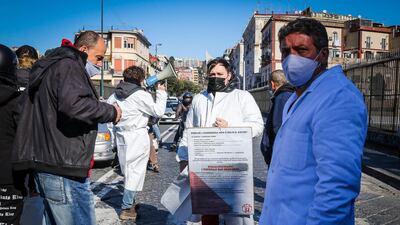
  • Doctors of the San Gennaro hospital protest and briefly block a road calling for the redevelopment of the hospital and the reopening of the emergency room in Naples, Italy. EPA
    Doctors of the San Gennaro hospital protest and briefly block a road calling for the redevelopment of the hospital and the reopening of the emergency room in Naples, Italy. EPA
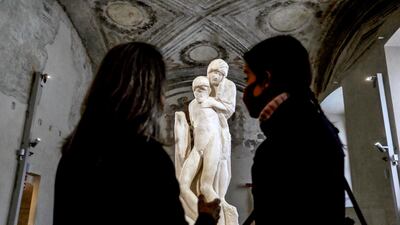
  • The 'Pieta Rondanini,' a marble work by Michelangelo on display at the Museum of the Sforzesco Castle in Milan, Italy. The sculpture can be seen again after the closures due to the coronavirus were lifted. EPA
    The 'Pieta Rondanini,' a marble work by Michelangelo on display at the Museum of the Sforzesco Castle in Milan, Italy. The sculpture can be seen again after the closures due to the coronavirus were lifted. EPA
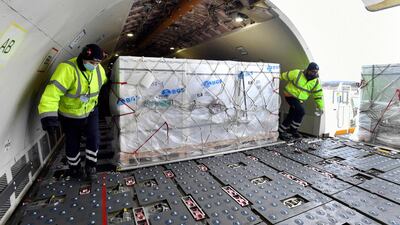
  • Workers unload the cargo of a Hungarian Airbus 330 plane, having transported the first doses of the Chinese Sinopharm vaccine at Budapest Ferenc Liszt International Airport. AFP
    Workers unload the cargo of a Hungarian Airbus 330 plane, having transported the first doses of the Chinese Sinopharm vaccine at Budapest Ferenc Liszt International Airport. AFP
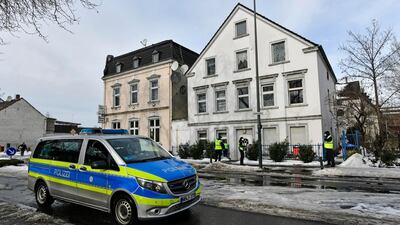
  • Police and security patrols at residential buildings that are placed under quarantine in Hamm, western Germany. AP Photo
    Police and security patrols at residential buildings that are placed under quarantine in Hamm, western Germany. AP Photo
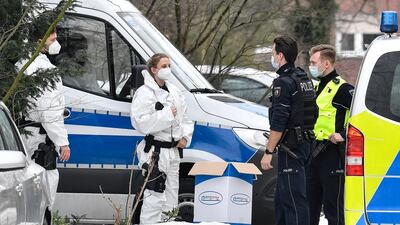
  • An on-site construction worker living in the buildings in Hamm tested positive for the mutated strain, which first emerged in Britain. AP Photo
    An on-site construction worker living in the buildings in Hamm tested positive for the mutated strain, which first emerged in Britain. AP Photo
  • A person walks inside the Covid-19 vaccination village at the Brussels Expo exposition halls on its inauguration day in Belgium. AFP
    A person walks inside the Covid-19 vaccination village at the Brussels Expo exposition halls on its inauguration day in Belgium. AFP
  • People wait to receive the vaccine at the Brussels Expo halls. AFP
    People wait to receive the vaccine at the Brussels Expo halls. AFP
  • A nurse tries to work as all computers are rendered out of service following a cyber attack at the Villefranche-sur-Saone's hospital in France. AFP
    A nurse tries to work as all computers are rendered out of service following a cyber attack at the Villefranche-sur-Saone's hospital in France. AFP
ELIO

Starring: Yonas Kibreab, Zoe Saldana, Brad Garrett

Directors: Madeline Sharafian, Domee Shi, Adrian Molina

Rating: 4/5

Three ways to limit your social media use

Clinical psychologist, Dr Saliha Afridi at The Lighthouse Arabia suggests three easy things you can do every day to cut back on the time you spend online.

1. Put the social media app in a folder on the second or third screen of your phone so it has to remain a conscious decision to open, rather than something your fingers gravitate towards without consideration.

2. Schedule a time to use social media instead of consistently throughout the day. I recommend setting aside certain times of the day or week when you upload pictures or share information. 

3. Take a mental snapshot rather than a photo on your phone. Instead of sharing it with your social world, try to absorb the moment, connect with your feeling, experience the moment with all five of your senses. You will have a memory of that moment more vividly and for far longer than if you take a picture of it.

How to keep control of your emotions

If your investment decisions are being dictated by emotions such as fear, greed, hope, frustration and boredom, it is time for a rethink, Chris Beauchamp, chief market analyst at online trading platform IG, says.

Greed

Greedy investors trade beyond their means, open more positions than usual or hold on to positions too long to chase an even greater gain. “All too often, they incur a heavy loss and may even wipe out the profit already made.

Tip: Ignore the short-term hype, noise and froth and invest for the long-term plan, based on sound fundamentals.

Fear

The risk of making a loss can cloud decision-making. “This can cause you to close out a position too early, or miss out on a profit by being too afraid to open a trade,” he says.

Tip: Start with a plan, and stick to it. For added security, consider placing stops to reduce any losses and limits to lock in profits.

Hope

While all traders need hope to start trading, excessive optimism can backfire. Too many traders hold on to a losing trade because they believe that it will reverse its trend and become profitable.

Tip: Set realistic goals. Be happy with what you have earned, rather than frustrated by what you could have earned.

Frustration

Traders can get annoyed when the markets have behaved in unexpected ways and generates losses or fails to deliver anticipated gains.

Tip: Accept in advance that asset price movements are completely unpredictable and you will suffer losses at some point. These can be managed, say, by attaching stops and limits to your trades.

Boredom

Too many investors buy and sell because they want something to do. They are trading as entertainment, rather than in the hope of making money. As well as making bad decisions, the extra dealing charges eat into returns.

Tip: Open an online demo account and get your thrills without risking real money.

Essentials

The flights
Etihad and Emirates fly direct from the UAE to Delhi from about Dh950 return including taxes.
The hotels
Double rooms at Tijara Fort-Palace cost from 6,670 rupees (Dh377), including breakfast.
Doubles at Fort Bishangarh cost from 29,030 rupees (Dh1,641), including breakfast. Doubles at Narendra Bhawan cost from 15,360 rupees (Dh869). Doubles at Chanoud Garh cost from 19,840 rupees (Dh1,122), full board. Doubles at Fort Begu cost from 10,000 rupees (Dh565), including breakfast.
The tours 
Amar Grover travelled with Wild Frontiers. A tailor-made, nine-day itinerary via New Delhi, with one night in Tijara and two nights in each of the remaining properties, including car/driver, costs from £1,445 (Dh6,968) per person.