


Momentum is building for Mark Rutte to be Nato's next boss after the US and UK threw their backing behind the outgoing Dutch prime minister.
Mr Rutte, 57, has built an image as a steady pair of hands and canny political survivor in 14 years at the top of Dutch politics.
His looming retirement from the national political arena puts him in the frame to succeed Jens Stoltenberg, whose term as Nato secretary general expires in September.
A bicycling fluent English speaker and familiar figure on the world stage, Mr Rutte would take over at a sensitive time for Nato as Ukraine's war effort drags on and Donald Trump returns to the fray.
But the ever-cheerful Mr Rutte has said Europe should “stop moaning and whining and nagging about Trump” because “we have to work with whoever is on the dance floor”.
While Nato could always choose to extend Mr Stoltenberg's term for a fourth time, Mr Rutte has made no secret of his interest in taking over.
“Such a role would be interesting as it would offer the chance to contribute for a few years on the international stage in a period of dramatic global changes,” Mr Rutte said last year.
Speaking at last weekend's Munich Security Conference, he made clear his belief that Nato territory will be in the Kremlin's sights if it succeeds in overpowering Ukraine.
“If Putin would be successful in Ukraine, that will have an impact on all of us in terms of our collective safety and defence,” he said.

Closed-door contest
There is no formal voting to choose a successor to Mr Stoltenberg, with a name emerging from closed-door talks among Nato's 31 members that could conclude at a July summit in Washington.
By convention, a European is chosen as secretary general – Nato's political leader and most visible face – while a US general is the supreme allied military commander.
However, any new boss would have to be acceptable to the US, with a lack of enthusiasm from the White House seen as having torpedoed previous hopefuls.
Mr Rutte, by contrast, was showered with praise by a White House official who said President Joe Biden “strongly endorses” his candidacy.
Nato through the years – in pictures
-

British Foreign Secretary Ernest Bevin signs the North Atlantic Treaty in Washington on April 4, 1949. All photos: Getty -
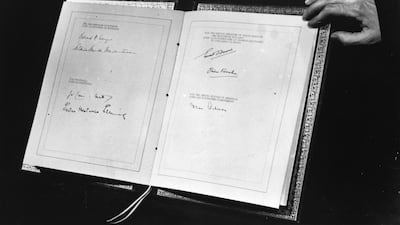
The North Atlantic Treaty showing the signatures of the foreign secretaries and ambassadors of the original signing nations - Belgium, Britain, Canada, Denmark, France, Iceland, Italy, Luxembourg, the Netherlands, Norway, Portugal and the US -
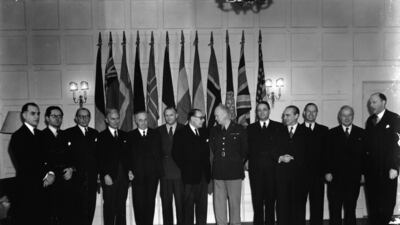
A meeting of the North Atlantic Council deputies in 1951 in London, attended by Gen Dwight D Eisenhower, centre -
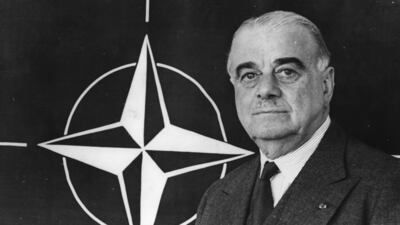
Lord Hastings Lionel Ismay, Secretary General of Nato, with the newly adopted Nato emblem in 1952 -
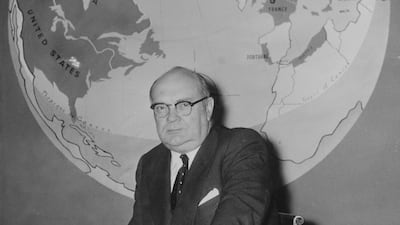
Belgian Foreign Minister Paul-Henri Spaak holds a press conference in Paris after taking over from Hastings Ismay as Nato chief in 1956 -
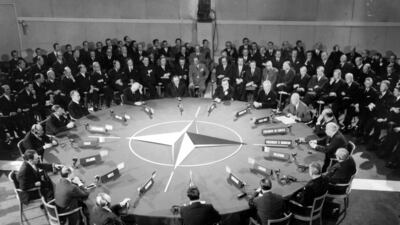
The opening speech at the Nato summit in Paris in 1957 -
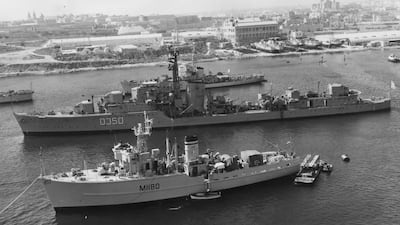
Some of the Nato vessels gathered for Exercise Medflex Invicta in Malta in 1961 -

A McDonnell Douglas F-4 Phantom II fighter-bomber of the Royal Navy is launched from HMS Ark Royal during a Nato exercise in 1972 -

German Nato troops on manoeuvres in 1980 -
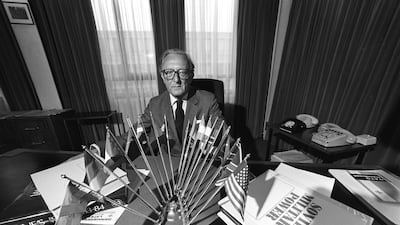
Lord Carrington, the new Secretary General of Nato, sits behind his desk in Brussels, Belgium, in 1984 -
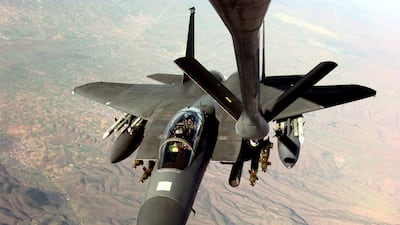
A US Air Force F-15E Strike Eagle refuels in the skies over Macedonia in 1999, as it flies missions in support of Nato Operation Allied Force -

Frigates, part of the Nato permanent fleet based in the Mediterranean Sea, enter the port of Piraeus, Greece, in 2003 -
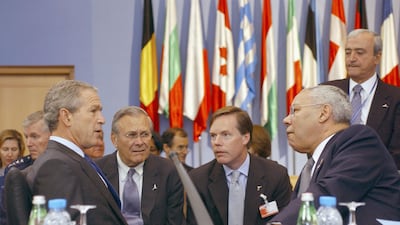
US President George W Bush, US Secretary of Defence Donald Rumsfeld, ambassador R Nicholas Burns and US Secretary of State Colin Powell attend the Nato summit in 2004 in Istanbul, Turkey -
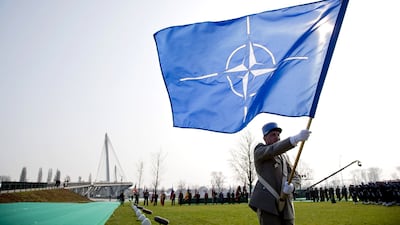
Members of the military attend a commemoration for Nato soldiers during the 2009 summit in Kehl, Germany -
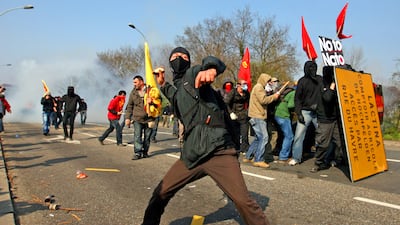
A protester throws a stone during clashes at the Nato summit in 2009 in Strasbourg, France -
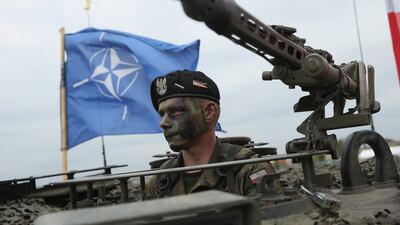
A Polish soldier sits in a tank as a Nato flag flies behind during military exercises in Zagan, Poland, in 2015 -
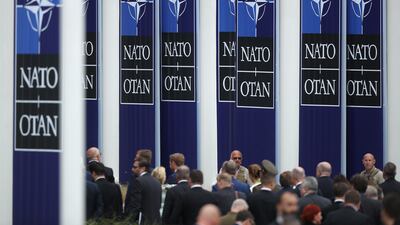
Guests depart after attending the opening ceremony at the 2018 Nato summit in Brussels -
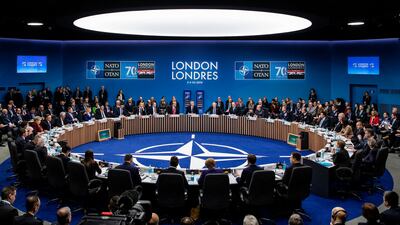
Nato leaders listen to British Prime Minister Boris Johnson while attending the summit in 2019 in Watford, England -
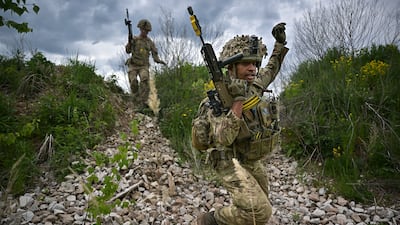
Soldiers from the Royal Welsh Battlegroup take part in manoeuvres during a Nato exercise on the Estonian-Latvian border in 2022 in Voru, Estonia -
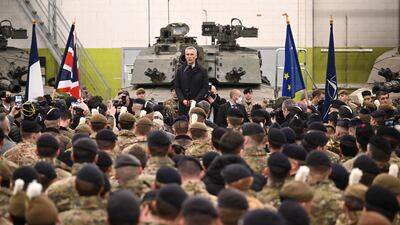
Secretary General of Nato Jens Stoltenberg meets troops at the Tapa Army Base in 2022 in Tallinn, Estonia -
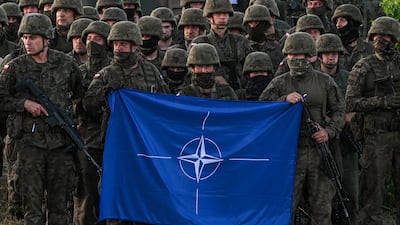
Polish soldiers hold a Nato flag in 2022 at a training ground in Orzysz, Poland -
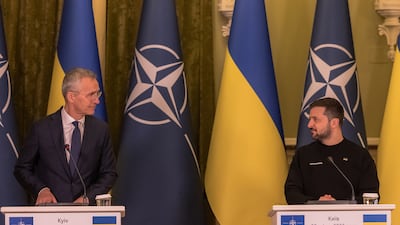
Ukrainian President Volodymyr Zelenskyy and Mr Stoltenberg attend a joint press conference in Kyiv, Ukraine, in April 2023


The Dutch leader “has a deep understanding of the importance of the alliance, is a natural leader and communicator, and his leadership would serve the alliance well at this critical time”, the official said.
The UK also “strongly backs” Mr Rutte's candidacy, a spokesman for Prime Minister Rishi Sunak said on Thursday.
He said Mr Rutte is “well respected across the alliance, has serious defence and security credentials, and will ensure that the alliance remains strong and ready to defend and deter”.
While the backing of Nato heavyweights gives Mr Rutte considerable momentum, a deal is not yet done and regular holdouts such as Turkey and Hungary could yet put up obstacles.
Female rivals out of the race
A possible count against Mr Rutte is a feeling in some quarters that Nato should choose its first female leader, or its first from eastern Europe in what would be seen as a message to Moscow.
Mr Rutte's background, as an experienced male leader from northern Europe, puts him in a similar mould to several of his predecessors, including ex-Norwegian premier Mr Stoltenberg.
However, one potential female rival, Danish Prime Minister Mette Frederiksen, said on Thursday she would not accept a top job at either the EU or Nato.
A second, Ursula von der Leyen, announced on Monday she will seek re-election as president of the European Commission, probably ruling her out of the Nato race.

From Nato's eastern flank, Estonia's Prime Minister Kaja Kallas has signalled interest in the job, while Lithuania's former president Dalia Grybauskaitė has also been mentioned by Nato watchers.
Baltic states have long sought a greater sway in Nato, with Lithuania's Foreign Minister Gabrielius Landsbergis remarking in Munich that his country “didn't join Europe, we fought for the freedom to return to Europe after years of Russian oppression”.
Another possible charge against Mr Rutte is that the Netherlands has never hit the target of spending 2 per cent of GDP on defence since it was set in 2014.
A lack of spending by European allies is a prime grievance for Mr Trump, who recently said he would “encourage” Russia to attack delinquent payers.
However, Dutch spending has increased every year since 2015 and Mr Rutte has made clear he wants Europe to ramp up arms production so that it can do more to assist Ukraine.
Mr Rutte's government has approved the delivery of Leopard battle tanks to Ukraine as well as air defence missiles, ammunition and medical equipment.
He has been less enthusiastic about Ukraine's prospects of joining the European Union and Nato, saying 2030 may be too soon for EU membership.
The next Nato chief is likely to be leading a 32-member alliance as applicant Sweden waits in the wings, with Hungary signalling it will soon lift the last obstacle.

As Dutch leader since 2010, Mr Rutte was in power during Mr Trump's term and mostly emerged unscathed from dealings with the volatile US President.
Even before the invasion of Ukraine he clashed with Moscow by blaming it for the downing of passenger flight MH17, which killed 196 Dutch nationals, and urged Europe to be less reliant on Russian gas.
Leading a centre-right, frugally-minded liberal party, Mr Rutte won four elections and was nicknamed “Teflon Mark” for his ability to survive political turbulence.
In 2017 he scored a memorable win against the anti-immigrant right at an election in which he pitched himself as a safe pair of hands in contrast to Trump-style populism.
But migration politics returned to haunt him as his coalition broke apart over asylum policy last summer, prompting Mr Rutte's surprise retirement.
He remains in office as caretaker after a messy election result last year in which far-right leader Geert Wilders pulled off an upset win.
The election result was “to say the least, interesting”, said Mr Rutte in Munich, but he is confident Dutch support for Nato will remain steadfast – even if he is sitting on the other side of the table.

