A new river of lava poured out on Saturday from the La Palma volcano, spreading more destruction.
The partial collapse of the volcanic cone overnight gave birth to the lava stream, which started to follow a similar path down the Cumbre Vieja ridge towards the western shore of the island to the ocean.
Vicente Soler, a volcanologist with Spain's National Research Council, said by flowing into the sea the lava was less likely to cause damage than it would on land.
Authorities said the new lava flow is within the area that was hastily evacuated following the September 19 eruption, when 6,000 residents were forced to flee their homes and farms and La Palma airport was temporarily closed for several days due to volcanic ash. The airport has opened again.
The lava flow destroyed more than 800 buildings, as well as banana plantations, roads and other infrastructure.
Emergency official Miguel Angel Morcuende said experts were closely watching the delta of new land being formed off the island's coast since the main lava flow reached the sea last week, after meandering downhill to the coast for nearly 10 days.
-

Lava flows behind houses following the eruption of a volcano on the Canary Island of La Palma, in Spain. The eruption forced the relocation of 5,000 people. Cumbre Vieja had been dormant for 50 years. Photo: Reuters -

A member of La Palma's Civil Protection team and a firefighter watch as a house burns in the Cumbre Vieja National Park. Photo: Reuters -

A 4.2-magnitude earthquake was recorded before the volcanic eruption, which took place in an area known as Cabeza de Vaca. Photo: Reuters -
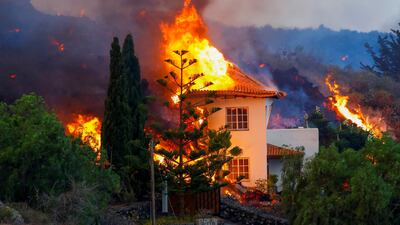
A house catches fire in La Palma as lava flows from the eruption. Photo: Reuters -

Lava reaches a house in La Palma's Cumbre Vieja National Park. Photo: Reuters -

As the eruptions continued, at least two openings spewed bright-red magma that flowed in tight streams down the mountain slope. Photo: AP -

A destroyed house is seen following the eruption. The last eruption on La Palma 50 years ago lasted slightly more than three weeks. Photo: Reuters -

The last eruption on La Palma 50 years ago lasted slightly over three weeks. Photo: Reuters -

Members of the media work in La Palma as smoke rises following the eruption. Reuters -
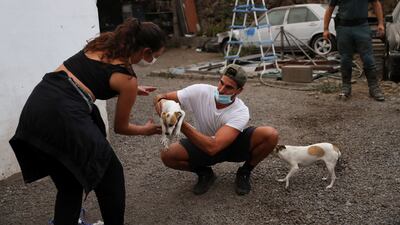
A man hands a dog to a woman as people are evacuated. Reuters -

Spanish Prime Minister Pedro Sanchez during his visit to the area affected by the volcanic eruption. EPA -
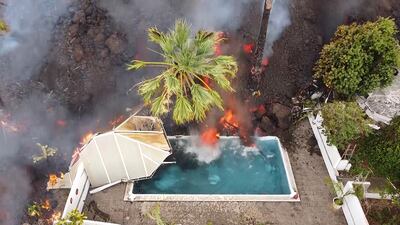
Hot lava reaches a swimming pool on the island of La Palma. AP Photo


He said that parts of it could collapse, causing explosions and large waves, but that would not pose a danger since the immediate area is already evacuated.
On reaching the water, the lava cools rapidly, binding to the cliffside and enlarging the island's territory. Despite fears of toxic gases from the lava reacting with the seawater, authorities said the air inland was fine to breathe.
The island is part of Spain's Canary Islands, an archipelago off north-west Africa that is a popular holiday destination for European tourists.

