
While the world is glued to updates about the coronavirus pandemic that has so far killed over 110,000 people, it is easy to forget that other news is still happening. But what is still happening and what developments have there been in 2020's biggest stories?
The oil price war
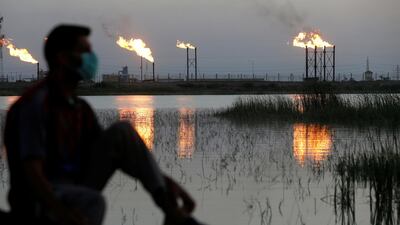
The world's largest oil producers have this week agreed on a deal to cut global oil production by almost 10 per cent, signalling a truce between Saudi Arabia, Opec's de facto leader, and Russia. The disagreement was triggered by the pandemic, with the global oil market battered by lower demand for fossil fuels and a collapse in global oil prices, but has far reaching consequences – the price war is one of the major causes of the ongoing global stock market crash.
Production cuts of almost 10 million barrels a day from next month were agreed after more than a week of tense talks between the world’s biggest oil-producing nations. Prices rose by more than 4 per cent to almost US$33 a barrel in London after swinging wildly in the first few minutes of trading following the deal, but it remains to be seen whether the cuts will be enough to rescue the global economy.

Israel’s leadership struggle
Israel could be heading for its fourth election in just over a year as Blue and White party leader Benny Gantz and Prime Minister Benjamin Netanyahu have until midnight on Monday to reach a power-sharing deal.
Mr Gantz was given the task of forming a government last month after a narrow majority of politicians said they were backing him to become prime minister. But in an abrupt U-turn, Mr Gantz announced he would instead try to form an “emergency” government with Mr Netanyahu’s Likud party to deal with the country’s coronavirus crisis.
Since then, negotiations on a power-sharing agreement between Mr Gantz and Mr Netanyahu appear to have stalled. Israel’s President Reuven Rivlin turned down a request for a two-week extension on Sunday, saying it would not be possible under the “current circumstances”.
Mr Netanyahu has been prime minister since 2009, having previously held the position from 1996 to 1999.
A ceasefire in Yemen
Yemen is still embroiled in its five-year-long civil war, with a coalition led by Saudi Arabia and the UAE battling the Houthi rebels in an attempt to restore power to President Abdrabu Mansur Hadi.
Last week, a two-week ceasefire was called in response to the United Nations urging a halt in the military campaign. It will likely be followed by the resumption of peace talks, the coalition said, and there are hopes that it could be the beginning of a political solution to the conflict. Previous talks failed because the Houthis refused to commit to the UN resolutions and 2014 talks.
Read more: Yemeni journalists tortured and sentenced to death in 'illegal' Houthi court
-
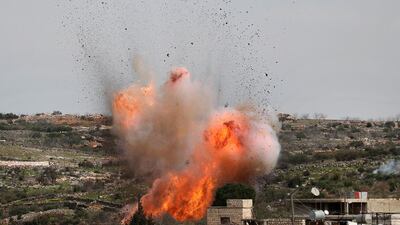
Warplanes attack the village of Al Bara in southern Idlib on March 5, 2020, a day before a ceasefire went into effect in the province. AFP -
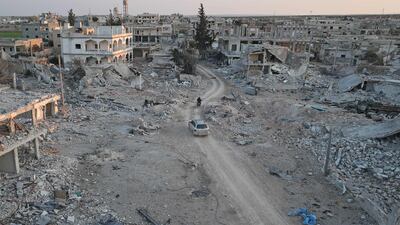
Destroyed buildings in Al Nayrab village, about 14 kilometres south-east of Idlib city. The city and its surroundings have suffered furious bombardment by Syrian forces and Russian jets since since December 2019. AFP -
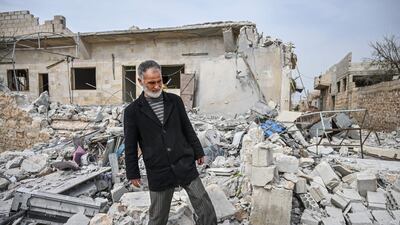
Malek Haj Khalil stands on the rubble of his home in Sarmin, about 8 kilometres south-east of Idlib city. AFP -
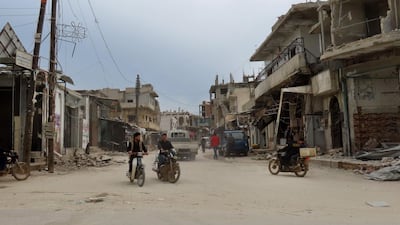
Syrians ride their motorcycles through a damaged neighbourhood in the town of Binnish in Idlib province. AFP -
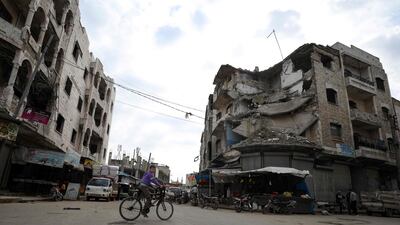
A boy rides his bicycle past damaged buildings in Idlib city. AFP -
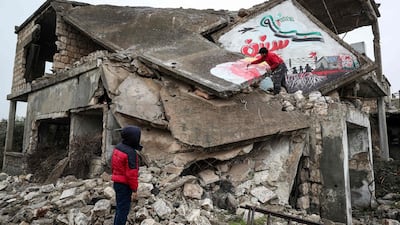
A boy watches as a man paints a mural on the roof of a collapsed building in Binnish to commemorate the ninth anniversary of the Syrian war. AFP -
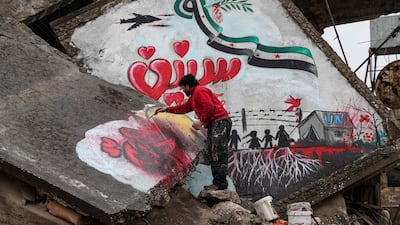
The mural shows a dove holding an olive branch in its beak flying over a Syrian opposition flag in the shape of the Arabic numeral 9, with the word 'years' below. AFP -

A mural on the wall of a destroyed school in Sarmin. The slogan refers to the Syrian government considering all rebels terrorists. AFP -

Like other towns in Idlib, Afis has sustained widespread destruction due to heavy fighting and air strikes. AFP -

A destroyed house in the village of Al Mastuma, about 7 kilometres south of Idlib city. AFP -
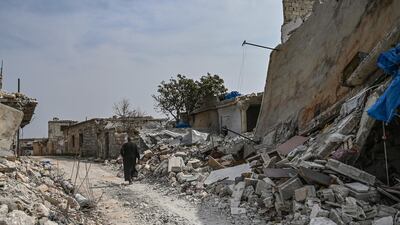
A man walks through a destroyed neighbourhood in Al Mastuma. AFP


The battle for Syria’s last opposition stronghold
The Syrian regime had been waging an aggressive offensive to retake territory in the north-western province of Idlib, the last rebel-held area. Fighting has calmed since March when Turkey, which backs some groups opposed to President Bashar Al Assad, agreed a ceasefire with Moscow, which has supported Damascus with heavy air power.
However, hundreds of thousands were displaced by the fighting, adding to already overcrowded displacement camps where conditions are so bad that many have decided to risk returning to their homes.
Elsewhere, ISIS has become increasingly active over the past few weeks in eastern Syria, especially in the desert in the south and Kurdish areas in the north.
Brexit
Yes, that’s still going on. The UK formally left the European Union on January 31, but is in a transition period until December 31 while negotiations continue, meaning it will still be treated as a member.
The UK government says a trade deal must be in place by the last day of the year and talks are to resume via videolink this week, according to the BBC, but many are skeptical it can be done in time. In yet another twist of classic Brexit irony, critics have said that a desire to show that the UK as an independent nation in charge of its own destiny has hampered its coronavirus response – it has often disregarded World Health Organisation advice and could not decide whether they should have taken part in an EU-wide effort to procure more ventilators.
-
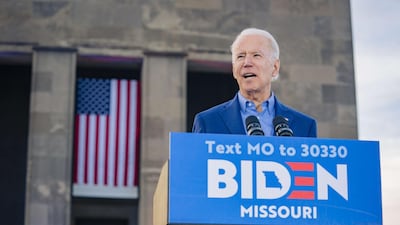
Democratic Presidential Candidate former Vice President Joe Biden speaks to a crowd during a campaign rally at the National World War I Museum and Memorial on March 7, 2020 in Kansas City, Missouri. AFP -

A supporter wears a mask to attend a Joe Biden rally in St. Louis, Missouri, U.S., March 7, 2020. Reuters -
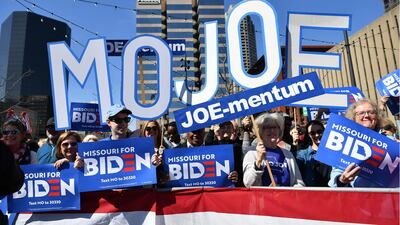
Supporters hold up signs before Joe Biden holds a rally at Kiener Plaza Park in St. Louis, Missouri on March 7, 2020. AFP -

Senator Amy Klobuchar, who dropped out of the race to be a Democratic candidate, campaigns for Joe Biden at a Women for Biden event in Southfield, Michigan on March 6, 2020. AP -
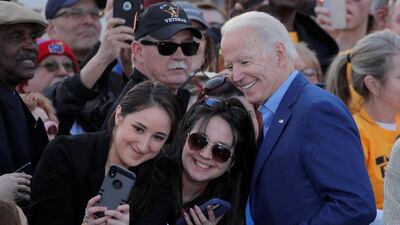
Joe Biden is greeted by supporters at a campaign stop in Kansas City, Missouri on March 7, 2020. Reuters -
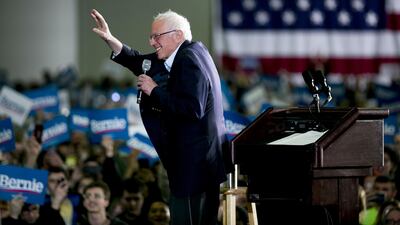
Senator Bernie Sanders, an Independent from Vermont and 2020 presidential candidate, speaks during a Get Out The Vote rally in Detroit, Michigan on March 6, 2020. Bloomberg -
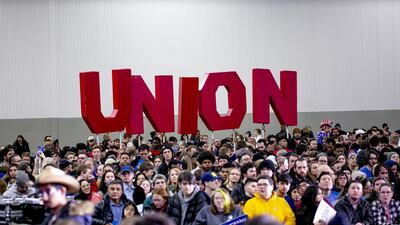
Attendees hold a sign at a Get Out The Vote rally with Senator Bernie Sanders in Detroit, Michigan on March 6, 2020. Bloomberg -

Attendees stand in front of an American flag during the Get Out The Vote rally with Bernie Sanders on March 6, 2020. Bloomberg -

Supporters of Bernie Sanders listen to a panel on African-American issues during a town hall in Flint, Michigan on March 7, 2020. Reuters -

Tinah Estrada, working at the receiving station for El Paso County, gives directions to Steve Nordberg, an election judge at the El Paso County Courthouse during the presidential primary in El Paso, Texas on Super Tuesday, March 3, 2020. AFP


US elections
The presidential vote is due to take place on November 3 and requires legislation enacted by Congress and signed by the president to delay it. Last week, democratic socialist Bernie Sanders suspended his campaign for president, saying he couldn’t see a path to the nomination. He was former vice-president Joe Biden’s last rival in the field as the de facto Democratic candidate to challenge President Donald Trump.
Many states have not been able to cast their ballots, although Wisconsin recently held controversial in-person voting in its primary. It’s not yet known if the election will run as usual or require drastic modifications to the system – many states would need to change their rules at huge cost to run a mail-only election.
The Democratic and Republican parties will officially name their candidates in August.

