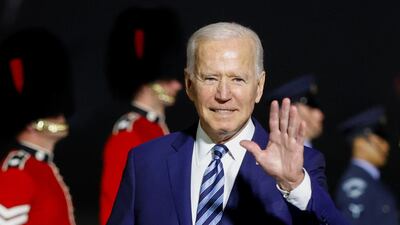
UK Prime Minister Boris Johnson and US President Joe Biden are expected to agree on an "Atlantic Charter" laying out their plans when they meet each other for the first time on Thursday.
The charter is named after the 1941 pact between wartime leaders Winston Churchill and Franklin D Roosevelt that led to the creation of Nato.
It will seek to reinvigorate the transatlantic alliance by pledging co-operation on climate change and recovery from Covid-19.
Meeting on the eve of the G7 summit in Britain, the two leaders will also seek an agreement on resuming UK-US travel after the pandemic.
But their encounter is taking place in the shadow of warnings from Washington that Britain must avoid jeopardising the Northern Ireland peace process.
Britain and the EU, who accuse each other of failing to honour an agreement on cross-border checks, failed to make a breakthrough during post-Brexit discussions on Wednesday.
European Commission President Ursula von der Leyen said on Thursday that the protocol was the "one and only solution" and that she saw "fundamental gaps" in Britain's implementation of it.
"We are determined to do everything to keep peace and stability on the island of Ireland. It is important that there is deep respect for the protocol," she said.
America's charge d'affaires to the UK, Yael Lempert, reportedly told Brexit Minister David Frost that the UK's stance on the Northern Ireland Protocol was inflaming tension in Ireland.
Ms Lempert is said to have issued Mr Frost with a demarche, a formal diplomatic reprimand, at a meeting in London on June 3.
A demarche is more commonly lodged with adversaries than close allies.
According to a leaked government memo obtained by The Times, Ms Lempert said the dispute over the implementation of post-Brexit arrangements in Northern Ireland was "commanding the attention" of Mr Biden, who is a proud Irish-American.
She relayed to him Mr Biden’s “great concern” over the UK’s approach to the protocol, which was established to prevent a hard Irish border.
It said that the US had urged the UK to come to a “negotiated settlement” with the EU, even if that meant making “unpopular compromises”.
Mr Biden's national security adviser Jake Sullivan said on Wednesday that any steps to undermine peace in Northern Ireland "would not be welcomed by the United States".
Asked whether Mr Johnson was jeopardising peace, Mr Sullivan said: "I'm not going to characterise that at this point. I'm only going to say that President Biden is going to make statements in principle on that front."
In a move likely to provoke anger from Brexiteers, the US reportedly suggested that if the UK signed up to EU rules on agricultural standards to ease problems with the protocol, Mr Biden would ensure it did not obstruct a UK-US trade deal.
The time has come to dispel any sense of gloom
The UK has ruled out aligning with the EU’s food and animal health rules, saying this would bind it to laws set in Brussels.
On Wednesday night, UK sources confirmed the details of the meeting but insisted Britain and the US were united in their determination to maintain peace in Northern Ireland.
Asked whether the G7 summit would be overshadowed by the spat, Mr Johnson said: "I'm not worried about that."
The prime minister said his charter with Mr Biden would cover science, technology, trade and defence.
Above all, it will underscore "our joint commitment to Nato that has been indispensable to our security for decades", he said.
"The time has come to dispel any sense of gloom and show how Nato is looking ahead to 2030," he said.
The charter is expected to call for urgent action on climate change, biodiversity and recovery from the Covid pandemic.
The two leaders are expected to agree in principle on a technology agreement that would allow both countries to share expertise in areas such as artificial intelligence.
On transatlantic travel, they are expected to set up a task force to make recommendations on resuming flights.
"While Churchill and Roosevelt faced the question of how to help the world recover following a devastating war, today we have to reckon with a very different but no less intimidating challenge – how to build back better from the coronavirus pandemic," Mr Johnson said.
"And as we do so, co-operation between the UK and US, the closest of partners and the greatest of allies, will be crucial for the future of the world’s stability and prosperity."
After talks with Mr Johnson, Mr Biden will attend the G7 gathering in a Cornish seaside resort from Friday to Sunday.
He will then visit Queen Elizabeth II at Windsor Castle and fly to Brussels for summits with Nato and the EU next week.
He will finish in Geneva to meet Russia's President Vladimir Putin next Wednesday.

The rules on fostering in the UAE
A foster couple or family must:
- be Muslim, Emirati and be residing in the UAE
- not be younger than 25 years old
- not have been convicted of offences or crimes involving moral turpitude
- be free of infectious diseases or psychological and mental disorders
- have the ability to support its members and the foster child financially
- undertake to treat and raise the child in a proper manner and take care of his or her health and well-being
- A single, divorced or widowed Muslim Emirati female, residing in the UAE may apply to foster a child if she is at least 30 years old and able to support the child financially
The Greatest Royal Rumble card as it stands
50-man Royal Rumble - names entered so far include Braun Strowman, Daniel Bryan, Kurt Angle, Big Show, Kane, Chris Jericho, The New Day and Elias
Universal Championship Brock Lesnar (champion) v Roman Reigns in a steel cage match
WWE World Heavyweight Championship AJ Styles (champion) v Shinsuke Nakamura
Intercontinental Championship Seth Rollins (champion) v The Miz v Finn Balor v Samoa Joe
United States Championship Jeff Hardy (champion) v Jinder Mahal
SmackDown Tag Team Championship The Bludgeon Brothers (champions) v The Usos
Raw Tag Team Championship (currently vacant) Cesaro and Sheamus v Matt Hardy and Bray Wyatt
Casket match The Undertaker v Chris Jericho
Singles match John Cena v Triple H
Cruiserweight Championship Cedric Alexander v tba
Mercer, the investment consulting arm of US services company Marsh & McLennan, expects its wealth division to at least double its assets under management (AUM) in the Middle East as wealth in the region continues to grow despite economic headwinds, a company official said.
Mercer Wealth, which globally has $160 billion in AUM, plans to boost its AUM in the region to $2-$3bn in the next 2-3 years from the present $1bn, said Yasir AbuShaban, a Dubai-based principal with Mercer Wealth.
“Within the next two to three years, we are looking at reaching $2 to $3 billion as a conservative estimate and we do see an opportunity to do so,” said Mr AbuShaban.
Mercer does not directly make investments, but allocates clients’ money they have discretion to, to professional asset managers. They also provide advice to clients.
“We have buying power. We can negotiate on their (client’s) behalf with asset managers to provide them lower fees than they otherwise would have to get on their own,” he added.
Mercer Wealth’s clients include sovereign wealth funds, family offices, and insurance companies among others.
From its office in Dubai, Mercer also looks after Africa, India and Turkey, where they also see opportunity for growth.
Wealth creation in Middle East and Africa (MEA) grew 8.5 per cent to $8.1 trillion last year from $7.5tn in 2015, higher than last year’s global average of 6 per cent and the second-highest growth in a region after Asia-Pacific which grew 9.9 per cent, according to consultancy Boston Consulting Group (BCG). In the region, where wealth grew just 1.9 per cent in 2015 compared with 2014, a pickup in oil prices has helped in wealth generation.
BCG is forecasting MEA wealth will rise to $12tn by 2021, growing at an annual average of 8 per cent.
Drivers of wealth generation in the region will be split evenly between new wealth creation and growth of performance of existing assets, according to BCG.
Another general trend in the region is clients’ looking for a comprehensive approach to investing, according to Mr AbuShaban.
“Institutional investors or some of the families are seeing a slowdown in the available capital they have to invest and in that sense they are looking at optimizing the way they manage their portfolios and making sure they are not investing haphazardly and different parts of their investment are working together,” said Mr AbuShaban.
Some clients also have a higher appetite for risk, given the low interest-rate environment that does not provide enough yield for some institutional investors. These clients are keen to invest in illiquid assets, such as private equity and infrastructure.
“What we have seen is a desire for higher returns in what has been a low-return environment specifically in various fixed income or bonds,” he said.
“In this environment, we have seen a de facto increase in the risk that clients are taking in things like illiquid investments, private equity investments, infrastructure and private debt, those kind of investments were higher illiquidity results in incrementally higher returns.”
The Abu Dhabi Investment Authority, one of the largest sovereign wealth funds, said in its 2016 report that has gradually increased its exposure in direct private equity and private credit transactions, mainly in Asian markets and especially in China and India. The authority’s private equity department focused on structured equities owing to “their defensive characteristics.”
Funk Wav Bounces Vol.1
Calvin Harris
Columbia
