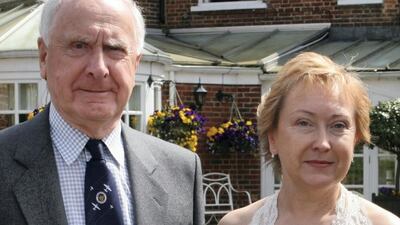
Dr Cathy Gardner with her late father Michael Gibson, who died in care. Courtesy Cathy Gardner

Bereaved doctor to fight UK government over ‘death trap’ care homes


Nicky Harley
  • English
  • Arabic

A doctor whose father died after contracting Covid-19 is taking the UK government to court over their "death trap" care homes.

Dr Cathy Gardner claimed the government failed to protect care home residents during the pandemic.

Her case will be brought to London's High Court later this year, she told The National, after a Covid-related delay.

On Wednesday, Prime Minister Boris Johnson said a public inquiry into the pandemic would start next year.

However, his announcement came after the government attempted to have Dr Gardner's legal action dismissed.

Lawyers acting for NHS England told the court the public interest would not be served by "diverting NHS England’s attention and resources from the management of the ongoing response to the Covid-19 crisis to expensive and time-consuming high court litigation".

But the court ruled in favour of the case being heard in the autumn.

“Mr Justice Linden has granted the case permission to proceed to a full trial,” Dr Gardner said.

“Despite the best efforts of the government and NHS to get the case thrown out, the judge ruled that we had an arguable case with reasonable prospects of success.

"The judge recognised the wider public interest in the case and that it affects the lives of many people who have lost loved ones in the pandemic.

"Simply put, he accepted that it is arguable that the government unlawfully failed to protect the lives of care home residents.”

Thousands of people donated money through a crowdfunding page to help her to pay legal costs.

More than 42,000 people died in care homes from Covid, Office of National Statistics figures show, thought to account for almost a quarter of care home deaths in England and Wales during the pandemic.

An investigation by The National revealed that more than 40,600 people admitted to hospital in England during the pandemic are believed to have contracted Covid-19 while there, at least 8,000 of whom died from the virus.

Former health secretary Jeremy Hunt, who is now chairman of the UK's Health and Social Care Select Committee, called the scandal the “biggest undiscussed problem” of the pandemic and believes England’s first wave could have been shortened had different guidance been followed.

Dr Gardner's father Michael Gibson, 88, who had advanced Alzheimer's disease, died last April at the Cherwood House Care Centre in Oxfordshire, England.

His death came amid a government policy of releasing hospital patients back into care homes without determining their Covid-19 status.

Mr Gibson's death certificate stated "Covid probable".

"I am extremely angry that an ill-thought-out policy has caused me, and thousands of others, so much anguish," she said.

"I knew that losing my father would be tough, but losing him in these circumstances is truly devastating.

"These people, like my father, were the most vulnerable in our society. I believe that many of these deaths could have been avoided if the government had acted to protect these people."
Dr Gardner accused the government of transforming care homes into "death traps" in which care workers were "exposed to unacceptable and avoidable risks".

"I will continue to fight for justice for my father and the thousands like him who died unnecessarily in care homes in the course of this pandemic," she said.

The government denies breaching the European Convention on Human Rights in managing risks posed by the virus to care home staff and residents.

Honeymoonish
%3Cp%3E%3Cstrong%3EDirector%3A%3C%2Fstrong%3E%20Elie%20El%20Samaan%3C%2Fp%3E%0A%3Cp%3E%3Cstrong%3EStarring%3A%20%3C%2Fstrong%3ENour%20Al%20Ghandour%2C%20Mahmoud%20Boushahri%3C%2Fp%3E%0A%3Cp%3E%3Cstrong%3ERating%3A%3C%2Fstrong%3E%203%2F5%3C%2Fp%3E%0A
Ultra processed foods

- Carbonated drinks, sweet or savoury packaged snacks, confectionery, mass-produced packaged breads and buns 

- margarines and spreads; cookies, biscuits, pastries, cakes, and cake mixes, breakfast cereals, cereal and energy bars;

- energy drinks, milk drinks, fruit yoghurts and fruit drinks, cocoa drinks, meat and chicken extracts and instant sauces

- infant formulas and follow-on milks, health and slimming products such as powdered or fortified meal and dish substitutes,

- many ready-to-heat products including pre-prepared pies and pasta and pizza dishes, poultry and fish nuggets and sticks, sausages, burgers, hot dogs, and other reconstituted meat products, powdered and packaged instant soups, noodles and desserts.

Match info

Uefa Champions League Group B

Barcelona v Tottenham Hotspur, midnight

GOLF’S RAHMBO

- 5 wins in 22 months as pro
- Three wins in past 10 starts
- 45 pro starts worldwide: 5 wins, 17 top 5s
- Ranked 551th in world on debut, now No 4 (was No 2 earlier this year)
- 5th player in last 30 years to win 3 European Tour and 2 PGA Tour titles before age 24 (Woods, Garcia, McIlroy, Spieth)

Mercer, the investment consulting arm of US services company Marsh & McLennan, expects its wealth division to at least double its assets under management (AUM) in the Middle East as wealth in the region continues to grow despite economic headwinds, a company official said.

Mercer Wealth, which globally has $160 billion in AUM, plans to boost its AUM in the region to $2-$3bn in the next 2-3 years from the present $1bn, said Yasir AbuShaban, a Dubai-based principal with Mercer Wealth.

Within the next two to three years, we are looking at reaching $2 to $3 billion as a conservative estimate and we do see an opportunity to do so,” said Mr AbuShaban.

Mercer does not directly make investments, but allocates clients’ money they have discretion to, to professional asset managers. They also provide advice to clients.

“We have buying power. We can negotiate on their (client’s) behalf with asset managers to provide them lower fees than they otherwise would have to get on their own,” he added.

Mercer Wealth’s clients include sovereign wealth funds, family offices, and insurance companies among others.

From its office in Dubai, Mercer also looks after Africa, India and Turkey, where they also see opportunity for growth.

Wealth creation in Middle East and Africa (MEA) grew 8.5 per cent to $8.1 trillion last year from $7.5tn in 2015, higher than last year’s global average of 6 per cent and the second-highest growth in a region after Asia-Pacific which grew 9.9 per cent, according to consultancy Boston Consulting Group (BCG). In the region, where wealth grew just 1.9 per cent in 2015 compared with 2014, a pickup in oil prices has helped in wealth generation.

BCG is forecasting MEA wealth will rise to $12tn by 2021, growing at an annual average of 8 per cent.

Drivers of wealth generation in the region will be split evenly between new wealth creation and growth of performance of existing assets, according to BCG.

Another general trend in the region is clients’ looking for a comprehensive approach to investing, according to Mr AbuShaban.

“Institutional investors or some of the families are seeing a slowdown in the available capital they have to invest and in that sense they are looking at optimizing the way they manage their portfolios and making sure they are not investing haphazardly and different parts of their investment are working together,” said Mr AbuShaban.

Some clients also have a higher appetite for risk, given the low interest-rate environment that does not provide enough yield for some institutional investors. These clients are keen to invest in illiquid assets, such as private equity and infrastructure.

“What we have seen is a desire for higher returns in what has been a low-return environment specifically in various fixed income or bonds,” he said.

“In this environment, we have seen a de facto increase in the risk that clients are taking in things like illiquid investments, private equity investments, infrastructure and private debt, those kind of investments were higher illiquidity results in incrementally higher returns.”

The Abu Dhabi Investment Authority, one of the largest sovereign wealth funds, said in its 2016 report that has gradually increased its exposure in direct private equity and private credit transactions, mainly in Asian markets and especially in China and India. The authority’s private equity department focused on structured equities owing to “their defensive characteristics.”

Libya's Gold

UN Panel of Experts found regime secretly sold a fifth of the country's gold reserves. 

The panel’s 2017 report followed a trail to West Africa where large sums of cash and gold were hidden by Abdullah Al Senussi, Qaddafi’s former intelligence chief, in 2011.

Cases filled with cash that was said to amount to $560m in 100 dollar notes, that was kept by a group of Libyans in Ouagadougou, Burkina Faso.

A second stash was said to have been held in Accra, Ghana, inside boxes at the local offices of an international human rights organisation based in France.

Our legal consultant

Name: Dr Hassan Mohsen Elhais

Position: legal consultant with Al Rowaad Advocates and Legal Consultants.
