
The scale of the Covid-19 outbreak in Wuhan early this year may have been nearly 10 times the recorded tally, a study conducted by China’s public health authorities indicates.
This leaves the city where the coronavirus first took hold still well short of the mass immunity required to protect against a potential resurgence.
About 4.4 per cent of those tested were found to have specific antibodies that can fight off the pathogen that causes Covid-19, indicating they were infected some time in the past, according to a serological survey of more than 34,000 people conducted in April by the Chinese Centre for Disease Control and Prevention. The data was released late on Monday.
That ratio would suggest that with Wuhan home to about 11 million people, as many as 500,000 residents may have been infected. That number is nearly 10 times more than the 50,000 confirmed Covid-19 cases reported by health authorities in mid-April, when the survey was conducted.
China has been criticised internationally for its initial handling of the outbreak, which has spread around the world in a global pandemic in the year since the first cases emerged.
Covid around the world – in pictures
-

Registered nurse Patricia Cummings administers the COVID-19 vaccine to Vice President-elect Kamala Harris at the United Medical Center in Washington, DC. AFP -

The first five vaccinated hospital staff and Health Director Alberto Deales pose for a photo as the Covid-19 vaccine is administered at the Umberto I Hospital in Rome, Italy. A vaccination campaign against Covid-19 started across the EU on 27 December. EPA -

A patient with the COVID-19 breaths in oxygen in the COVID-19 ward at Khayelitsha Hospital, about 35km from the centre of Cape Town. The patents in this ward are not critically serious, but do require oxygen and to lie down. South Africa has become the first African nation to record one million coronavirus cases, according to new data published by the country's health ministry on December 27, 2020. Currently suffering a second wave of infections, of which the majority are a new variant of the coronavirus, South Africa is the hardest hit country on the African continent. AFP -

City of Tshwane's Special Infection Unit Leading Emergency Care Practitioner Rocco Veer and Station Officer Arrie Visser do final check on the isolation chamber equipped with a negative pressure filtration system used to transport positive Covid-19 patients before starting their night shift at the Hatfield Emergency Station in Pretoria. AFP -
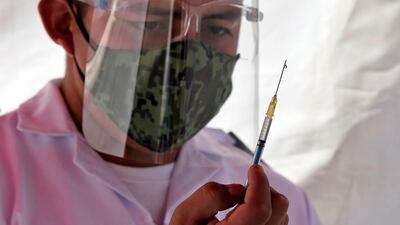
Medical staff administer the Pfizer/BioNTech vaccine against the coronavirus, at the Military Field Number 1A in Mexico City. Mexico will first apply the vaccine to all health personnel and the elderly as part of their mass immunization program. AFP -

A woman on a scooter has her temperature taken and is given a facemask at a checkpoint set up to examine people in a bid to halt the spread of the Covid-19 coronavirus in the southern Thai province of Narathiwat. AFP -

Gabriel Cervera and Sanjana Krishnan take a break from treating patients infected with the coronavirus disease at United Memorial Medical Center in Houston, Texas, U.S. Reuters -

People line up in their vehicles at Dodger Stadium as post-Christmas COVID-19 testing resumes during a surge in positive coronavirus disease cases in Los Angeles, California, U.S. Reuters -

People wait for their turn during a mass coronavirus testing in Palma de Mallorca, Spain. Palma de Mallorca records 621 cases per 100,000 inhabitants and has become Spain's hardest hit area. EPA -

Passengers wearing protective face masks wait at a station for a subway during an evening rush hour in Wuhan, China. Life in Wuhan, a Chinese city of more than 11 million, which nearly a year ago became the epicenter of the coronavirus outbreak is returning to normal. Since May the capital of Hubei province has not recorded locally-transmitted cases of Covid-19. EPA -

An Iranian health worker prepares a dose of locally made COVID-19 vaccine during phase one of its trial test in Tehran, Iran, 29 December 2020. Media reports state that Iran inaugurated and tested its local made coronavirus disease vaccine during the first phase of trial session. EPA -

Buses carrying some inmates infected with coronavirus disease leave Dongbu Detention Center in Seoul, South Korea, for a medical clinic. A total of 792 inmates there have come down with the virus so far. EPA -

People wearing face masks to protect against the spread of the coronavirus visit the Ameyoko shopping street to purchase ingredients for New Year's dishes, in Tokyo. AP -

Villagers wave away journalists visiting a village near Danaoshan in southern China's Yunnan province. A mine shaft in the area once harbored bats infected with the closest known relative of the COVID-19 virus. AP -

A medical worker waits for the next individual to take a swab test for the COVID-19 coronavirus at a hospital in Beijing. AFP


The US has raised questions about China’s accounting of the virus fallout in Wuhan, which was quickly eclipsed by larger outbreaks in Europe and North America.
Revisions of the case and deaths data added to suspicions China was massaging the numbers.
While the serological data may reignite those claims, it is common for health authorities to underreport cases during an acute outbreak, given testing capabilities can be limited and hospitals overwhelmed with a sudden surge in patients.
The coronavirus’s ability to quietly infect people without making some of them sick until later or even throughout the infection period only exacerbates the problem.
Serological surveillance has been widely used by health professionals around the world to gauge the true scale of epidemics, from Covid-19 to Aids and hepatitis.
The prevalence of disease derived from such studies can guide mitigation and vaccination efforts.
The China CDC survey showed a far lower impact of the virus outside Wuhan, which was effectively shut off as a way of containing the outbreak.
The positive rate for antibodies dropped to 0.44 per cent for the broader Hubei province, which was also placed under a three-month lockdown.
Only two people tested positive for the antibody among the 12,000 surveyed in six other Chinese cities and provinces, including Beijing, Shanghai and Guangdong – suggesting an extremely low prevalence of the virus across the rest of the country.
The results for Wuhan mean even China’s worst-hit city is still vulnerable to Covid-19.
Epidemiologists say at least half a population needs to have come into contact with the virus for even the minimum threshold for herd immunity.
But the city’s rate of infection is generally in line with those found in other countries after the first wave of coronavirus infections, the China CDC said in a press release published on its website.
The antibody-positive rates in Spain and Switzerland this spring, for example, were as much as 6.2 per cent and 11 per cent, respectively, the China CDC said.
While those are higher than the 4.4 per cent found in Wuhan, and come before later waves that have swept across Europe, they still fall short of the herd immunity threshold.
Since quelling the Hubei outbreak, China has largely contained the coronavirus, with sporadic flare-ups since April snuffed out through aggressive contract tracing and quickly testing millions of people in a matter of days.

