
Three days of elaborate ceremonies begin on Saturday for the formal coronation of Thailand's King Maha Vajiralongkorn, who has been on the throne for more than two years.
What King Vajiralongkorn — also known as King Rama X, the 10th king of the Chakri dynasty — will do with the power and influence the venerated status confers is still not clear.
The 66-year-old monarch has sent mixed signals. Bursts of assertiveness alternate with a seemingly hands off approach in other matters — a perception girded by the amount of time he spends at a large residence he maintains in Germany.
On Wednesday, he suddenly announced his fourth marriage, to a former flight attendant who is a commander of his security detail, and appointed her Queen Suthida.
The timing of the announcement, just ahead of his coronation, suggests a fresh commitment to his royal duties.
On Thursday, the king and his new bride took part in ceremonies to pay homage to Vajiralongkorn's royal ancestors and worship deities, and on Friday he attended preparatory rituals for his coronation.
"I am excited and happy," said Chanachai Charoensue, a 55-year-old office worker who is one of the many Thais looking forward to the coronation.
"Actually, His Majesty the King has carried out his duties for a while," he said. "I know that the government will hold a ceremony befitting his royal stature. I want to witness this ceremony."
King Vajiralongkorn is likely to remain burdened by old gossip about his personal life that has dogged him since returning from his education in England and Australia. Many Thais are familiar with tales about his alleged exploits while he was crown prince, even though harsh laws mandate a prison term of three to 15 years for anyone found guilty of insulting the monarchy.
King Vajiralongkorn early on was pinned with the reputation of a playboy, a trait that even his own mother acknowledged. He has gone through bitter divorces with three women who have borne him seven children.
His father, King Bhumibol Adulyadej — the only monarch most Thais had known when he died in October 2016 after seven decades on the throne — won most of his countrymen's deep love and respect as an exemplar of rectitude and an avid cheerleader for his country's economic development. His three sisters are frequently engaged in public service.
"The defining years saw King Bhumibol spending large amounts of time in provincial Thailand, visiting ordinary people," said Michael Montesano, co-ordinator of the Thailand Studies Programme at Singapore's ISEAS-Yusof Ishak Institute. "We have yet to see similar behaviour on the part of his heir."
Paul Chambers, a political scientist at Naresuan University in northern Thailand, finds King Vajiralongkorn's style "more hands off", even as he has brought more of Thailand's administration directly under the palace.
His early actions as king included replacing his late father's loyalists with his own in key palace posts. Some of those he fired were called lazy, or arrogant, and in some cases, guilty of "extremely evil behaviour".
"The new king is a very decisive man, and he's a very daring man, unlike his father," said Sulak Sivaraksa, a conservative social critic. "His father was on the whole, a very quiet person, and he suffered fools around him. He knew somebody cheated him and so, but he was very tolerant."
There have been suggestions that the new king's purges amount to an anti-corruption campaign.
Such a case can be made, acknowledges Mr Montesano.
"But the same actions also appear to bespeak an interest in gaining or exerting greater control over certain institutions," he said. "That possible motive must be kept in mind."
There is little question that King Vajiralongkorn has tightened control over royal institutions and what amounts to political privileges.
-

King Maha Vajiralongkorn and his consort, Queen Suthida, perform a traditional ritual at their wedding ceremony in Bangkok. All photos by Reuters -

Thai television shows Queen Suthida prostrating herself before the king. -

She presented the king with a tray of flowers and joss sticks, and in return was bestowed traditional gifts associated with royal power. -

Although Queen Suthida has been in the public eye for about three years, there has been little official information released about her. -

She is reported to be 40 years old and to have previously worked as a flight attendant for Thai Airways. The two reportedly met on a flight. -

Queen Suthida joined the palace guard in 2013 and became commander of the king's security unit, currently holding a general's rank. -

King Maha Vajiralongkorn watches Queen Suthida sign their marriage certificate. -

King Maha Vajiralongkorn and his consort Queen Suthida. -

Thailand's King Maha Vajiralongkorn and Queen Suthida leave after paying their respect at the statue of King Rama V at the Royal Plaza in Bangkok, Thailand. REUTERS -

Thailand's King Maha Vajiralongkorn will be officially crowned king on Saturday. -

This coronation will take place fron Saturday to Monday. -

His father, the previous king, died in 2016. -

King Maha Vajiralongkorn wanted the country to mourn King Bhumibol Adulyadej before he considered his coronation date, -

Thailand's King Maha Vajiralongkorn and Queen Suthida pay their respect at the statue of King Rama V. -

Well-wishers gather in front of a portrait of Thailand's King Maha Vajiralongkorn. AFP -

Thailand's King Maha Vajiralongkorn (2nd L) and Queen Suthida (2nd R) pay their respect at King Rama V. AFP


He surprised the country's ruling junta when, "to ensure his royal powers", he requested changes to a new constitution that had already been approved in a referendum. They acquiesced.
The powers he acquired centralise royal authority in his hands and make explicit his right to intervene in government affairs, especially in times of political crisis.
King Vajiralongkorn has also sought to shore up the palace's finances, previously controlled by a vast and somewhat creaky bureaucracy. The palace's fortune, estimated by sources such as Forbes magazine to be in the neighborhood of $30 billion (Dh110.2bn), is largely controlled by the Crown Property Bureau, a professionally managed holding company with large stakes in real estate, banking and industry. The new king instituted changes giving him tighter control to personally manage the bureau and its holdings.
King Vajiralongkorn's greatest challenge is likely to be sorting out the palace's relationship with the military.
His father and the army worked out a delicate balance of power, with the palace arguably holding the stronger hand, especially after a 1973 pro-democracy uprising temporarily discredited military rule. The army's declared mission of protecting the monarchy became its shield against criticism.
-
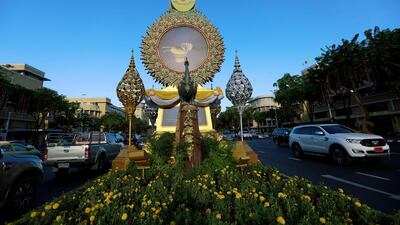
A billboard shows Thai King Maha Vajiralongkorn's regalia to be used during his three-day coronation ceremony in Bangkok. Reuters -

Thailand's King Maha Vajiralongkorn pictured as a boy. AFP -

King Maha Vajiralongkorn pictured in 1999. AFP -
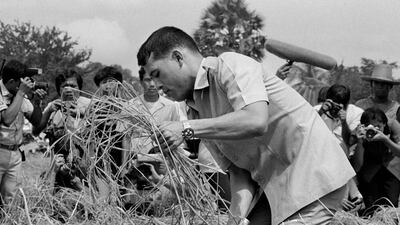
Maha Vajiralongkorn harvests rice in Suphan Buri province, near Bangkok in 1986. AFP -

Maha Vajiralongkorn poses in front of the Taj Mahal in Agra in April 1992. AFP -
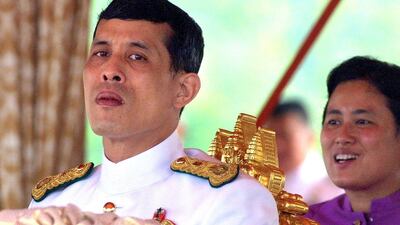
Maha Vajiralongkorn with Princess Sirindhorn at an annual royal ploughing ceremony in Bangkok. AFP -

Thailand's King Vajiralongkorn pays his respects at the statue of King Rama I in Bangkok in 2017. AFP -
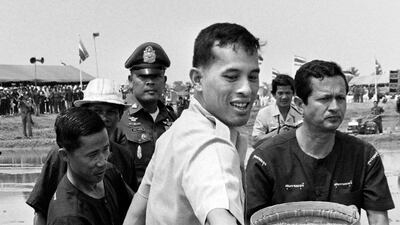
Thailand's Maha Vajiralongkorn sows rice seed in 1986. AFP -

Thailand's former King Bhumibol Adulyadej sits on the throne after delivering an address with his son and Crown Prince Maha Vajiralongkorn looking on. AFP -

In this file photo taken in June 1955, Thailand's King Bhumibol and Queen Sirikit pose with their children Princess Sirindhorn and Crown Prince Maha Vajiralongkorn. AFP -

The former Thai king and King Vajiralongkorn sit in a royal limousine. AFP -

Thailand's King Bhumibol and Queen Sirikit and Crown Prince Maha Vajiralongkorn review troops in Bangkok in 200. AFP -
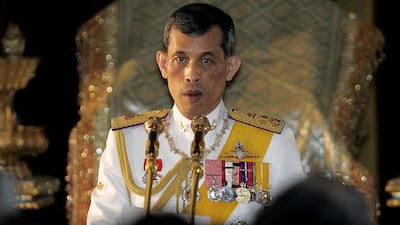
Maha Vajiralongkorn reads a statement during the opening session of the parliament in Bangkok in 2008. AFP -
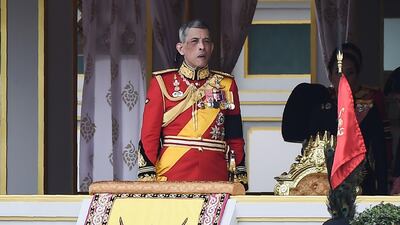
King Maha Vajiralongkorn attends the funeral procession of his father in October 2017. AFP -
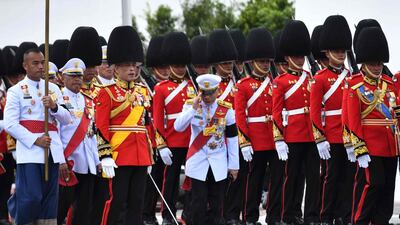
King Maha Vajiralongkorn attends the funeral procession of his father in October 2017. AFP AFP -
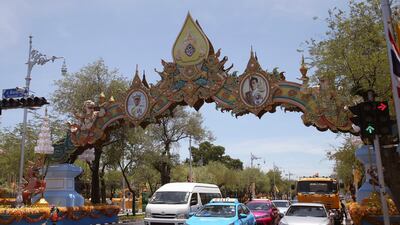
A Thai worker cleans a road ahead of the coronation. AP Photo -

Soldiers gather in front of a portrait of Thailand's King, ahead of the coronation. AFP -
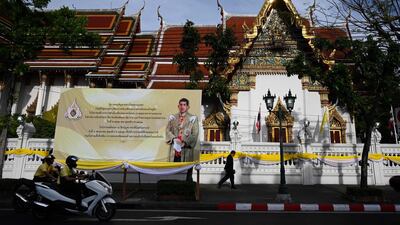
People make their way in front of a portrait of Thailand's King, ahead of the coronation. AFP -

People make their way in front of a portrait of Thailand's King, ahead of the coronation. AFP -
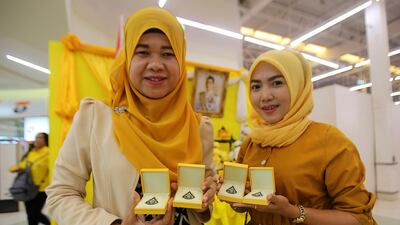
Muslim women pose with commemorative pins in Pattani province ahead of the coronation. AFP -
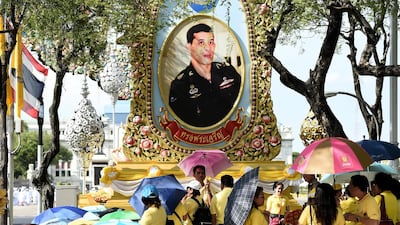
Well-wishers gather in front of a portrait of Thailand's King Maha Vajiralongkorn in Bangkok. AFP -
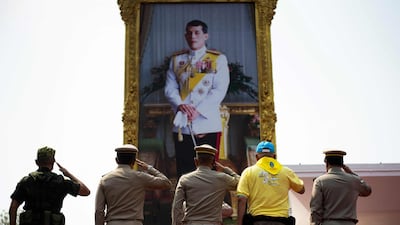
Thailand's Prime Minister Prayut Chan-O-Cha, Royal Thai Army Commander-in-Chief Apirat Kongsompong and others salute in front of a portrait of King Maha Vajiralongkorn in Lopburi. AFP


But as Bhumibol's health declined in the last decade and a half of his life, that balance began to shift. Now, with the army entrenched in government for five years after staging a coup in 2014, things seem to have shifted more in the military's favour.
KIng Vajiralongkorn has supporters in the military. He was educated at military academies, took part in 1970s counterinsurgency action against the Communist Party of Thailand, and is a qualified pilot in the air force, the service he is closest to.
There are special army units directly under the palace's command, and King Vajiralongkorn has augmented their strength.
"He has sought to bring more army units under his personal control," said Mr Chambers. "Prior to his father's death, the junta leaders seemed to have acted for the ailing and aged king but they were becoming too big for their britches, so to speak. Hence the new sovereign wanted to ensure personalised monarchical control over the military."
King Vajiralongkorn's actions help restore the balance of palace-barracks relations and "reflect a diminution of the army's own influence", Mr Montesano agreed.
The relationship, however, is a two-way street. An election held in March has been widely seen as rigged through convoluted election laws to favor the military and its preferred candidate, Prayuth Chan-ocha, who led the 2014 coup and has headed the government since then.
King Vajiralongkorn quickly clamped down when his older sister, Princess Ubolratana, lent her support to Mr Prayuth's opponents by agreeing to be a candidate for prime minister. The king declared the action unconstitutional and "inappropriate" because it violated a tradition of royals staying out of politics.
On the eve of the election, he issued a statement saying people should support "good people" to prevent "bad people" from gaining power and causing chaos, words that seemed to echo the junta in its justification for staging a coup.
New political jousting may follow King Vajiralongkorn's coronation within days, when election results are supposed to be certified and will almost certainly be challenged by the losers.
The Thai people, said Mr Sulak, will probably be peaceful and "full of joy" during the coronation ceremony period.
"But I'm not sure afterwards," he said.

