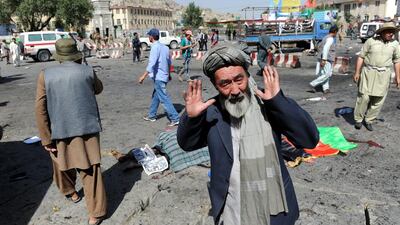
After years of persecuting Afghanistan’s religious and ethnic minorities, the Taliban are now trying to win over and recruit from the Shiite Hazara community ahead of intra-Afghan peace talks.
The predominantly Sunni insurgents posted a video on their website last week to introduce their first local leader from the Hazara community. Mawlawi Mahdi, a Shiite cleric militia leader, was named the Taliban’s governor for Balkhab district in Sar-e-Pul province in northern Afghanistan.
In the video posted on April 22, Mahdi urges Hazaras, who have faced repeated attacks from the Taliban over the past two decades, to join the group in fighting against “Jewish and Christian invaders”, referring to the United States.
“Weren’t you in the frontline fighting the Soviet Union alongside your Sunni brothers?” he says. “Why aren't you joining your Taliban brothers in fighting this invasion?”
The Taliban are “inclusive of all people without any racism” and Shiites are very much a part of their “divine strategy”, Mahdi says in another section of the roughly edited video, in which some of his statements are cut off in mid-sentence.
The Taliban are scheduled to hold peace talks with government officials and representatives of civil society under a deal with the US administration to end nearly two decades of war in the country. The group has continued to attack the US-backed government forces as preparations for the talks make halting progress.
Bringing in minority members like Mahdi at this stage could be an attempt by the Taliban to gain more legitimacy for the negotiations, experts say.
“The Taliban has never been an inclusive force; their leadership in Quetta and Peshawar and their political office in Doha are run by Sunni Pashtuns. They have had token Tajik commanders in the field, particularly in the north, but now they are trying to include some token Shia Hazaras in the mix,” said Sabir Ibrahimi, an Afghan security analyst and research associate at New York University’s Centre on International Co-operation.
Ali Yawar Adili, a researcher with the Afghanistan Analysts Network, agrees. “In recent years, the Taliban have recruited from other communities like Tajiks and Uzbeks. They seemed to feel a gap in their effort to portray themselves as a nationwide movement due to the lack of any significant influence among ethnic Hazaras,” he said.
There is no census data available, but it is estimated that Hazaras comprise up to 15 per cent of the Afghan population.
However, Mahdi’s background is unlikely to reassure ordinary civilians in Balkhab, even though he is a native of the predominantly Hazara district.
Mr Ibrahim said Mahdi was responsible for a number of attacks on Afghan government forces, abduction and extortion, and served six years in prison on criminal charges.
After his release in 2018, Mahdi was sent to Balkhab by Afghan politician Mohammad Mohaqeq as his “viceroy”, and established himself as warlord in the region, Mr Ibrahimi said.
Mr Mohaqeq, the deputy chief executive of Afghanistan in the previous government, is leader of the Hezb-e Wahdat party of which Mahdi was once a member.
The people of Balkhab became fed up with Mahdi and there was an uprising against him in October 2018, Mr Ibrahimi said. “He then fled the town. He returned a year later and is based there now,” he said.
Mr Ibrahimi suggested Mahdi’s appointment might also be an attempt by the Taliban to appeal to Shiite-majority Iran, which has maintained a loose alliance with the insurgents despite ideological differences.
He said the Taliban had a political office in the Iranian city of Mashhad, while Iranian foreign minister Mohammad Javad Zarif had publicly admitted that Iran had ties with the Taliban.
“This is more of a political alliance with Iran than to create sectarian harmony,” Mr Ibrahimi said.
Many Hazaras fled to Iran to escape Afghanistan’s wars after the Soviet invasion in 1979, and some of those refugees have joined the Fatemiyoun Afghan militia mobilised by Tehran to fight for the Assad regime in Syria.
But the Taliban will find it difficult to sway the Hazaras, according to both Mr Ibrahimi and Mr Adili.
“Afghan Hazaras suffered, perhaps more than any other ethnic group, under the Taliban and have continued to suffer from its insurgency. It is hard to imagine they will trust the Taliban that soon, especially given that they pushed into Hazara districts in Ghazni and Uruzgan in 2018 and have been carrying out attacks against certain Hazara villages in the north,” Mr Adili said.
But if more Shiite areas fall to the Taliban, people there might have no choice but to accept their rule or flee, Mr Ibrahimi added.

Islamophobia definition
A widely accepted definition was made by the All Party Parliamentary Group on British Muslims in 2019: “Islamophobia is rooted in racism and is a type of racism that targets expressions of Muslimness or perceived Muslimness.” It further defines it as “inciting hatred or violence against Muslims”.
Fatherland
Kele Okereke
(BMG)
Vikram%20Vedha
%3Cp%3E%3Cstrong%3EDirectors%3A%3C%2Fstrong%3E%20Gayatri%2C%20Pushkar%3C%2Fp%3E%0A%3Cp%3E%3Cstrong%3EStars%3A%3C%2Fstrong%3E%20Hrithik%20Roshan%2C%20Saif%20Ali%20Khan%2C%20Radhika%20Apte%3C%2Fp%3E%0A%3Cp%3E%3Cstrong%3ERating%3A%C2%A0%3C%2Fstrong%3E3.5%2F5%3C%2Fp%3E%0A
The rules on fostering in the UAE
A foster couple or family must:
- be Muslim, Emirati and be residing in the UAE
- not be younger than 25 years old
- not have been convicted of offences or crimes involving moral turpitude
- be free of infectious diseases or psychological and mental disorders
- have the ability to support its members and the foster child financially
- undertake to treat and raise the child in a proper manner and take care of his or her health and well-being
- A single, divorced or widowed Muslim Emirati female, residing in the UAE may apply to foster a child if she is at least 30 years old and able to support the child financially
UAE currency: the story behind the money in your pockets
Points about the fast fashion industry Celine Hajjar wants everyone to know
- Fast fashion is responsible for up to 10 per cent of global carbon emissions
- Fast fashion is responsible for 24 per cent of the world's insecticides
- Synthetic fibres that make up the average garment can take hundreds of years to biodegrade
- Fast fashion labour workers make 80 per cent less than the required salary to live
- 27 million fast fashion workers worldwide suffer from work-related illnesses and diseases
- Hundreds of thousands of fast fashion labourers work without rights or protection and 80 per cent of them are women
PSG's line up
GK: Alphonse Areola (youth academy)
Defence - RB: Dani Alves (free transfer); CB: Marquinhos (€31.4 million); CB: Thiago Silva (€42m); LB: Layvin Kurzawa (€23m)
Midfield - Angel di Maria (€47m); Adrien Rabiot (youth academy); Marco Verratti (€12m)
Forwards - Neymar (€222m); Edinson Cavani (€63m); Kylian Mbappe (initial: loan; to buy: €180m)
Total cost: €440.4m (€620.4m if Mbappe makes permanent move)
Who has lived at The Bishops Avenue?
- George Sainsbury of the supermarket dynasty, sugar magnate William Park Lyle and actress Dame Gracie Fields were residents in the 1930s when the street was only known as ‘Millionaires’ Row’.
- Then came the international super rich, including the last king of Greece, Constantine II, the Sultan of Brunei and Indian steel magnate Lakshmi Mittal who was at one point ranked the third richest person in the world.
- Turkish tycoon Halis Torprak sold his mansion for £50m in 2008 after spending just two days there. The House of Saud sold 10 properties on the road in 2013 for almost £80m.
- Other residents have included Iraqi businessman Nemir Kirdar, singer Ariana Grande, holiday camp impresario Sir Billy Butlin, businessman Asil Nadir, Paul McCartney’s former wife Heather Mills.
Hunting park to luxury living
- Land was originally the Bishop of London's hunting park, hence the name
- The road was laid out in the mid 19th Century, meandering through woodland and farmland
- Its earliest houses at the turn of the 20th Century were substantial detached properties with extensive grounds
UAE tour of the Netherlands
UAE squad: Rohan Mustafa (captain), Shaiman Anwar, Ghulam Shabber, Mohammed Qasim, Rameez Shahzad, Mohammed Usman, Adnan Mufti, Chirag Suri, Ahmed Raza, Imran Haider, Mohammed Naveed, Amjad Javed, Zahoor Khan, Qadeer Ahmed
Fixtures:
Monday, 1st 50-over match
Wednesday, 2nd 50-over match
Thursday, 3rd 50-over match
The specs
Engine: 4.0-litre, twin-turbocharged V8
Transmission: nine-speed automatic
Power: 630bhp
Torque: 900Nm
Price: Dh810,000
COMPANY%20PROFILE%20
%3Cp%3E%3Cstrong%3EName%3A%3C%2Fstrong%3E%20Haltia.ai%0D%3Cbr%3E%3Cstrong%3EStarted%3A%3C%2Fstrong%3E%202023%0D%3Cbr%3E%3Cstrong%3ECo-founders%3A%3C%2Fstrong%3E%20Arto%20Bendiken%20and%20Talal%20Thabet%0D%3Cbr%3E%3Cstrong%3EBased%3A%3C%2Fstrong%3E%20Dubai%2C%20UAE%0D%3Cbr%3E%3Cstrong%3EIndustry%3A%3C%2Fstrong%3E%20AI%0D%3Cbr%3E%3Cstrong%3ENumber%20of%20employees%3A%3C%2Fstrong%3E%2041%0D%3Cbr%3E%3Cstrong%3EFunding%3A%3C%2Fstrong%3E%20About%20%241.7%20million%0D%3Cbr%3E%3Cstrong%3EInvestors%3A%3C%2Fstrong%3E%20Self%2C%20family%20and%20friends%26nbsp%3B%3C%2Fp%3E%0A
THE LOWDOWN
Romeo Akbar Walter
Rating: 2/5 stars
Produced by: Dharma Productions, Azure Entertainment
Directed by: Robby Grewal
Cast: John Abraham, Mouni Roy, Jackie Shroff and Sikandar Kher
Manchester United v Liverpool
Premier League, kick off 7.30pm (UAE)
WE%20NO%20LONGER%20PREFER%20MOUNTAINS
%3Cp%3E%3Cstrong%3EDirector%3A%3C%2Fstrong%3E%20Inas%20Halabi%3C%2Fp%3E%0A%3Cp%3E%3Cstrong%3EStarring%3A%20%3C%2Fstrong%3ENijmeh%20Hamdan%2C%20Kamal%20Kayouf%2C%20Sheikh%20Najib%20Alou%3C%2Fp%3E%0A%3Cp%3E%3Cstrong%3ERating%3A%3C%2Fstrong%3E%204%2F5%3C%2Fp%3E%0A
