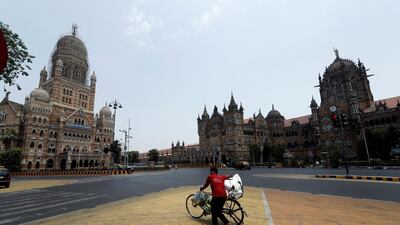
Migrant workers are fleeing India’s cities over fears that record increases in Covid-19 infections and deaths will lead to a nationwide lockdown that will leave them jobless and stranded far from home like last year.
Tens of millions of casual workers were laid off after Prime Minister Narendra Modi imposed a sudden nationwide lockdown last March that forced businesses to close and shut down public transport. Despite restrictions on movement, hundreds of thousands attempted to walk, cycle or hitch-hike to their villages hundreds of kilometres away as the lockdown was extended for several months.
Although many have since returned to find work, they are growing anxious after several states and cities announced new restrictions to contain infections and reduce the burden on health facilities.
In the capital New Delhi, the city government imposed a night curfew, while Maharashtra, the worst-affected state, imposed a weekend lockdown. The state's main city of Mumbai, India's financial capital, has recorded nearly 10,000 cases a day since last week.
-
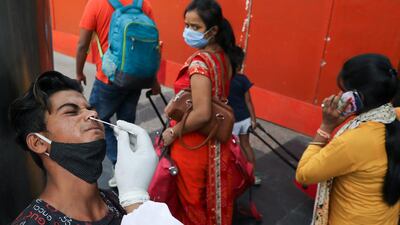
A man undergoes a swab sample at a railway station in New Delhi, India, on April 7, 2021. Reuters -
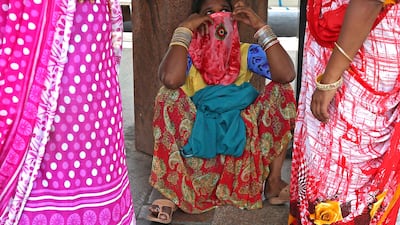
A woman covers her mouth in Bangalore, India, on April 7, 2021. The country recorded 115,736 new coronavirus cases in the latest 24-hour reporting period, the highest daily figure since the start of the pandemic. A second wave of Covid-19 in India has led several states, including Maharashtra and the capital, New Delhi, to reimpose restrictions. EPA -
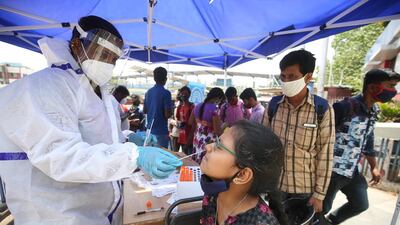
A girl undergoes a swab test at a bus stop in Bangalore, India, on April 7, 2021. EPA -
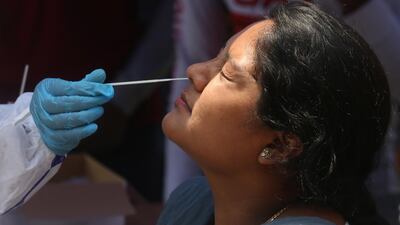
A woman undergoes a swab test at a bus stop in Bangalore, India, on April 7, 2021. EPA -
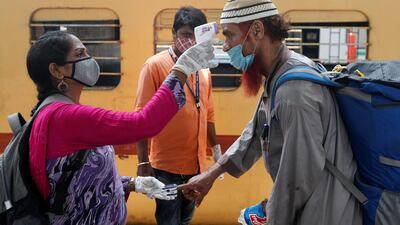
A health worker checks a train passenger’s temperature and pulse on a railway station platform in Mumbai, India, on April 7, 2021. Reuters -

A man is immunised against Covid-19 at a government hospital in Noida, a suburb of New Delhi, India, on April 7, 2021. AP -
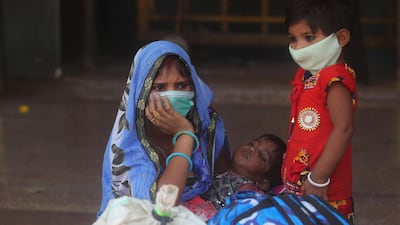
A woman and her children wait for a train at Lokmanya Tilak Terminus in Mumbai, India, on April 7, 2021. Mumbai and dozens of other cities have imposed night-time curfews to counter a rise in coronavirus infections. AP -
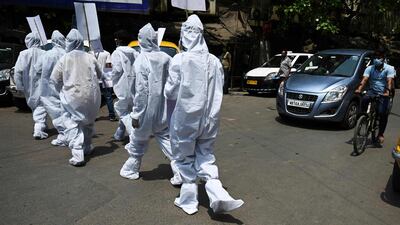
Protesters wearing hazmat suits demonstrate near the Election Commission office in Kolkata on April 7, 2021. They demand that the ongoing state legislative election and campaign rallies be put on hold because of the rise in coronavirus cases. AFP -
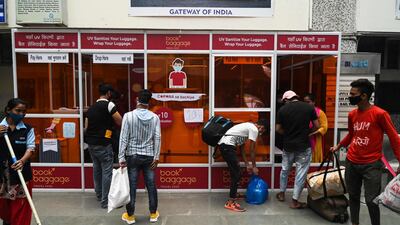
Passengers sanitise their baggage using a UV disinfection machine at a railway terminal in Mumbai, India, on April 7, 2021. AFP -
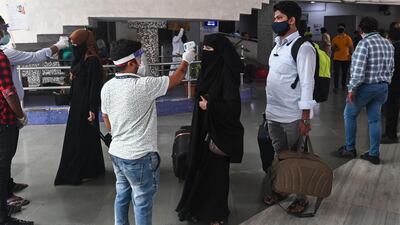
A health worker takes the body temperature of incoming passengers at a railway terminal. Restrictions were imposed in Mumbai by the state government because of a rising number of Covid-19 cases. AFP -
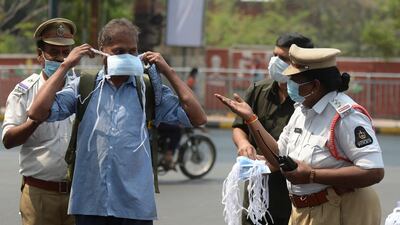
A woman police officer tells a man to wear face mask during an awareness campaign against the spread of Covid-19 at a traffic junction in Hyderabad, India, on April 7, 2021. AFP -
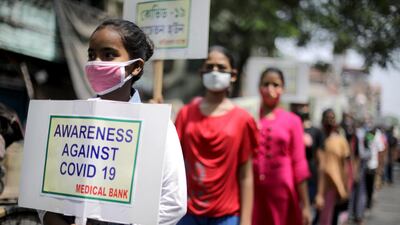
Volunteers take part in a Covid-19 awareness rally to mark World Health Day, in Kolkata, India, on April 7, 2021. EPA


Punjab, Gujarat and Chhattisgarh states have also announced partial lockdowns and curfews until April 30.
“We are scared of being stuck here again like last year when the government declared a sudden lockdown,” said Ram Singh, a migrant worker in New Delhi who is from the state of Bihar.
Transport operators at a major bus terminal in the capital said workers have been leaving in large numbers.
"Every day, more and more labourers are leaving the city. They are going to villages. We are seeing a sudden increase in their numbers since the curfew has been imposed," Puran Lal, 46, a bus conductor told The National.
Officials say India is experiencing its second wave of the pandemic as infections rise sharply after a slump in cases earlier this year. On Saturday, health authorities reported more than 145,000 cases over the previous 24 hours, a new daily record that took its overall tally to 13.2 million, the third-highest after the United States and Brazil. Deaths rose by 794 to 168,436, health ministry data showed.
State governments have closed malls, theatres, restaurants and markets except those selling essential goods. Masks and social distancing have been made mandatory and the government has urged people to take vaccines in a bid to arrest the infection rates.
Attendance caps have been reimposed on wedding, funerals and other gatherings, months after most restrictions were gradually lifted.
The earlier drop in cases and easing of restrictions since August encouraged many migrant workers to go back to the cities.
Nazrul Haq, 38, returned to Mumbai from Bihar to work as a tailor at a small workshop in Dharavi, Asia’s largest slum.
Nazrul Haq, tailor
He said he was reassured when the case numbers dropped but now fears the workshop could be shut at any time and that work will become scarce with fresh restrictions. Many businesses are operating with reduced working hours.
"I came back in January but the work is not the same as pre-pandemic levels. We are working six hours a day but only making enough money for two weeks," Mr Haq told The National.
“There is a constant fear of what happens next. I am keeping an eye on daily [case] updates and waiting to pack my bags."
Nearly 80 per cent of India’s 400 million blue-collar workforce, mostly migrant workers, are employed in the country's informal sector that includes an estimated seven million small and micro industries or as domestic and construction workers.
Most of them earn about $100-$150 a month with no job or social security, and have savings that could only last 10 days, according to several independent surveys.
India's economy was severely affected by the lockdown imposed by Mr Modi last year, with gross domestic product contracting by a record 24.4 per cent and the country experiencing its first recession since attaining independence from Britain in 1947.

