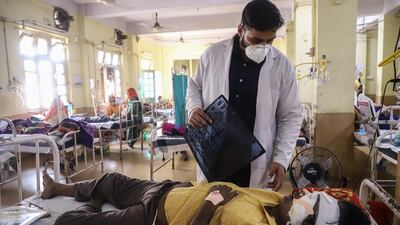
A doctor attends a Covid-19 patient infected with black fungus at the NSCB hospital in Jabalpur, India on May 20, 2021. AFP

India's Covid-19 crisis: states sound alarm over surge in 'black fungus' case numbers


  • English
  • Arabic

States across India have ordered emergency measures to counter a surge of the rare, often deadly, "black fungus" infection among Covid-19 patients.

Two more states declared epidemics of mucormycosis while New Delhi and other major cities opened special wards to treat thousands of cases of the infection commonly known as black fungus.

India normally deals with fewer than 20 cases a year, but the infection has become a new threat after a second wave of Covid-19 that killed 120,000 people in six weeks.

The health ministry on Friday reported another 4,209 deaths and 259,551 new infections over the previous 24 hours, raising India's death toll to 291,331 out of 26.03 million cases.

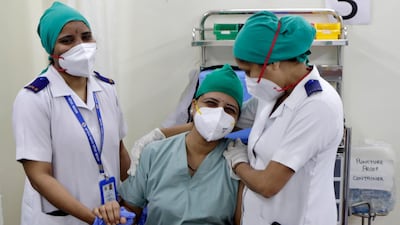
  • A health worker reacts after receiving a dose of Covaxin vaccine at a vaccination centre in Mumbai, India. AP Photo
    A health worker reacts after receiving a dose of Covaxin vaccine at a vaccination centre in Mumbai, India. AP Photo
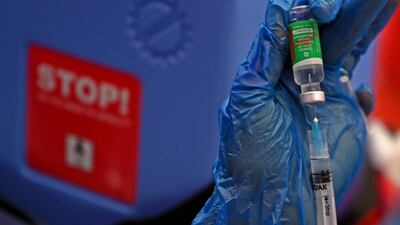
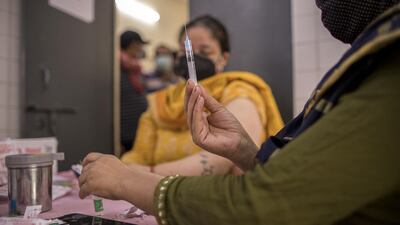
  • A health worker prepares the jab of the Covishield Covid-19 vaccine in a residential area in Chennai. AFP
    A health worker prepares the jab of the Covishield Covid-19 vaccine in a residential area in Chennai. AFP
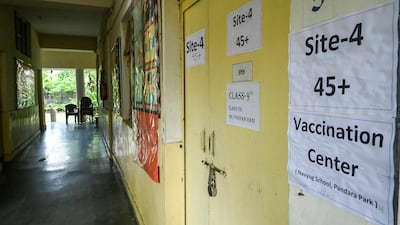
  • A vaccination centre is seen closed due to non-availability of Covid-19 vaccines in New Delhi. AFP
    A vaccination centre is seen closed due to non-availability of Covid-19 vaccines in New Delhi. AFP
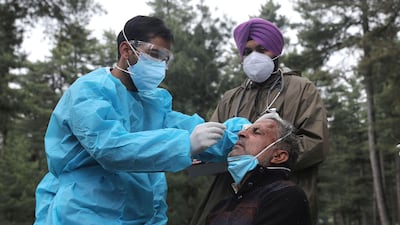
  • Health workers collect a nasal swab sample from a man for Covid-19 testing at Khag village, in central Kashmir's Budgam district. AFP
    Health workers collect a nasal swab sample from a man for Covid-19 testing at Khag village, in central Kashmir's Budgam district. AFP
  • Jagdish Chand Sharma shows a photograph of his late wife Anita sharma, who was a Covid-19 patient at Dr Karam Singh Memorial Multi Specially hospital in Amritsar. AFP
    Jagdish Chand Sharma shows a photograph of his late wife Anita sharma, who was a Covid-19 patient at Dr Karam Singh Memorial Multi Specially hospital in Amritsar. AFP
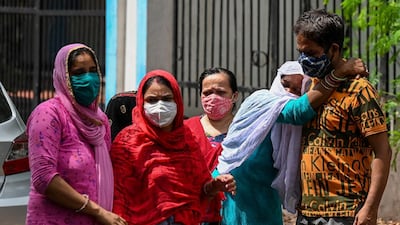
  • Relatives mourn as they wait to receive the body of their loved one, who died due to the Covid-19, at a mortuary in New Delhi. AFP
    Relatives mourn as they wait to receive the body of their loved one, who died due to the Covid-19, at a mortuary in New Delhi. AFP
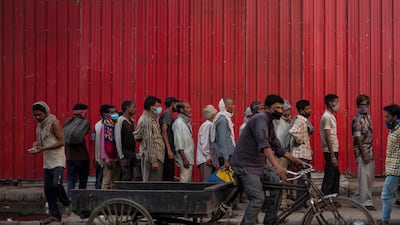
  • Rickshaw-pullers and other migrant labourers queue up to receive food distributed by a charity as the lockdown continues in New Delhi. Getty Images
    Rickshaw-pullers and other migrant labourers queue up to receive food distributed by a charity as the lockdown continues in New Delhi. Getty Images
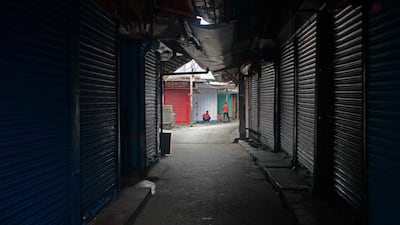
  • Partially deserted roads with closed shops are seen in a market in Siliguri. AFP
    Partially deserted roads with closed shops are seen in a market in Siliguri. AFP
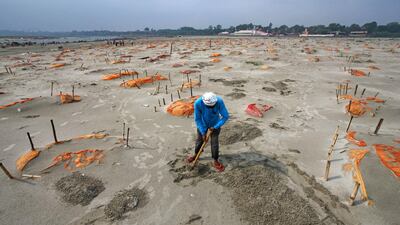
  • Bodies, some of which are believed to be Covid-19 victims, are seen partially exposed in shallow sand graves after rains washed away the top layer of sand at a cremation ground on the banks of the Ganges River in Shringverpur, north-west of Allahabad, Uttar Pradesh. Getty Images
    Bodies, some of which are believed to be Covid-19 victims, are seen partially exposed in shallow sand graves after rains washed away the top layer of sand at a cremation ground on the banks of the Ganges River in Shringverpur, north-west of Allahabad, Uttar Pradesh. Getty Images

The fungal infection, which some doctors blame on the high use of steroids in treating coronavirus patients, kills more than 50 per cent of sufferers within days. In some cases, surgeons removed eyes and upper jaws to save lives.

Authorities have not said how many people have died from black fungus.

But a government alert to state authorities on Thursday said teams of reconstruction and general surgeons as well as ear, nose and throat specialists had to be readied to treat the growing number of sufferers.

Gujarat and Telangana states became the latest to declare black fungus epidemics on Thursday, a day after Rajasthan.

Maharashtra state has reported more than 2,000 cases. Gujarat, home state of Prime Minister Narendra Modi, has about 1,200, officials said.

Ahmedabad civil hospital, one of Gujarat's biggest, was treating 371 cases, a spokesman said. Health officials said there were about 400 cases in the government hospital in the city of Rajkot.

New Delhi set up special wards at three hospitals to cope with increased numbers of black fungus.

There are more than 200 black fungus patients in New Delhi hospitals, with dozens on waiting lists for beds, according to media reports.

The IT hub of Bangalore opened special wards on Wednesday which filled within hours, doctors said.

Anti-fungal drugs are the latest shortage to hit India's stretched healthcare system and social media is being flooded with requests from relatives of mucormycosis patients pleading for help to find medicine.

Black fungus is caused by organisms called mucormycetes, which can enter the body through breathing or skin injuries.

These are naturally present in soil and decaying organic matter, but once inside the human body, they can infect air pockets behind the forehead, nose, cheekbones and between the eyes and teeth.

Some doctors said the panic use of steroids to combat Covid-19 helped the spread of black fungus.

"Indiscriminate use of steroids to treat Covid-19 patients should be avoided," Maharashtra's Health Minister Rajesh Tope said Wednesday.

Other doctors say the unhygienic conditions in some hospitals when putting coronavirus patients on oxygen cylinders allowed black fungus to take hold.

Coronavirus patients with diabetes and a weakened immune system are particularly prone to attack.

Many of the drugs used to fight the coronavirus suppress the body's immune system that would normally ward off a fungal infection.

  • A nurse attends to a patient at a free Covid-19 care centre being operated by a Sikh voluntary organisation in Ghaziabad, on the outskirts of New Delhi. AP Photo
    A nurse attends to a patient at a free Covid-19 care centre being operated by a Sikh voluntary organisation in Ghaziabad, on the outskirts of New Delhi. AP Photo
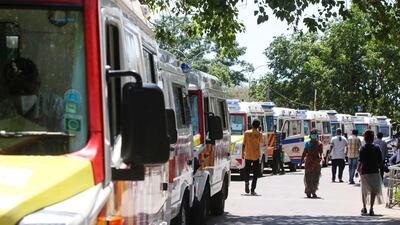
  • Ambulances carrying Covid-19 patients wait for admission at the Rajiv Gandhi General Hospital, in Chennai. AP Photo
    Ambulances carrying Covid-19 patients wait for admission at the Rajiv Gandhi General Hospital, in Chennai. AP Photo
  • A patient waits for a Covid-19 test at a testing centre in Kalyani near Kolkata. EPA
    A patient waits for a Covid-19 test at a testing centre in Kalyani near Kolkata. EPA
  • A heath worker collects swab samples of people to test for Covid-19 in a slum area in Gauhati, Assam state, India. AP Photo
    A heath worker collects swab samples of people to test for Covid-19 in a slum area in Gauhati, Assam state, India. AP Photo
  • A health worker prepares a dose of a Covid-19 vaccine at a heath centre in the village of Bazrak, Uttar Pradesh. Bloomberg
    A health worker prepares a dose of a Covid-19 vaccine at a heath centre in the village of Bazrak, Uttar Pradesh. Bloomberg
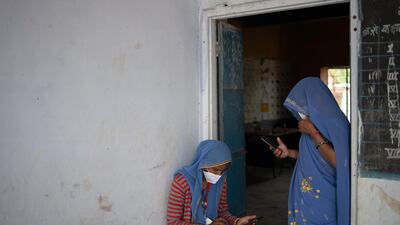
  • Social health activists call and register vaccine beneficiaries ahead of the start of a vaccination clinic to administer the Covaxin vaccine in Aakhtadi, Tonk District, Rajasthan. Getty Images
    Social health activists call and register vaccine beneficiaries ahead of the start of a vaccination clinic to administer the Covaxin vaccine in Aakhtadi, Tonk District, Rajasthan. Getty Images
  • A woman walks past notices displayed in a civil hospital indicating the Covid-19 vaccine is out of stock, in Amritsar, India. AFP
    A woman walks past notices displayed in a civil hospital indicating the Covid-19 vaccine is out of stock, in Amritsar, India. AFP
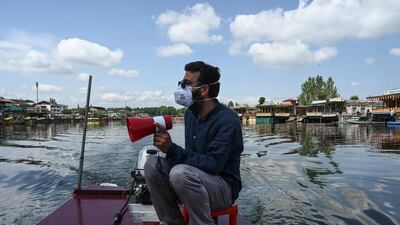
  • A man on a private ambulance boat announces Covid-19 protocols at Dal lake in Srinagar. AFP
    A man on a private ambulance boat announces Covid-19 protocols at Dal lake in Srinagar. AFP
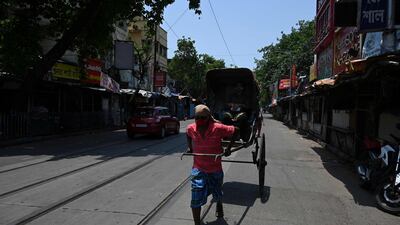
  • A rickshaw worker is seen along a deserted road after the West Bengal government announced a 15-day lockdown in Kolkata. AFP
    A rickshaw worker is seen along a deserted road after the West Bengal government announced a 15-day lockdown in Kolkata. AFP
  • A relative performs the last rites of a Covid-19 victim at a cremation ground in Srinagar. EPA
    A relative performs the last rites of a Covid-19 victim at a cremation ground in Srinagar. EPA
Timeline

2012-2015

The company offers payments/bribes to win key contracts in the Middle East

May 2017

The UK SFO officially opens investigation into Petrofac’s use of agents, corruption, and potential bribery to secure contracts

September 2021

Petrofac pleads guilty to seven counts of failing to prevent bribery under the UK Bribery Act

October 2021

Court fines Petrofac £77 million for bribery. Former executive receives a two-year suspended sentence 

December 2024

Petrofac enters into comprehensive restructuring to strengthen the financial position of the group

May 2025

The High Court of England and Wales approves the company’s restructuring plan

July 2025

The Court of Appeal issues a judgment challenging parts of the restructuring plan

August 2025

Petrofac issues a business update to execute the restructuring and confirms it will appeal the Court of Appeal decision

October 2025

Petrofac loses a major TenneT offshore wind contract worth €13 billion. Holding company files for administration in the UK. Petrofac delisted from the London Stock Exchange

November 2025

180 Petrofac employees laid off in the UAE

Ten tax points to be aware of in 2026

1. Domestic VAT refund amendments: request your refund within five years

If a business does not apply for the refund on time, they lose their credit.

2. E-invoicing in the UAE

Businesses should continue preparing for the implementation of e-invoicing in the UAE, with 2026 a preparation and transition period ahead of phased mandatory adoption. 

3. More tax audits

Tax authorities are increasingly using data already available across multiple filings to identify audit risks. 

4. More beneficial VAT and excise tax penalty regime

Tax disputes are expected to become more frequent and more structured, with clearer administrative objection and appeal processes. The UAE has adopted a new penalty regime for VAT and excise disputes, which now mirrors the penalty regime for corporate tax.

5. Greater emphasis on statutory audit

There is a greater need for the accuracy of financial statements. The International Financial Reporting Standards standards need to be strictly adhered to and, as a result, the quality of the audits will need to increase.

6. Further transfer pricing enforcement

Transfer pricing enforcement, which refers to the practice of establishing prices for internal transactions between related entities, is expected to broaden in scope. The UAE will shortly open the possibility to negotiate advance pricing agreements, or essentially rulings for transfer pricing purposes. 

7. Limited time periods for audits

Recent amendments also introduce a default five-year limitation period for tax audits and assessments, subject to specific statutory exceptions. While the standard audit and assessment period is five years, this may be extended to up to 15 years in cases involving fraud or tax evasion. 

8. Pillar 2 implementation 

Many multinational groups will begin to feel the practical effect of the Domestic Minimum Top-Up Tax (DMTT), the UAE's implementation of the OECD’s global minimum tax under Pillar 2. While the rules apply for financial years starting on or after January 1, 2025, it is 2026 that marks the transition to an operational phase.

9. Reduced compliance obligations for imported goods and services

Businesses that apply the reverse-charge mechanism for VAT purposes in the UAE may benefit from reduced compliance obligations. 

10. Substance and CbC reporting focus

Tax authorities are expected to continue strengthening the enforcement of economic substance and Country-by-Country (CbC) reporting frameworks. In the UAE, these regimes are increasingly being used as risk-assessment tools, providing tax authorities with a comprehensive view of multinational groups’ global footprints and enabling them to assess whether profits are aligned with real economic activity. 

Contributed by Thomas Vanhee and Hend Rashwan, Aurifer

How to wear a kandura

Dos

  • Wear the right fabric for the right season and occasion 
  • Always ask for the dress code if you don’t know
  • Wear a white kandura, white ghutra / shemagh (headwear) and black shoes for work 
  • Wear 100 per cent cotton under the kandura as most fabrics are polyester

Don’ts 

  • Wear hamdania for work, always wear a ghutra and agal 
  • Buy a kandura only based on how it feels; ask questions about the fabric and understand what you are buying
What are the main cyber security threats?

Cyber crime - This includes fraud, impersonation, scams and deepfake technology, tactics that are increasingly targeting infrastructure and exploiting human vulnerabilities.
Cyber terrorism - Social media platforms are used to spread radical ideologies, misinformation and disinformation, often with the aim of disrupting critical infrastructure such as power grids.
Cyber warfare - Shaped by geopolitical tension, hostile actors seek to infiltrate and compromise national infrastructure, using one country’s systems as a springboard to launch attacks on others.

Tamkeen's offering
  • Option 1: 70% in year 1, 50% in year 2, 30% in year 3
  • Option 2: 50% across three years
  • Option 3: 30% across five years