


Park Hyun stops to catch his breath after climbing a few steps to the entrance of the engineering college of Pusan National University, where he teaches. Despite persistent shortness of breath, he uses the stairs and avoids lifts.
Mr Park was Busan's "Patient 47", one of more than 5,000 South Koreans who have recovered from a coronavirus infection.
But 25 days after testing negative for the second time, he is in a new battle – against the stigma of having had the virus.
"I do understand the concerns and anxiety of my colleagues and neighbours, so I only use the stairs in this university building, and even to my apartment on the ninth floor," he said.
-
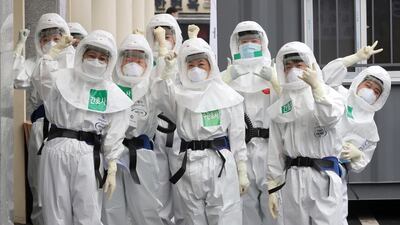
Medical staff members gesture as they arrive for a duty shift at Dongsan Hospital in Daegu, South Korea. Newsis via AP -
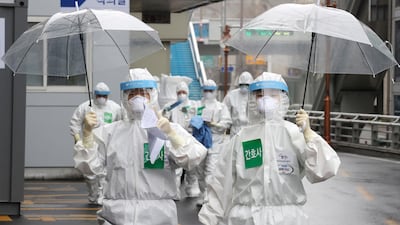
Medical staff members gesture as they arrive for a duty shift at Dongsan Hospital in Daegu, South Korea. Newsis via AP -
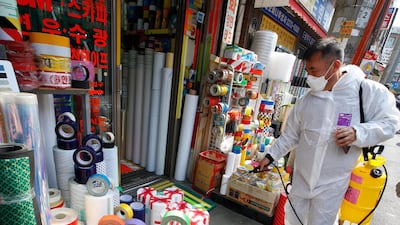
An member of a quarantine team sprays disinfectant as a preventive measure against coronavirus in Bangsan Market in Seoul. EPA -
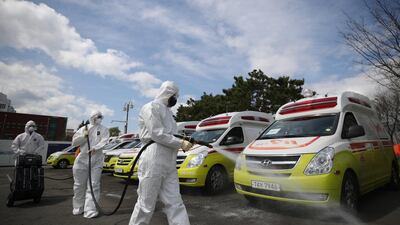
Emergency workers disinfect ambulances used for transferring the novel coronavirus Covid-19 patients in the south-east city of Daegu. EPA -
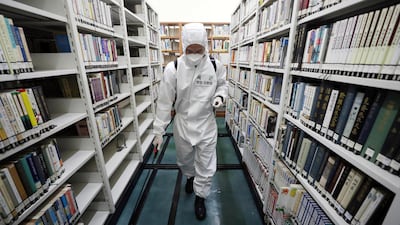
An army soldier sprays disinfectant to curb the spread of the coronavirus at a library in Daegu, South Korea. Yonhap via AP -
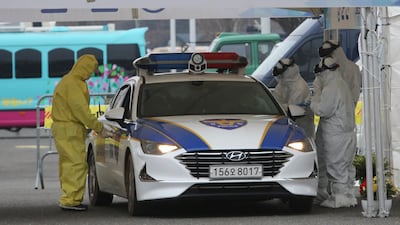
Medical staff wearing protective suits take samples from a driver with symptoms of the coronavirus at a "drive-through" virus test facility in Goyang. AP -
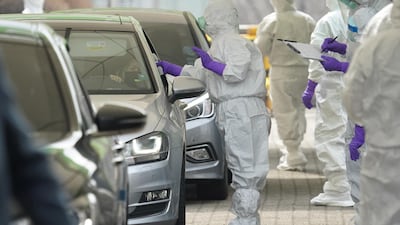
A driver gets a coronavirus test at a drive-through clinic in Seoul. Reuters -
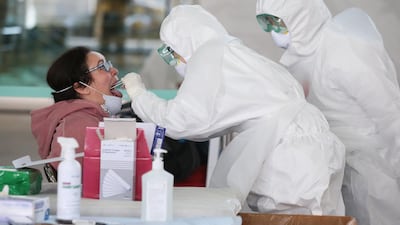
Medical workers wearing protective gear take samples from a foreign visitor at an 'Open Walking-Thru' centre for coronavirus Covid-19 tests at the airport in Incheon. EPA -
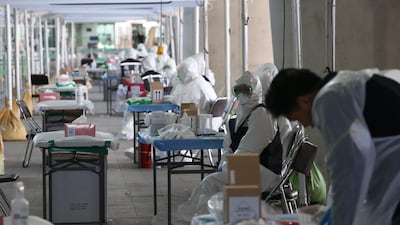
Medical workers wearing protective gear wait for foreign passengers to take samples at an 'Open Walking-Thru' centre for coronavirus Covid-19 tests at the airport in Incheon. EPA -
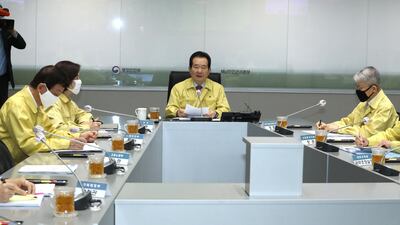
South Korea's Prime Minister Chung Sye-kyun speaks via video conference with senior government officials and heads of local governments EPA/YONHAP -
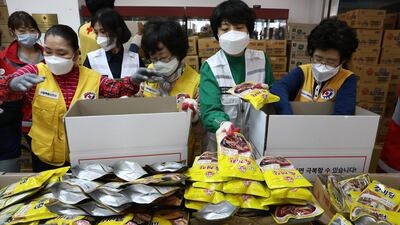
South Korean Red Cross workers prepare emergency relief kits packed with basic necessities for delivery to impoverished people experiencing difficulties amid the spread of coronavirus. Getty Images -
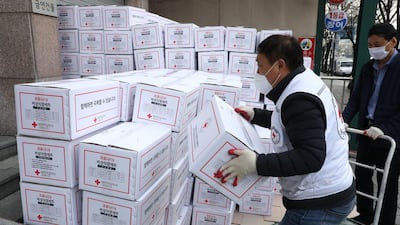
South Korean Red Cross workers prepare emergency relief kits packed with basic necessities for delivery to impoverished people experiencing difficulties amid the spread of coronavirus. Getty Images -
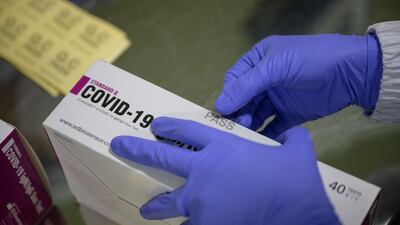
Covid-19 novel coronavirus testing kits are packaged on a production line at the SD Biosensor bio-diagnostic company near Cheongju, south of Seoul. AFP -
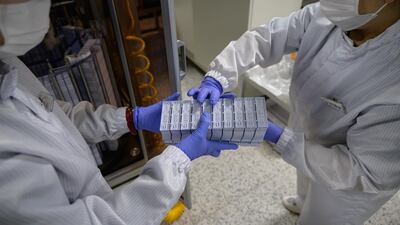
Staff members restock a machine with components used in testing for Covid-19 novel coronavirus. AFP -
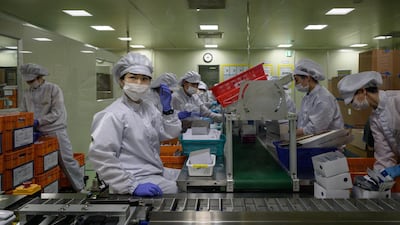
Staff members restock a machine with components used in testing for Covid-19 novel coronavirus. AFP -
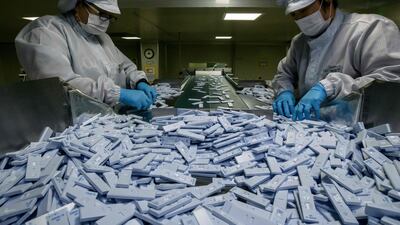
Sample testing devices used in diagnosing the Covid-19 novel coronavirus are checked on a production line as they are prepared to be included in testing kits for shipment. AFP -
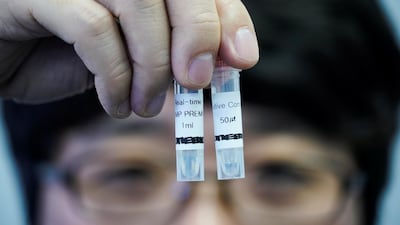
Kim Min-bae, CEO of iONEBIO Inc. poses for photographs with samples of iLAMP Novel-Coronavirus Detection Kit. Reuters -
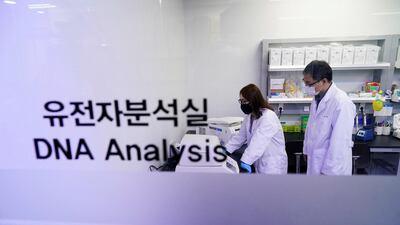
Researchers demonstrate samples of iLAMP Novel-Coronavirus Detection Kit at an iONEBIO's office in Seongnam, South Korea. Reuters -
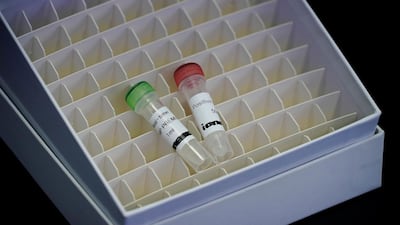
Samples of iLAMP Novel-Coronavirus Detection Kit are seen during a demonstration at an iONEBIO's office in Seongnam. Reuters -
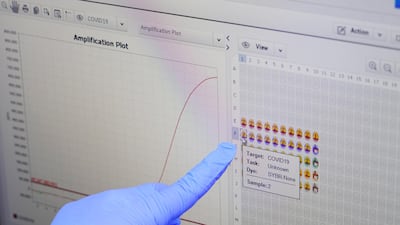
A researcher shows a result of coronavirus-positive case as she demonstrates samples of iLAMP Novel-Coronavirus Detection Kit at an iONEBIO's office in Seongnam, South Korea. Reuters -
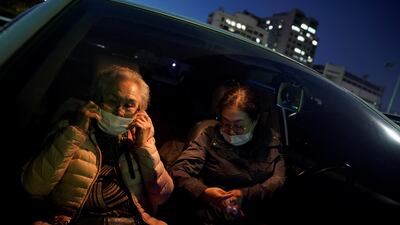
An elderly woman adjusts her mask as she waits for a movie to start at a drive-in theatre temporarily set up for residents following the outbreak of the coronavirus. Reuters -
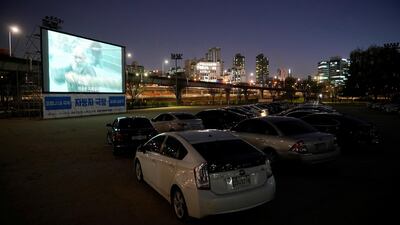
Vehicles parked at a drive-in theatre that has been temporarily made for residents to enjoy movies while keeping social distancing amid the outbreak of the coronavirus. Reuters


Mr Park, 47, spent nine days in a special ward before being released, then spent 14 days in isolation plus 10 more days to recover his strength, but says many people around him still think of the disease first.
During his hospitalisation, Mr Park's mother heard a neighbour screaming in front of their home: "We're all going to die because of a son in this family!"
Mr Park said he believed suspicions in the community run deeper because a large majority of the early outbreak was among the members of a secretive religious sect in the city of Daegu, about 100 kilometres north-west of Busan.
He said he decided to share his experience of the infection and the treatment he received to help dispel the mystery surrounding the epidemic. He has recorded the ups and downs of his fight with the disease on Facebook since day one.
‘Uncertainty breeds anxiety’
"By revealing my identity, I thought people would realise that I am not distributing fake news," he said. "Uncertainties are too high, and the anxieties are coming from uncertainties."
The pace of South Korea's outbreak has slowed since the dramatic increase in cases through February and early March, with 9,786 cases as of Tuesday. More than 5,400 patients have been released after testing negative.
Mr Park's colleagues welcomed him back to work on Monday, but there were no hugs or handshakes. He eats a boxed lunch at the lab with his workmates, but uses a separate table several metres away from them. If any are worried about having him around, he says, they are doing a good job not showing it.
"There were some people who were tested positive again after full recovery. I am mindful of the people around me," Mr Park said. He wears a face mask at all times.
The Korea Centres for Disease Control and Prevention said cases of people who tested positive after recovering required further epidemiological study and there was nothing definitive yet to suggest people can be infected twice in quick succession.
"We are now back to normal, but things are not the same as before – we used to debate sitting close to each other while using same keyboard, which is no longer possible since the outbreak," said a colleague, Prof Ahn Seok-young.
Mr Park's first task after resuming work was to make boxes using 3D printers for soap to be delivered to the elderly in Busan and other cities affected by the outbreak.
"Many elderly [people] in my city are living around the poverty line, having a problem buying hand sanitisers," Mr Park said. "We will also send soap and cases together to Daegu and other highly affected areas."

