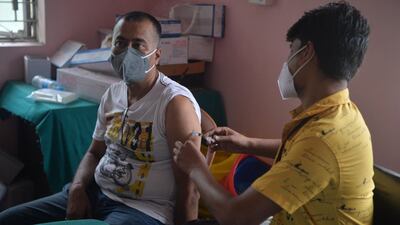
A third wave of coronavirus infections is likely to hit India by October, according to medical experts.
Although it will be better controlled than the latest outbreak, the pandemic will remain a public health threat for at least another year, they predicted.
However, a significant increase in the vaccination rate is expected to provide some protection against a fresh outbreak, according 40 healthcare specialists, doctors, scientists, virologists, epidemiologists and professors from around the world polled by Reuters news agency.
Of those who ventured a prediction, more than 85 per cent of respondents, or 21 of 24, said the next wave will hit by October, including three who forecast it as early as August and 12 in September.
The remaining three said between November and February.
But more than 70 per cent of experts, or 24 of 34, said any new outbreak would be better controlled compared with the current one, which has been far more devastating – with shortage of vaccines, medicines, oxygen and hospital beds – than the smaller first surge in infections last year.
"It will be more controlled, as cases will be much less because more vaccinations would have been rolled out and there would be some degree of natural immunity from the second-wave," said Dr Randeep Guleria, director at the All India Institute Of Medical Sciences.
The country has so far administered 272 million vaccine doses, including 50.5 million second doses, the government said on Saturday.
The number of active cases declined to 760,019 from a May 10 peak of 3.7 million, while 60,753 new cases and 1,647 deaths were reported in the past 24 hours.
-
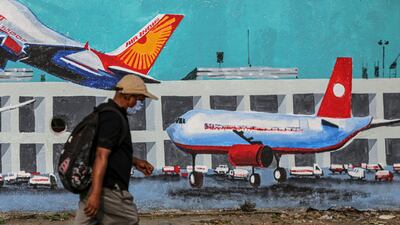
The UAE will next review flights between the country and India in early July. -
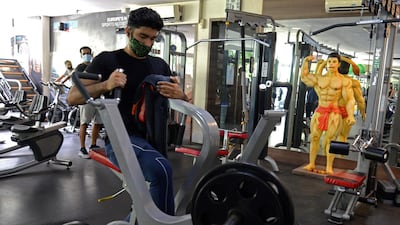
People workout at a gym in Mumbai, as India's financial hub. -
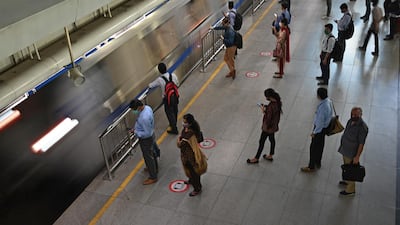
Commuters wait to board the metro at a station on June 7, 2021. -
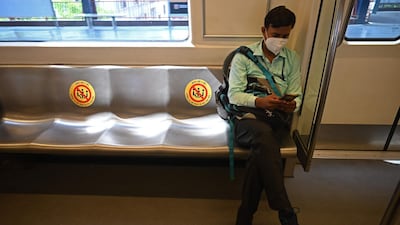
A man commutes on a train after the services were allowed to operate at 50 per cent capacity in New Delhi. AFP -
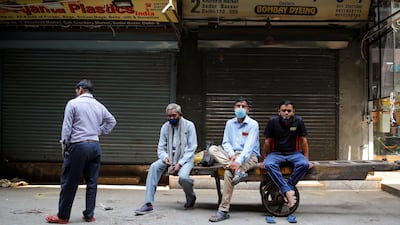
Shopkeepers wait to open their stores at a market area after authorities eased lockdown restrictions in New Delhi. -
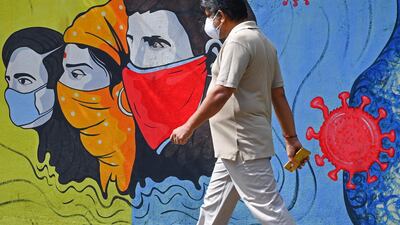
A pedestrian walks past a mural representing awareness measures against Covid-19 in Navi Mumbai. -
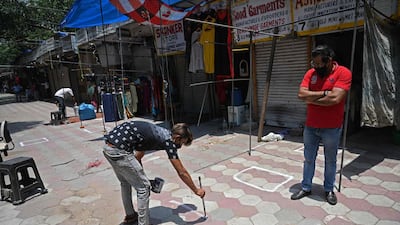
A shopkeeper paints a social distancing mark outside his shop after shops were allowed to reopen with restrictions in New Delhi. -
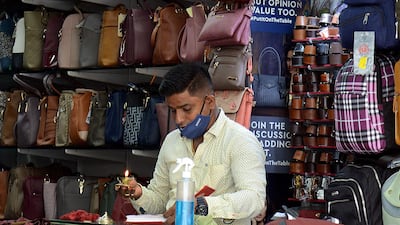
A shopkeeper offers prayers after he reopened his store in Mumbai. -
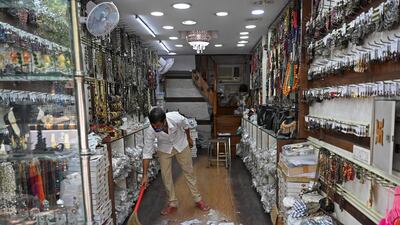
A shopkeeper cleans up after shops were allowed to reopen in New Delhi. -
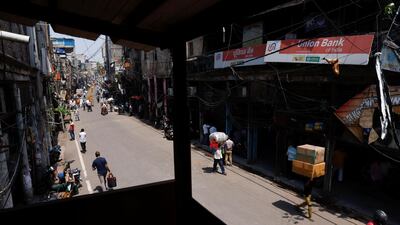
Workers carry goods at a market area in New Delhi.


When asked if children and those under 18 years would be most at risk in a potential third wave, nearly two-thirds of experts – or 26 of 40 – said yes.
"The reason being they are a completely virgin population in terms of vaccination because currently there is no vaccine available for them," said Pradeep Banandur, head of epidemiology at the National Institute of Mental Health and Neurosciences.
Experts warn the situation could become severe.
"If children get infected in large numbers and we are not prepared, there is nothing you can do at the last minute," said Dr Devi Shetty, a cardiologist at Narayana Health and an adviser to the Karnataka state government on pandemic response planning.
"It will be a whole different problem as the country has very, very few paediatric intensive care unit beds, and that is going to be a disaster."
But 14 experts said children were not at risk.
Earlier this week, a senior health ministry official said children were vulnerable and susceptible to infections but that analysis has shown a less severe health impact.
While 25 of 38 respondents said future coronavirus variants would not make existing vaccines ineffective, in response to a separate question, 30 of 41 experts said the coronavirus would remain a public health threat in India for at least a year.
Eleven experts said the threat would remain for under a year, 15 said for under two years, while 13 said over two years and two said the risks will never go away.
"Covid-19 is a solvable problem, as obviously it was easy to get a solvable vaccine. In two years, India likely will develop herd immunity through vaccine and exposure of the disease," said Robert Gallo, director of the Institute of Human Virology at the University of Maryland and international scientific adviser, Global Virus Network.
India has reported nearly 30 million Covid-19 infections since the pandemic began early last year – the second-highest after the US – and more than 385,000 deaths, placing it third after the US and Brazil.
-
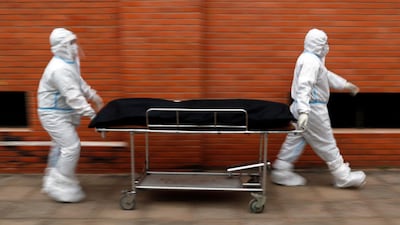
Nurses take the body of Isidra Coronel to the morgue after removing her body from a hospital bed where she died from the new coronavirus at Hospital de Clinicas in San Lorenzo, Paraguay. AP Photo -

A woman wearing a mask sits outside a closed shop in Hanoi. AFP -
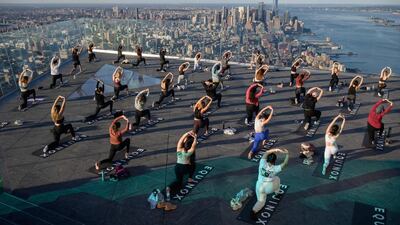
Yoga practitioners attend a class on the Edge Observation Deck, billed as the 'highest outdoor sky deck in the Western Hemisphere' at 1,131 feet (345 meters), and overlooking the Manhattan skyline, in New York. Pandemic restrictions have been gradually lifted in the US with just over 52 per cent of the US population, or 174 million people, having received at least one dose, according to health officials. AFP -
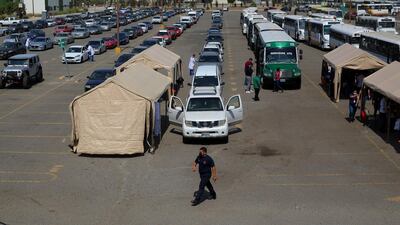
Cars and buses from maquiladoras line up for people to receive the Johnson & Johnson vaccine as part of a government plan to inoculate Mexican border residents on its shared frontier with the United States, in Tijuana, Mexico. Reuters -
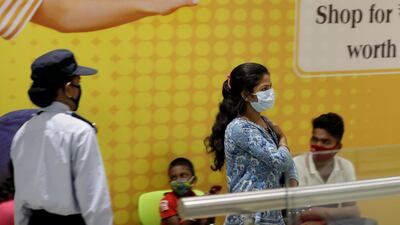
A woman leaves after receiving a vaccine shot during a vaccination drive at a shopping mall in Kolkata, India. Medica Superspecialty Hospital and Hindustan Club jointly start the vaccination drive. EPA -

A worker wearing a protective face mask and sunglasses, prepares the grave during a funeral of a Covid-19 victim at a dedicated cemetery in Jakarta, Indonesia. EPA -

A man shields himself from rain as he walks past Hounslow Jamia Masjid and Islamic Centre, used as a vaccination clinic, amid the spread of the coronavirus disease pandemic, London, Britain. Reuters


While a majority of healthcare experts predicted India's vaccination drive would pick up significantly this year, they cautioned against an early removal of restrictions, as some states have done.
Maharashtra, the epicentre of India's second wave, lifted many curbs this week in its cities, such as the financial capital of Mumbai, reopening malls, movie theatres and gyms at 50 per cent capacity and freeing offices from staff attendance limits.
Health officials in the western state, India's richest and second-most populous, urged authorities to step up preparations against a possible third wave of coronavirus infections.
"We should have a clear plan, and keep our preparations ready for the next few weeks, whenever the next wave comes," Rahul Pandit, a member of the state's Covid task force and a director of Fortis Hospitals Mumbai, said.
"Our efforts should be directed in delaying the wave as much as we can, and even try to prevent it."

