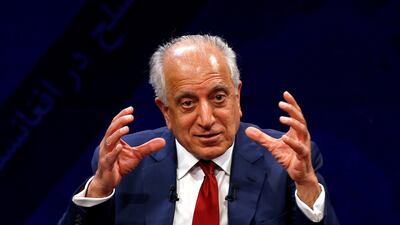
US envoy for peace in Afghanistan Zalmay Khalilzad said levels of violence in the country are too high. Reuters, File

Afghan violence 'too high' says US as Kabul-Taliban talks falter


  • English
  • Arabic

The level of violence in Afghanistan is unacceptably high and the United States expects further setbacks during talks, the Special Representative for Afghanistan said on Tuesday, as the Afghan government and Taliban remain far apart on even the most basic issues 10 days into talks meant to end two decades of war.

"By any measure, current levels of violence are too high," US Special Envoy for Afghanistan Zalmay Khalilzad told a House of Representatives hearing.

"We know that reductions are possible," Mr Khalilzad said.

Despite the difficulties, the talks are the best hope for peace in years and come as a result of a February pact between the Taliban and the United States, allowing US forces to withdraw in exchange for Taliban promises on terrorism.

But the militant group has refused to agree to a ceasefire and the war is grinding on. At least 57 members of the security forces have been killed in recent days in clashes across Afghanistan.

With all foreign troops due to be gone by May 2021, pressure is building on the US-backed government in Kabul as it grapples with how to share power with its implacable foe or contend with a likely Taliban push for military victory.

Since the spotlight faded from the lavish September 12 opening ceremony in Doha, attended by US Secretary of State Mike Pompeo, the two sides have only confirmed that they are diametrically opposed on virtually every issue.

"While we have reasons to be hopeful, we are under no illusions about the challenges ahead ... We expect that there will be setbacks and obstacles," Mr Khalilzad said.

The United States is expected to reduce troop levels to 4,000 to 5,000 in the coming months and will look at further reductions based on conditions.

David Helvey, who is performing the duties of assistant secretary of defence for Indo-Pacific security affairs, told the subcommittee hearing focusing on national security the Pentagon was carrying out "prudent planning" to withdraw all US troops from Afghanistan by May 2021 if conditions were met.

He added that for now, Defence Secretary Mark Esper had not issued any orders to go below 4,000 troops.


Mercer, the investment consulting arm of US services company Marsh & McLennan, expects its wealth division to at least double its assets under management (AUM) in the Middle East as wealth in the region continues to grow despite economic headwinds, a company official said.

Mercer Wealth, which globally has $160 billion in AUM, plans to boost its AUM in the region to $2-$3bn in the next 2-3 years from the present $1bn, said Yasir AbuShaban, a Dubai-based principal with Mercer Wealth.

Within the next two to three years, we are looking at reaching $2 to $3 billion as a conservative estimate and we do see an opportunity to do so,” said Mr AbuShaban.

Mercer does not directly make investments, but allocates clients’ money they have discretion to, to professional asset managers. They also provide advice to clients.

“We have buying power. We can negotiate on their (client’s) behalf with asset managers to provide them lower fees than they otherwise would have to get on their own,” he added.

Mercer Wealth’s clients include sovereign wealth funds, family offices, and insurance companies among others.

From its office in Dubai, Mercer also looks after Africa, India and Turkey, where they also see opportunity for growth.

Wealth creation in Middle East and Africa (MEA) grew 8.5 per cent to $8.1 trillion last year from $7.5tn in 2015, higher than last year’s global average of 6 per cent and the second-highest growth in a region after Asia-Pacific which grew 9.9 per cent, according to consultancy Boston Consulting Group (BCG). In the region, where wealth grew just 1.9 per cent in 2015 compared with 2014, a pickup in oil prices has helped in wealth generation.

BCG is forecasting MEA wealth will rise to $12tn by 2021, growing at an annual average of 8 per cent.

Drivers of wealth generation in the region will be split evenly between new wealth creation and growth of performance of existing assets, according to BCG.

Another general trend in the region is clients’ looking for a comprehensive approach to investing, according to Mr AbuShaban.

“Institutional investors or some of the families are seeing a slowdown in the available capital they have to invest and in that sense they are looking at optimizing the way they manage their portfolios and making sure they are not investing haphazardly and different parts of their investment are working together,” said Mr AbuShaban.

Some clients also have a higher appetite for risk, given the low interest-rate environment that does not provide enough yield for some institutional investors. These clients are keen to invest in illiquid assets, such as private equity and infrastructure.

“What we have seen is a desire for higher returns in what has been a low-return environment specifically in various fixed income or bonds,” he said.

“In this environment, we have seen a de facto increase in the risk that clients are taking in things like illiquid investments, private equity investments, infrastructure and private debt, those kind of investments were higher illiquidity results in incrementally higher returns.”

The Abu Dhabi Investment Authority, one of the largest sovereign wealth funds, said in its 2016 report that has gradually increased its exposure in direct private equity and private credit transactions, mainly in Asian markets and especially in China and India. The authority’s private equity department focused on structured equities owing to “their defensive characteristics.”

JAPANESE GRAND PRIX INFO

Schedule (All times UAE)
First practice: Friday, 5-6.30am
Second practice: Friday, 9-10.30am
Third practice: Saturday, 7-8am
Qualifying: Saturday, 10-11am
Race: Sunday, 9am-midday 

Race venue: Suzuka International Racing Course
Circuit Length: 5.807km
Number of Laps: 53
Watch live: beIN Sports HD

The specs

Engine: 2.0-litre 4cyl turbo

Power: 261hp at 5,500rpm

Torque: 405Nm at 1,750-3,500rpm

Transmission: 9-speed auto

Fuel consumption: 6.9L/100km

On sale: Now

Price: From Dh117,059

How to wear a kandura

Dos

  • Wear the right fabric for the right season and occasion 
  • Always ask for the dress code if you don’t know
  • Wear a white kandura, white ghutra / shemagh (headwear) and black shoes for work 
  • Wear 100 per cent cotton under the kandura as most fabrics are polyester

Don’ts 

  • Wear hamdania for work, always wear a ghutra and agal 
  • Buy a kandura only based on how it feels; ask questions about the fabric and understand what you are buying
Indoor cricket in a nutshell

Indoor Cricket World Cup - Sep 16-20, Insportz, Dubai

16 Indoor cricket matches are 16 overs per side

8 There are eight players per team

There have been nine Indoor Cricket World Cups for men. Australia have won every one.

5 Five runs are deducted from the score when a wickets falls

Batsmen bat in pairs, facing four overs per partnership

Scoring In indoor cricket, runs are scored by way of both physical and bonus runs. Physical runs are scored by both batsmen completing a run from one crease to the other. Bonus runs are scored when the ball hits a net in different zones, but only when at least one physical run is score.

Zones

A Front net, behind the striker and wicketkeeper: 0 runs

B Side nets, between the striker and halfway down the pitch: 1 run

Side nets between halfway and the bowlers end: 2 runs

Back net: 4 runs on the bounce, 6 runs on the full

Who was Alfred Nobel?

The Nobel Prize was created by wealthy Swedish chemist and entrepreneur Alfred Nobel.

  • In his will he dictated that the bulk of his estate should be used to fund "prizes to those who, during the preceding year, have conferred the greatest benefit to humankind".
  • Nobel is best known as the inventor of dynamite, but also wrote poetry and drama and could speak Russian, French, English and German by the age of 17. The five original prize categories reflect the interests closest to his heart.
  • Nobel died in 1896 but it took until 1901, following a legal battle over his will, before the first prizes were awarded.