Sudan's Prime Minister Abdalla Hamdok in Berlin, Germany, February 14, 2020. Reuters

Sudan’s prime minister Abdalla Hamdok says ‘no intention’ of war with Ethiopia


Hamza Hendawi
  • English
  • Arabic

Sudanese Prime Minister Abdalla Hamdok has told a senior European Union official visiting Khartoum that his country has no intention of going to war with neighbouring Ethiopia over a recent border dispute.

The dam must be established on the basis of international law, which maintains the rights of every party

A dispute over agricultural land has recently spilled over into armed clashes between the two sides.

Mr Hamdok, however, warned during a meeting with Finnish Foreign Minister Pekka Haavisto that some 20 million Sudanese living on the banks of the Blue Nile would be in danger if Ethiopia made good on its threat to undertake a second filling of its massive Nile dam next summer.

Ethiopia has planned to go ahead with the megaproject regardless of whether an agreement was reached with Egypt and Sudan, which are most vulnerable to water shortages. The project is known as the Grand Ethiopian Renaissance Dam, or GERD.

Mr Haavisto arrived in Khartoum on Sunday at the head of an EU delegation to try and defuse tension between Sudan and Ethiopia over their porous border.

He was heading to the disputed border region on Monday and is due to visit Ethiopia later this week.

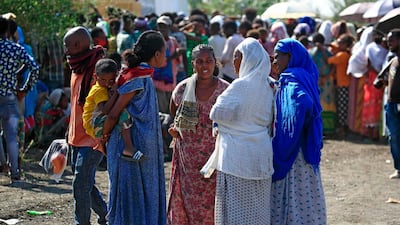
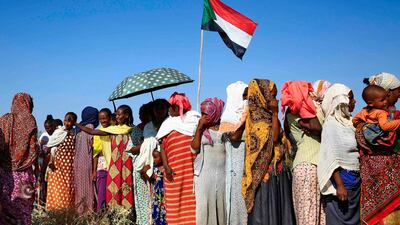
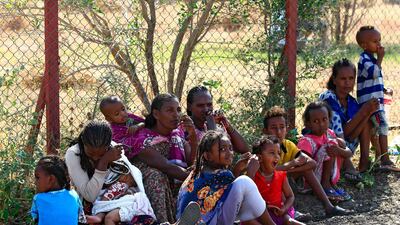
At the core of the tension between the two African neighbours is a move by Sudanese troops in December to wrest back control of border enclaves inside Sudan, which had long been settled by members of the powerful ethnic

Amhara group. The Amhara communities enjoy the protection of federal forces and allied Amhara militias.

Ethiopia has said it will not negotiate with Sudan unless it pulls out from the enclaves it retook. Sudan has rejected that condition and vowed to regain control of other areas still held by the Amhara farmers and militias.

“Sudan’s constant position is that it has no intention to go to war with our neighbour, Ethiopia,” Mr Hamdok was quoted as saying by state media after Sunday night’s meeting with the Finnish minister.

“The issue of the border has been decided since 1902 and all that is left is to place border post signs. Everything else can be resolved in the spirit of good neighbourliness and the ancient bonds between the two countries.”

The Sudanese Prime Minister was alluding to a 1902 agreement demarking the border between Sudan and Ethiopia, which was reaffirmed in1972.

Beside the border dispute, Sudan and its neighbour Egypt are at sharp odds with Ethiopia over the GERD.

Sudan has insisted that Ethiopia must share data on the operation of the dam to ensure that its own hydro-electric dams on the Blue Nile are not disrupted, and to avert flooding.

The alternative, Mr Hamdok told his Finnish guest, would be “disastrous.”

Ethiopia refuses to enter a legally-binding agreement on the operation of the dam, arguing that it prefers recommendations instead.

Adis Ababa is also resisting pressure to enter a legally binding deal on mechanisms governing future disputes and handling persistent droughts.

“The dam must be established on the basis of international law, which maintains the rights of every party and that no party is affected,” the Sudanese prime minister told Mr Haavisto.

Egypt, for its part, argues that the dam could significantly reduce its vital share of the Nile waters, a possibility that it views as an existential threat.


Dhadak 2

Director: Shazia Iqbal

Starring: Siddhant Chaturvedi, Triptii Dimri 

Rating: 1/5

UAE jiu-jitsu squad

Men: Hamad Nawad and Khalid Al Balushi (56kg), Omar Al Fadhli and Saeed Al Mazroui (62kg), Taleb Al Kirbi and Humaid Al Kaabi (69kg), Mohammed Al Qubaisi and Saud Al Hammadi (70kg), Khalfan Belhol and Mohammad Haitham Radhi (85kg), Faisal Al Ketbi and Zayed Al Kaabi (94kg)

Women: Wadima Al Yafei and Mahra Al Hanaei (49kg), Bashayer Al Matrooshi and Hessa Al Shamsi (62kg)

Mercer, the investment consulting arm of US services company Marsh & McLennan, expects its wealth division to at least double its assets under management (AUM) in the Middle East as wealth in the region continues to grow despite economic headwinds, a company official said.

Mercer Wealth, which globally has $160 billion in AUM, plans to boost its AUM in the region to $2-$3bn in the next 2-3 years from the present $1bn, said Yasir AbuShaban, a Dubai-based principal with Mercer Wealth.

Within the next two to three years, we are looking at reaching $2 to $3 billion as a conservative estimate and we do see an opportunity to do so,” said Mr AbuShaban.

Mercer does not directly make investments, but allocates clients’ money they have discretion to, to professional asset managers. They also provide advice to clients.

“We have buying power. We can negotiate on their (client’s) behalf with asset managers to provide them lower fees than they otherwise would have to get on their own,” he added.

Mercer Wealth’s clients include sovereign wealth funds, family offices, and insurance companies among others.

From its office in Dubai, Mercer also looks after Africa, India and Turkey, where they also see opportunity for growth.

Wealth creation in Middle East and Africa (MEA) grew 8.5 per cent to $8.1 trillion last year from $7.5tn in 2015, higher than last year’s global average of 6 per cent and the second-highest growth in a region after Asia-Pacific which grew 9.9 per cent, according to consultancy Boston Consulting Group (BCG). In the region, where wealth grew just 1.9 per cent in 2015 compared with 2014, a pickup in oil prices has helped in wealth generation.

BCG is forecasting MEA wealth will rise to $12tn by 2021, growing at an annual average of 8 per cent.

Drivers of wealth generation in the region will be split evenly between new wealth creation and growth of performance of existing assets, according to BCG.

Another general trend in the region is clients’ looking for a comprehensive approach to investing, according to Mr AbuShaban.

“Institutional investors or some of the families are seeing a slowdown in the available capital they have to invest and in that sense they are looking at optimizing the way they manage their portfolios and making sure they are not investing haphazardly and different parts of their investment are working together,” said Mr AbuShaban.

Some clients also have a higher appetite for risk, given the low interest-rate environment that does not provide enough yield for some institutional investors. These clients are keen to invest in illiquid assets, such as private equity and infrastructure.

“What we have seen is a desire for higher returns in what has been a low-return environment specifically in various fixed income or bonds,” he said.

“In this environment, we have seen a de facto increase in the risk that clients are taking in things like illiquid investments, private equity investments, infrastructure and private debt, those kind of investments were higher illiquidity results in incrementally higher returns.”

The Abu Dhabi Investment Authority, one of the largest sovereign wealth funds, said in its 2016 report that has gradually increased its exposure in direct private equity and private credit transactions, mainly in Asian markets and especially in China and India. The authority’s private equity department focused on structured equities owing to “their defensive characteristics.”

Islamophobia definition

A widely accepted definition was made by the All Party Parliamentary Group on British Muslims in 2019: “Islamophobia is rooted in racism and is a type of racism that targets expressions of Muslimness or perceived Muslimness.” It further defines it as “inciting hatred or violence against Muslims”.

The specs: Rolls-Royce Cullinan

Price, base: Dh1 million (estimate)

Engine: 6.75-litre twin-turbo V12

Transmission: Eight-speed automatic

Power: 563hp @ 5,000rpm

Torque: 850Nm @ 1,600rpm

Fuel economy, combined: 15L / 100km

All you need to know about Formula E in Saudi Arabia

What The Saudia Ad Diriyah E-Prix

When Saturday

Where Diriyah in Saudi Arabia

What time Qualifying takes place from 11.50am UAE time through until the Super Pole session, which is due to end at 12.55pm. The race, which will last for 45 minutes, starts at 4.05pm.

Who is competing There are 22 drivers, from 11 teams, on the grid, with each vehicle run solely on electronic power.

Brief scores:

Manchester United 4

Young 13', Mata 28', Lukaku 42', Rashford 82'

Fulham 1

Kamara 67' (pen),

Red card: Anguissa (68')

Man of the match: Juan Mata (Man Utd)

Nancy 9 (Hassa Beek)

Nancy Ajram

(In2Musica)

Mica

Director: Ismael Ferroukhi

Stars: Zakaria Inan, Sabrina Ouazani

3 stars

Politics in the West
From Zero

Artist: Linkin Park

Label: Warner Records

Number of tracks: 11

Rating: 4/5

Results

6.30pm: Baniyas (PA) Group 2 Dh195,000 1,400m | Winner: ES Ajeeb, Sam Hitchcock (jockey), Ibrahim Aseel (trainer)

7.05pm: Maiden (TB) Dh165,000 1,400m | Winner: Al Shamkhah, Royston Ffrench, Sandeep Jadhav

7.40pm: Handicap (TB) Dh190,000 1,200m | Winner: Lavaspin, Richard Mullen, Satish Seemar

8.15pm: Maiden (TB) Dh165,000 1,200m | Winner: Kawasir, Dane O’Neill, Musabah Al Muhairi

8.50pm: Rated Conditions (TB) Dh240,000 1,600m | Winner: Cosmo Charlie, Pat Dobbs, Doug Watson

9.20pm: Handicap (TB) Dh165,000 1,400m | Winner: Bochart, Richard Mullen, Satish Seemar

10pm: Handicap (TB) Dh175,000 2,000m | Winner: Quartier Francais, Fernando Jara, Ali Rashid Al Raihe