Sadiq Al Mahdi: a stalwart of democracy who found new purpose in Sudan’s uprising

Sadiq Al Mahdi: a stalwart of democracy who found new purpose in Sudan’s uprising


Hamza Hendawi
  • English
  • Arabic

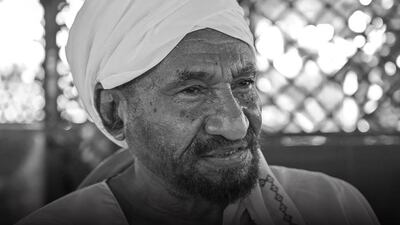
Sadiq Al Mahdi, Sudan’s last elected prime minister who died on Thursday, was an elder statesman of Sudan who fostered democracy to the end.

At 84, his death brings to an end an era of turbulent Sudanese politics in which the Oxford-educated scion of a historical family played a key role.

He will be buried on Friday in Umm Durman, Khartoum’s twin city and a stronghold of his supporters, known as the Al Ansar.

“He spent his entire adult life in politics and died a martyr of that epidemic,” said Salah Talha, a Sudanese university professor close to the Al Mahdi family. “He was a moderate Islamist who leaned in favour of democracy and centrist ideas.”

Al Mahdi’s political career spanned more than 50 years, its milestones and details often mirroring the tempestuous, post-independence history of Sudan, from military coups, democratic rule and economic woes to popular uprisings, civil wars and famines.

Sadiq Al Mahdi,'selected government was toppled in a 1989 coup. AFP

Imprisonment, hiding and exile in many ways defined his political life. In other ways, they serve as something of a manual for the art of political survival in a country that often looked like it was about to come unglued or implode and where every democratic experiment won international accolades but was later abruptly ended by military coups.

Known to his supporters as simply the Imam, Al Mahdi will not be remembered only for his political career. He has left behind a wealth of writings on Islamic jurisprudence and on modernising Islam’s teachings to fit in with the complexities and contradictions of the present time.

Al Mahdi, critics contend, spent much of his political career addressing himself to Sudan’s political establishment and intellectual elite in near total seclusion from the rest of the country, while also striving to maintain his standing and relevance as a traditional religious leader to the hundreds of thousands of loyal supporters who treated him with deep reverence and saw him as a spiritual guide.

“The pain that comes with ailment is the best time to take stock of one’s personal, moral and social track record,” Al Mahdi, forever the philosopher, wrote after he was diagnosed with Covid-19 last month. “Self-criticism is one of the most important tools for personal betterment and satisfaction.”

In his two spells as prime minister, Al Mahdi led dysfunctional governments that miserably failed to resolve any of the country’s major problems, from civil wars, an economy that’s in disarray and the ethnic and religious fault lines that divided the country.

  • Sudanese protesters run for cover from tear gas canisters fired by police outside the military headquarters in the capital Khartoum on April 6, 2019. AFP
    Sudanese protesters run for cover from tear gas canisters fired by police outside the military headquarters in the capital Khartoum on April 6, 2019. AFP
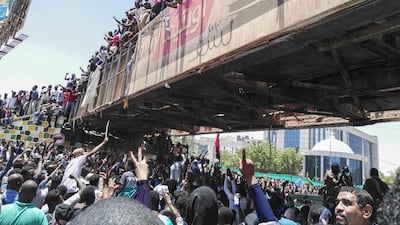
  • Sudanese protesters rally in front of the military headquarters in the capital Khartoum on April 8, 2019. AFP
    Sudanese protesters rally in front of the military headquarters in the capital Khartoum on April 8, 2019. AFP
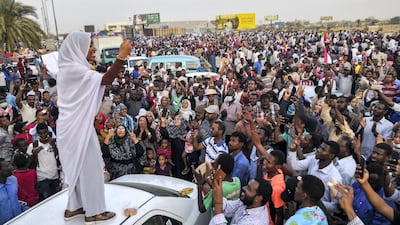
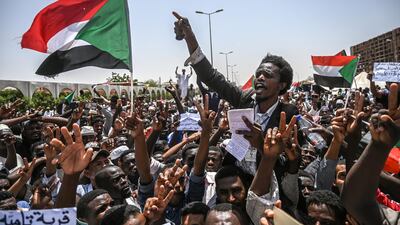
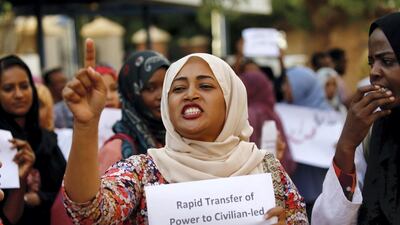
  • Alaa Salah, a Sudanese woman propelled to internet fame earlier this week after clips went viral of her leading powerful protest chants against President Omar Al Bashir, addresses protesters during a demonstration in front of the military headquarters in the capital Khartoum on April 10, 2019. AFP
    Alaa Salah, a Sudanese woman propelled to internet fame earlier this week after clips went viral of her leading powerful protest chants against President Omar Al Bashir, addresses protesters during a demonstration in front of the military headquarters in the capital Khartoum on April 10, 2019. AFP
  • Sudanese judges, dressed in their robes, gather for a "million-strong" march outside the army headquarters in the capital Khartoum on April 25, 2019. AFP
    Sudanese judges, dressed in their robes, gather for a "million-strong" march outside the army headquarters in the capital Khartoum on April 25, 2019. AFP
  • A Sudanese anti-regime protester kisses a soldier on the head during protests on April 11, 2019 in the area around the army headquarters in Sudan's capital Khartoum. AFP
    A Sudanese anti-regime protester kisses a soldier on the head during protests on April 11, 2019 in the area around the army headquarters in Sudan's capital Khartoum. AFP
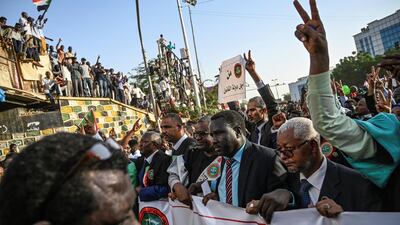
  • Sudanese demonstrators march with national flags as they gather during a rally demanding a civilian body to lead the transition to democracy. AFP
    Sudanese demonstrators march with national flags as they gather during a rally demanding a civilian body to lead the transition to democracy. AFP
  • Protesters massed outside the army complex in central Khartoum on April 6, initially to demand the overthrow of longtime leader Omar Al Bashir. AFP
    Protesters massed outside the army complex in central Khartoum on April 6, initially to demand the overthrow of longtime leader Omar Al Bashir. AFP
  • Sudanese protesters gather outside the army headquarters in Khartoum on May 6, 2019. AFP
    Sudanese protesters gather outside the army headquarters in Khartoum on May 6, 2019. AFP
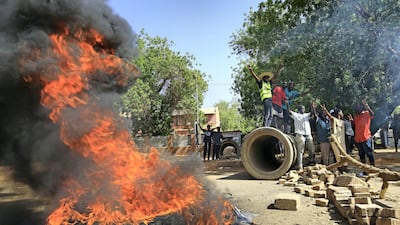
  • Sudanese protesters burn tyres as they block Nile Street for the second consecutive day during continuing protests in Sudan's capital Khartoum on May 13, 2019. AFP
    Sudanese protesters burn tyres as they block Nile Street for the second consecutive day during continuing protests in Sudan's capital Khartoum on May 13, 2019. AFP
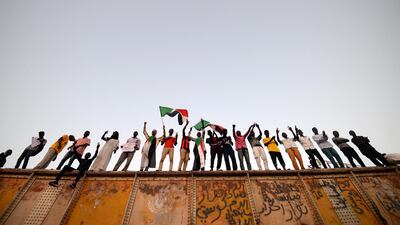
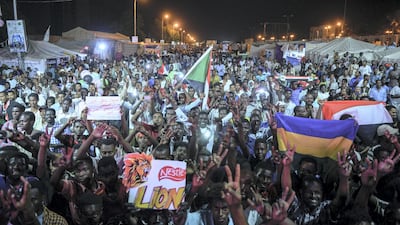
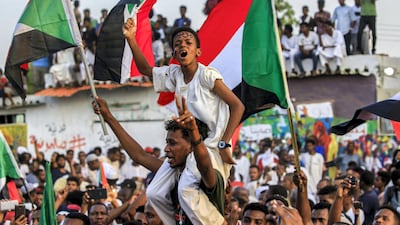
  • Sudanese protesters wave flags and flash victory signs as they gather for a sit-in outside the military headquarters in Khartoum on May 19, 2019. AFP
    Sudanese protesters wave flags and flash victory signs as they gather for a sit-in outside the military headquarters in Khartoum on May 19, 2019. AFP
  • A Sudanese health worker carries a placard as scores of medics hold a rally in front of a hospital in the capital Khartoum on May 23, 2019. AFP
    A Sudanese health worker carries a placard as scores of medics hold a rally in front of a hospital in the capital Khartoum on May 23, 2019. AFP
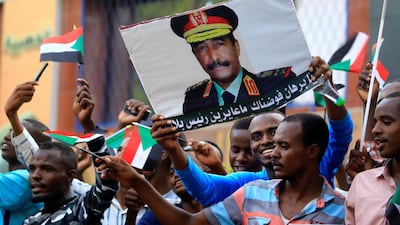
  • Sudanese supporters of the ruling Transitional Military Council (TMC) hold up a sign showing a portrait of its head General Abdel Fattah Al Burhan with a caption below reading in Arabic "we have delegated you Burhan, we want no president but you", during a rally in the centre of the capital Khartoum on May 31, 2019. AFP
    Sudanese supporters of the ruling Transitional Military Council (TMC) hold up a sign showing a portrait of its head General Abdel Fattah Al Burhan with a caption below reading in Arabic "we have delegated you Burhan, we want no president but you", during a rally in the centre of the capital Khartoum on May 31, 2019. AFP
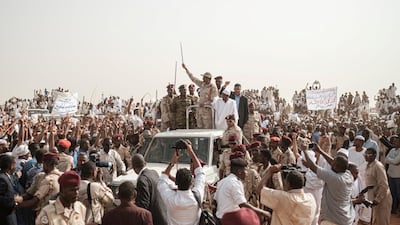
  • Mohamed Hamdan Dagalo, known as Himediti, deputy head of Sudan's ruling Transitional Military Council and commander of the Rapid Support Forces paramilitaries, waves a baton to supporters on a vehicle as he arrives for a rally in the village of Abraq, about 60 kilometres northwest of Khartoum, on June 22, 2019. AFP
    Mohamed Hamdan Dagalo, known as Himediti, deputy head of Sudan's ruling Transitional Military Council and commander of the Rapid Support Forces paramilitaries, waves a baton to supporters on a vehicle as he arrives for a rally in the village of Abraq, about 60 kilometres northwest of Khartoum, on June 22, 2019. AFP
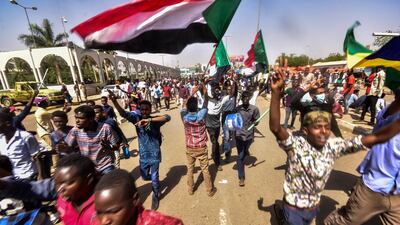
  • Sudanese protestors celebrate in the streets of Khartoum after ruling generals and protest leaders announced they have reached an agreement on the disputed issue of a new governing body on July 5, 2019. AFP
    Sudanese protestors celebrate in the streets of Khartoum after ruling generals and protest leaders announced they have reached an agreement on the disputed issue of a new governing body on July 5, 2019. AFP
  • Thousands went to the streets to welcome the agreement on Saturday. AFP
    Thousands went to the streets to welcome the agreement on Saturday. AFP
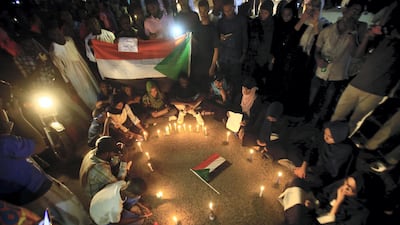
  • Sudanese protesters take part in a vigil in the capital Khartoum to mourn dozens of demonstrators killed last month in a raid on a Khartoum sit-in. AFP
    Sudanese protesters take part in a vigil in the capital Khartoum to mourn dozens of demonstrators killed last month in a raid on a Khartoum sit-in. AFP
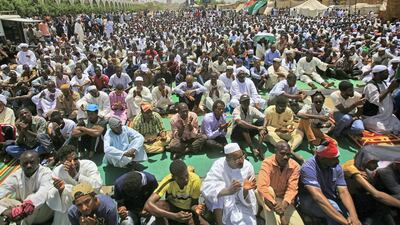
  • Sudanese protesters gather during Friday noon prayers outside the army headquarters in Khartoum on May 3, 2019, as they continue to protest demanding that the ruling military council hand power to a civilian administration. AFP
    Sudanese protesters gather during Friday noon prayers outside the army headquarters in Khartoum on May 3, 2019, as they continue to protest demanding that the ruling military council hand power to a civilian administration. AFP
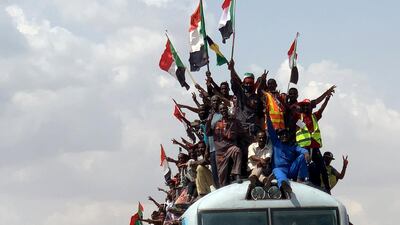
  • Sudanese civilians from other provinces ride on the train to join in the celebrations of the signing of Sudan's power-sharing deal. Reuters
    Sudanese civilians from other provinces ride on the train to join in the celebrations of the signing of Sudan's power-sharing deal. Reuters
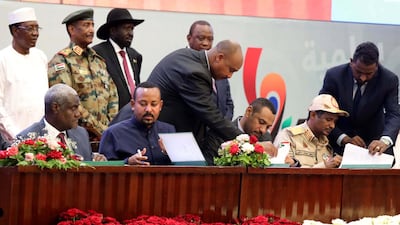
  • Sudan's Forces of Freedom and Change coalition leader Ahmad Rabiah (3-R) and Sudan's General and Vice President of Sudanese Transitional Military Council, Mohamed Hamdan Dagalo (2-R) sign power-sharing agreement,. EPA
    Sudan's Forces of Freedom and Change coalition leader Ahmad Rabiah (3-R) and Sudan's General and Vice President of Sudanese Transitional Military Council, Mohamed Hamdan Dagalo (2-R) sign power-sharing agreement,. EPA
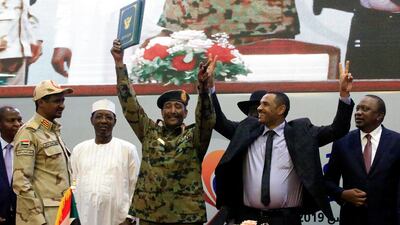
  • Sudan's Head of Transitional Military Council, Lieutenant General Abdel Fattah Al-Burhan, and Sudan's opposition alliance coalition's leader Ahmad Rabiah, celebrate the signing of the power-sharing deal, that paves the way for a transitional government, and eventual elections. Reuters
    Sudan's Head of Transitional Military Council, Lieutenant General Abdel Fattah Al-Burhan, and Sudan's opposition alliance coalition's leader Ahmad Rabiah, celebrate the signing of the power-sharing deal, that paves the way for a transitional government, and eventual elections. Reuters
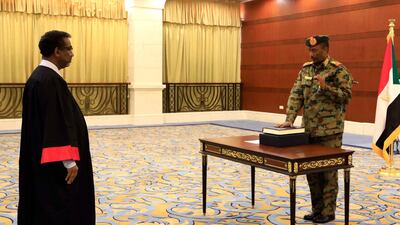
  • epa07783624 Leader of Sudan's transitional council, Lieutenant General Abdel Fattah Abdelrahman Burhan (R) is sworn in as the Head of the newly formed transitional Council at the presidential palace in Khartoum, Sudan, 21 August 2019. The Sudanese opposition and military council signed on 17 August a power sharing agreement. The agreement sets up a sovereign council made of five generals and six civilians, to rule the country until general elections. Protests had erupted in Sudan at the end of 2018, culminating in a long sit-in outside the army headquarters which ended with more than one hundred people being killed and others injured. Sudanese President Omar Hassan al-Bashir stepped down on 11 April 2019. EPA/STRINGER
    epa07783624 Leader of Sudan's transitional council, Lieutenant General Abdel Fattah Abdelrahman Burhan (R) is sworn in as the Head of the newly formed transitional Council at the presidential palace in Khartoum, Sudan, 21 August 2019. The Sudanese opposition and military council signed on 17 August a power sharing agreement. The agreement sets up a sovereign council made of five generals and six civilians, to rule the country until general elections. Protests had erupted in Sudan at the end of 2018, culminating in a long sit-in outside the army headquarters which ended with more than one hundred people being killed and others injured. Sudanese President Omar Hassan al-Bashir stepped down on 11 April 2019. EPA/STRINGER
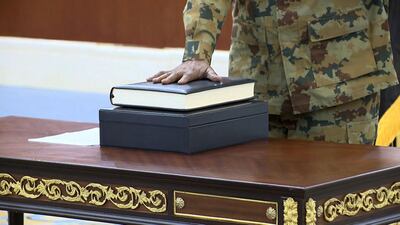
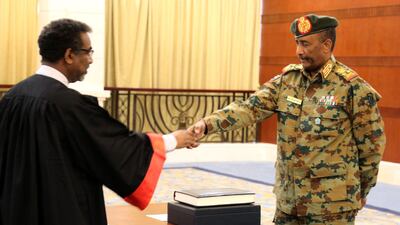
  • A pictured released by Sudan's Presidential Palace shows General Abdel Fattah al-Burhan, the head of Sudan's ruling military council, during a swearing in ceremony in Khartoum on August 21, 2019. Burhan was sworn today as chairman of Sudan's new sovereign council that will steer the country through a three-year transition to civilian rule. "General Abdel Fattah al-Burhan Abdel Rahman was sworn in as president of the sovereign council," the official SUNA news agency reported. / AFP / SUDAN PRESIDENTIAL PALACE / - / RESTRICTED TO EDITORIAL USE - MANDATORY CREDIT "AFP PHOTO / SUDAN PRESIDENTAIL PALACE" - NO MARKETING NO ADVERTISING CAMPAIGNS - DISTRIBUTED AS A SERVICE TO CLIENTS
    A pictured released by Sudan's Presidential Palace shows General Abdel Fattah al-Burhan, the head of Sudan's ruling military council, during a swearing in ceremony in Khartoum on August 21, 2019. Burhan was sworn today as chairman of Sudan's new sovereign council that will steer the country through a three-year transition to civilian rule. "General Abdel Fattah al-Burhan Abdel Rahman was sworn in as president of the sovereign council," the official SUNA news agency reported. / AFP / SUDAN PRESIDENTIAL PALACE / - / RESTRICTED TO EDITORIAL USE - MANDATORY CREDIT "AFP PHOTO / SUDAN PRESIDENTAIL PALACE" - NO MARKETING NO ADVERTISING CAMPAIGNS - DISTRIBUTED AS A SERVICE TO CLIENTS
  • A picture released by Sudan's Presidential Palace shows General Abdel Fattah al-Burhan, the head of Sudan's ruling military council, during a swearing in ceremony in Khartoum on August 21, 2019. Burhan was sworn today as chairman of Sudan's new sovereign council that will steer the country through a three-year transition to civilian rule. "General Abdel Fattah al-Burhan Abdel Rahman was sworn in as president of the sovereign council," the official SUNA news agency reported. / AFP / SUDAN PRESIDENTIAL PALACE / - / RESTRICTED TO EDITORIAL USE - MANDATORY CREDIT "AFP PHOTO / SUDAN PRESIDENTAIL PALACE" - NO MARKETING NO ADVERTISING CAMPAIGNS - DISTRIBUTED AS A SERVICE TO CLIENTS
    A picture released by Sudan's Presidential Palace shows General Abdel Fattah al-Burhan, the head of Sudan's ruling military council, during a swearing in ceremony in Khartoum on August 21, 2019. Burhan was sworn today as chairman of Sudan's new sovereign council that will steer the country through a three-year transition to civilian rule. "General Abdel Fattah al-Burhan Abdel Rahman was sworn in as president of the sovereign council," the official SUNA news agency reported. / AFP / SUDAN PRESIDENTIAL PALACE / - / RESTRICTED TO EDITORIAL USE - MANDATORY CREDIT "AFP PHOTO / SUDAN PRESIDENTAIL PALACE" - NO MARKETING NO ADVERTISING CAMPAIGNS - DISTRIBUTED AS A SERVICE TO CLIENTS
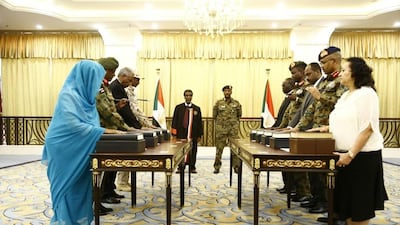
  • A picture released by Sudan's Presidential Palace shows General Abdel Fattah al-Burhan (C-R), the head of Sudan's ruling military council, standing during a swearing in of the new sovereign council, in Khartoum on August 21, 2019. Sudan took further steps in its transition towards civilian rule today with the swearing in of a new sovereign council, to be followed by the appointment of a prime minister. The body replaces the Transitional Military Council (TMC) that took charge after months of deadly street protests brought down longtime ruler Omar al-Bashir in April. Burhan, who already headed the TMC, was sworn in as the chairman of the new sovereign council in the morning. / AFP / SUDAN PRESIDENTIAL PALACE / - / RESTRICTED TO EDITORIAL USE - MANDATORY CREDIT "AFP PHOTO / SUDAN PRESIDENTAIL PALACE" - NO MARKETING NO ADVERTISING CAMPAIGNS - DISTRIBUTED AS A SERVICE TO CLIENTS
    A picture released by Sudan's Presidential Palace shows General Abdel Fattah al-Burhan (C-R), the head of Sudan's ruling military council, standing during a swearing in of the new sovereign council, in Khartoum on August 21, 2019. Sudan took further steps in its transition towards civilian rule today with the swearing in of a new sovereign council, to be followed by the appointment of a prime minister. The body replaces the Transitional Military Council (TMC) that took charge after months of deadly street protests brought down longtime ruler Omar al-Bashir in April. Burhan, who already headed the TMC, was sworn in as the chairman of the new sovereign council in the morning. / AFP / SUDAN PRESIDENTIAL PALACE / - / RESTRICTED TO EDITORIAL USE - MANDATORY CREDIT "AFP PHOTO / SUDAN PRESIDENTAIL PALACE" - NO MARKETING NO ADVERTISING CAMPAIGNS - DISTRIBUTED AS A SERVICE TO CLIENTS
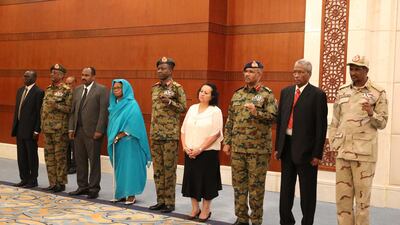
  • epa07784051 Members of Sudan's newly formed transitional Council (R-L) General Mohamed Hamdan Dagalo, Hassan Sheikh Idris, Genereal Ibrahim Jaber, Raja Nicola Issa Abdul-Masseh, General Shams al-Din Kabashi, Aisha Moussa, Mohamed Alfaki, General Yasser al-Atta and Sadeek Tawer look on during their sweaing-in ceremony at the presidential palace in Khartoum, Sudan, 21 August 2019. The Sudanese opposition and military council signed on 17 August a power sharing agreement. The agreement sets up a sovereign council made of five generals and six civilians, to rule the country until general elections. Protests had erupted in Sudan at the end of 2018, culminating in a long sit-in outside the army headquarters which ended with more than one hundred people being killed and others injured. Sudanese President Omar Hassan al-Bashir stepped down on 11 April 2019. EPA/MORWAN ALI
    epa07784051 Members of Sudan's newly formed transitional Council (R-L) General Mohamed Hamdan Dagalo, Hassan Sheikh Idris, Genereal Ibrahim Jaber, Raja Nicola Issa Abdul-Masseh, General Shams al-Din Kabashi, Aisha Moussa, Mohamed Alfaki, General Yasser al-Atta and Sadeek Tawer look on during their sweaing-in ceremony at the presidential palace in Khartoum, Sudan, 21 August 2019. The Sudanese opposition and military council signed on 17 August a power sharing agreement. The agreement sets up a sovereign council made of five generals and six civilians, to rule the country until general elections. Protests had erupted in Sudan at the end of 2018, culminating in a long sit-in outside the army headquarters which ended with more than one hundred people being killed and others injured. Sudanese President Omar Hassan al-Bashir stepped down on 11 April 2019. EPA/MORWAN ALI
  • Demonstrators march with banners and the old (L) and current (R) flags of Sudan outside a courthouse complex in the capital's twin city of Omdurman on August 21, 2019 during the trial of 40 members of Sudan's now-dissolved National Intelligence and Security Service facing charges over the death in custody of Ahmed al-Kheir, a teacher from the eastern town of Khashma el-Girba, in the early days of the wave of nationwide protests that eventually brought longtime ruler Omar al-Bashir. / AFP / Ahmed Mustafa
    Demonstrators march with banners and the old (L) and current (R) flags of Sudan outside a courthouse complex in the capital's twin city of Omdurman on August 21, 2019 during the trial of 40 members of Sudan's now-dissolved National Intelligence and Security Service facing charges over the death in custody of Ahmed al-Kheir, a teacher from the eastern town of Khashma el-Girba, in the early days of the wave of nationwide protests that eventually brought longtime ruler Omar al-Bashir. / AFP / Ahmed Mustafa
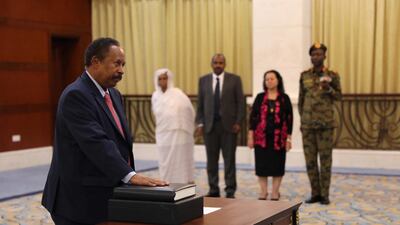
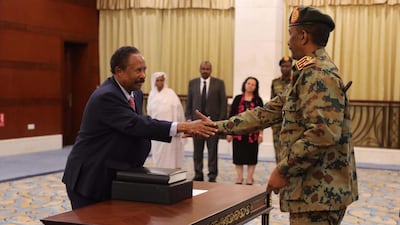
  • epa07784904 Sudan's new Prime Minister Abdalla Hamdok (L) swears in during a ceremony at the presidential palace in Khartoum, Sudan, 21 August 2019. The Sudanese opposition and military council signed on 17 August a power sharing agreement. The agreement sets up a sovereign council made of five generals and six civilians, to rule the country until general elections. Protests had erupted in Sudan in December 2018, culminating in a long sit-in outside the army headquarters which ended with more than one hundred people being killed and others injured. Sudanese President Omar Hassan al-Bashir stepped down on 11 April 2019. EPA/MARWAN ALI
    epa07784904 Sudan's new Prime Minister Abdalla Hamdok (L) swears in during a ceremony at the presidential palace in Khartoum, Sudan, 21 August 2019. The Sudanese opposition and military council signed on 17 August a power sharing agreement. The agreement sets up a sovereign council made of five generals and six civilians, to rule the country until general elections. Protests had erupted in Sudan in December 2018, culminating in a long sit-in outside the army headquarters which ended with more than one hundred people being killed and others injured. Sudanese President Omar Hassan al-Bashir stepped down on 11 April 2019. EPA/MARWAN ALI
  • epa07784903 Sudan's new Prime Minister Abdalla Hamdok (L) shakes hands with Abdel Fattah Abdelrahman Burhan (R) after being sworn in during a ceremony at the presidential palace in Khartoum, Sudan, 21 August 2019. The Sudanese opposition and military council signed on 17 August a power sharing agreement. The agreement sets up a sovereign council made of five generals and six civilians, to rule the country until general elections. Protests had erupted in Sudan in December 2018, culminating in a long sit-in outside the army headquarters which ended with more than one hundred people being killed and others injured. Sudanese President Omar Hassan al-Bashir stepped down on 11 April 2019. EPA/MARWAN ALI
    epa07784903 Sudan's new Prime Minister Abdalla Hamdok (L) shakes hands with Abdel Fattah Abdelrahman Burhan (R) after being sworn in during a ceremony at the presidential palace in Khartoum, Sudan, 21 August 2019. The Sudanese opposition and military council signed on 17 August a power sharing agreement. The agreement sets up a sovereign council made of five generals and six civilians, to rule the country until general elections. Protests had erupted in Sudan in December 2018, culminating in a long sit-in outside the army headquarters which ended with more than one hundred people being killed and others injured. Sudanese President Omar Hassan al-Bashir stepped down on 11 April 2019. EPA/MARWAN ALI
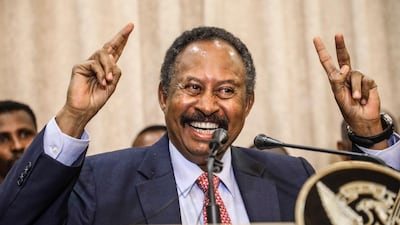
  • Sudan's new Prime Minister Abdalla Hamdok speaks duringa press conference in Khartoum, Sudan, Wednesday, Aug. 21, 2019. (AP Photo)
    Sudan's new Prime Minister Abdalla Hamdok speaks duringa press conference in Khartoum, Sudan, Wednesday, Aug. 21, 2019. (AP Photo)

In some ways, his critics say, his ineffectiveness played a part in tempting the military to seize power in 1969 and 1989, with the generals convinced that they could easily do a better job running the country than civilians.

In his later years, Al Mahdi capably took on the role of statesman, offering counsel to the young men and women who led months of violent street protests against the 29-year regime of Omar Al Bashir until the generals stepped in and removed him last year.

In the aftermath, Al Mahdi helped in no insignificant way to eke out compromises between young protest leaders and generals on the future of Sudan.

His effort bore fruit in August 2019, when the two sides signed a landmark power-sharing agreement that has since served as a transitional constitution for Sudan until a new one is adopted and free elections are held.

Ameen Makki, a prominent figure in the anti-Al Bashir uprising, recalled Al Mahdi’s role in the early days of the uprising. He and others in the pro-democracy movement sought the counsel of elderly statesmen like Al Mahdi as the regime’s security forces grew more brutal in dealing with the protesters.

“The Imam carried more weight, was the wiser and more rational among them. He contributed to the halt of bloodletting,” he said.

“It’s for people like him that the flags are lowered, a state of mourning is declared and official funerals are held.”

In some ways, Al Mahdi’s role in the 2018-19 uprising was a surprise to some of the young opposition activists, who saw him as a political relic from a bygone era who was out of touch with the mood, aspirations and rebellious traits of Sudan’s contemporary youth.

Self-criticism is one of the most important tools for personal betterment and satisfaction

To them, Al Mahdi was the quintessential symbol of the traditional and religious forces that dominated but achieved little during spells of democratic rule in the 1950s, 1960s and 1980s. These forces, they argued, have been displaced by a new strain of political activism that is mostly liberal, left-leaning and fearless in the face of brutal force.

Their argument may not be entirely without merit, although Al Mahdi dismissed it as untrue and argued that he and his Umma party, Sudan’s largest, were at the heart of the uprising.

He was also just as dismissive of the notion held by some activists that with his impeccable English, aristocratic manners and Oxford degree, he presided over an elitist political system.

However, a significant part of Al Mahdi’s relevance in the “new Sudan” came from the voting power of his supporters, which has for decades kept his Umma party as a political powerhouse.

Al Mahdi served twice as prime minister, the first time when he was barely 30 in 1966. His second term as prime minister came in 1986, a year after the military seized power in a bloodless and popularly-supported coup amid nationwide street protests against the 16-year rule of military dictator Jaafar Al Nimeiri.

His democratically elected government was toppled in a 1989 coup led by Al Bashir, an Islamist whose time in office handed Sudan its worst chapter since independence in 1956.

Al Bashir is now in prison following his conviction of corruption and is facing additional trials for the shooting deaths of protesters in 2018 and 2019 and for violating the constitution when he plotted and led the Islamist-backed 1989 coup.

But Al Mahdi betrayed no glee when he spoke about what it meant for him to see Al Bashir appear before a criminal court last year charged with corruption.

"The wrong must eventually be vanquished, the righteous state must come back," Al Mahdi told The National in an interview last year at his Umm Durman residence.


Who's who in Yemen conflict

Houthis: Iran-backed rebels who occupy Sanaa and run unrecognised government

Yemeni government: Exiled government in Aden led by eight-member Presidential Leadership Council

Southern Transitional Council: Faction in Yemeni government that seeks autonomy for the south

Habrish 'rebels': Tribal-backed forces feuding with STC over control of oil in government territory

Women%E2%80%99s%20T20%20World%20Cup%20Qualifier
%3Cp%3E%3Cstrong%3EUAE%20fixtures%3C%2Fstrong%3E%3C%2Fp%3E%0A%3Cp%3E25%20April%20%E2%80%93%20Ireland%20v%20UAE*%3Cbr%3E27%20April%20%E2%80%93%20UAE%20v%20Zimbabwe**%3Cbr%3E29%20April%20%E2%80%93%20Netherlands%20v%20UAE*%3Cbr%3E3%20May%20%E2%80%93%20UAE%20v%20Vanuatu*%3Cbr%3E5%20May%20%E2%80%93%20Semi-finals%3Cbr%3E7%20May%20%E2%80%93%20Final%3Cbr%3E%3Cstrong%3EUAE%20squad%3A%20%3C%2Fstrong%3EEsha%20Oza%20(captain)%2C%20Al%20Maseera%20Jahangir%2C%20Avanee%20Patel%2C%20Heena%20Hotchandani%2C%20Indhuja%20Nandakumar%2C%20Kavisha%20Kumari%2C%20Khushi%20Sharma%2C%20Lavanya%20Keny%2C%20Mehak%20Thakur%2C%20Rinitha%20Rajith%2C%20Samaira%20Dharnidharka%2C%20Siya%20Gokhale%2C%20Suraksha%20Kotte%2C%20Theertha%20Satish%2C%20Vaishnave%20Mahesh.%3C%2Fp%3E%0A%3Cp%3E*Zayed%20Cricket%20Stadium%3C%2Fp%3E%0A%3Cp%3E**Tolerance%20Oval%3C%2Fp%3E%0A
RESULT

Norway 1 Spain 1
Norway: King (90 4')
Spain: Niguez (47')

Family reunited

Nazanin Zaghari-Ratcliffe was born and raised in Tehran and studied English literature before working as a translator in the relief effort for the Japanese International Co-operation Agency in 2003.

She moved to the International Federation of Red Cross and Red Crescent Societies before moving to the World Health Organisation as a communications officer.

She came to the UK in 2007 after securing a scholarship at London Metropolitan University to study a master's in communication management and met her future husband through mutual friends a month later.

The couple were married in August 2009 in Winchester and their daughter was born in June 2014.

She was held in her native country a year later.

Company profile

Company name: Suraasa

Started: 2018

Founders: Rishabh Khanna, Ankit Khanna and Sahil Makker

Based: India, UAE and the UK

Industry: EdTech

Initial investment: More than $200,000 in seed funding

Brown/Black belt finals

3pm: 49kg female: Mayssa Bastos (BRA) v Thamires Aquino (BRA)
3.07pm: 56kg male: Hiago George (BRA) v Carlos Alberto da Silva (BRA)
3.14pm: 55kg female: Amal Amjahid (BEL) v Bianca Basilio (BRA)
3.21pm: 62kg male: Gabriel de Sousa (BRA) v Joao Miyao (BRA)
3.28pm: 62kg female: Beatriz Mesquita (BRA) v Ffion Davies (GBR)
3.35pm: 69kg male: Isaac Doederlein (BRA) v Paulo Miyao (BRA)
3.42pm: 70kg female: Thamara Silva (BRA) v Alessandra Moss (AUS)
3.49pm: 77kg male: Oliver Lovell (GBR) v Tommy Langarkar (NOR)
3.56pm: 85kg male: Faisal Al Ketbi (UAE) v Rudson Mateus Teles (BRA)
4.03pm: 90kg female: Claire-France Thevenon (FRA) v Gabreili Passanha (BRA)
4.10pm: 94kg male: Adam Wardzinski (POL) v Kaynan Duarte (BRA)
4.17pm: 110kg male: Yahia Mansoor Al Hammadi (UAE) v Joao Rocha (BRA

GAC GS8 Specs

Engine: 2.0-litre 4cyl turbo

Power: 248hp at 5,200rpm

Torque: 400Nm at 1,750-4,000rpm

Transmission: 8-speed auto

Fuel consumption: 9.1L/100km

On sale: Now

Price: From Dh149,900

The specs
Engine: 4.0-litre flat-six
Power: 510hp at 9,000rpm
Torque: 450Nm at 6,100rpm
Transmission: 7-speed PDK auto or 6-speed manual
Fuel economy, combined: 13.8L/100km
On sale: Available to order now
Price: From Dh801,800


If you go...

Etihad Airways flies from Abu Dhabi to Kuala Lumpur, from about Dh3,600. Air Asia currently flies from Kuala Lumpur to Terengganu, with Berjaya Hotels & Resorts planning to launch direct chartered flights to Redang Island in the near future. Rooms at The Taaras Beach and Spa Resort start from 680RM (Dh597).

Pots for the Asian Qualifiers

Pot 1: Iran, Japan, South Korea, Australia, Qatar, United Arab Emirates, Saudi Arabia, China
Pot 2: Iraq, Uzbekistan, Syria, Oman, Lebanon, Kyrgyz Republic, Vietnam, Jordan
Pot 3: Palestine, India, Bahrain, Thailand, Tajikistan, North Korea, Chinese Taipei, Philippines
Pot 4: Turkmenistan, Myanmar, Hong Kong, Yemen, Afghanistan, Maldives, Kuwait, Malaysia
Pot 5: Indonesia, Singapore, Nepal, Cambodia, Bangladesh, Mongolia, Guam, Macau/Sri Lanka

MOUNTAINHEAD REVIEW

Starring: Ramy Youssef, Steve Carell, Jason Schwartzman

Director: Jesse Armstrong

Rating: 3.5/5

Company Fact Box

Company name/date started: Abwaab Technologies / September 2019

Founders: Hamdi Tabbaa, co-founder and CEO. Hussein Alsarabi, co-founder and CTO

Based: Amman, Jordan

Sector: Education Technology

Size (employees/revenue): Total team size: 65. Full-time employees: 25. Revenue undisclosed

Stage: early-stage startup 

Investors: Adam Tech Ventures, Endure Capital, Equitrust, the World Bank-backed Innovative Startups SMEs Fund, a London investment fund, a number of former and current executives from Uber and Netflix, among others.

The specs: 2018 Audi R8 V10 RWS

Price: base / as tested: From Dh632,225

Engine: 5.2-litre V10

Gearbox: Seven-speed automatic

Power: 540hp @ 8,250rpm

Torque: 540Nm @ 6,500rpm

Fuel economy, combined: 12.4L / 100km

Springsteen: Deliver Me from Nowhere

Director: Scott Cooper

Starring: Jeremy Allen White, Odessa Young, Jeremy Strong

Rating: 4/5

It

Director: Andres Muschietti

Starring: Bill Skarsgard, Jaeden Lieberher, Sophia Lillis, Chosen Jacobs, Jeremy Ray Taylor

Three stars