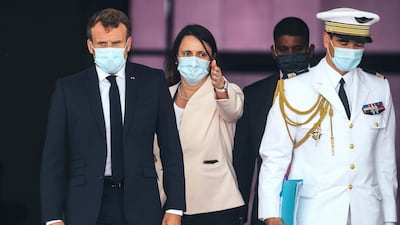
Sahel countries and their ally France on Tuesday vowed to press ahead with a tactical shift in their campaign against an eight-year-old jihadist insurgency, saying the change had notched up substantial gains although major challenges also remain.
After a summit in the Mauritanian capital Noukchott to review the new strategy at the six-month mark, French President Emmanuel Macron said there had been "spectacular results."
"We are convinced that victory is possible in the Sahel, and that it is decisive for stability in Africa and Europe," he said.
The comments came after the presidents reviewed a campaign that they rebooted in January after a string of reversals.
Since then, the extremists have continued to carry out almost daily attacks, but they are also under pressure, losing a key leader to a French raid and fighting internally, say security sources.
Wearing a mask as he arrived for his first trip outside Europe since the start of the coronavirus epidemic, French President Emmanuel Macron said the summit sought to "consolidate the gains".
The allies have notched up "real successes over the past six months, neutralising feared leaders," he said, praising the "upscaling of intervention" by Sahel armies.
Mr Macron hosted a summit in January to help secure a stronger public commitment from Burkina Faso, Chad, Mali, Mauritania and Niger at a time of deepening concern in France after it lost 13 troops in a helicopter crash.
The insurgency kicked off in northern Mali in 2012, during a rebellion by Tuareg separatists that was later overtaken by the extremists.
Despite thousands of UN and French troops, the conflict spread to central Mali, neighbouring Burkina Faso and Niger, stirring feuds between ethnic groups and triggering fears for states farther south.
Thousands of soldiers and civilians have been killed, hundreds of thousands of people have fled their homes and the economies of the three countries, already among the poorest in the world, have been grievously damaged.
The meeting marks the first time that Sahel allies have gathered physically since the start of the coronavirus crisis.
One priority was to assess affairs in the “three-border region,” a hotspot where the frontiers of Burkina, Niger and Mali converge.
France, which added 500 troops to its Sahel mission after the summit in the French town of Pau, is co-leading the campaign in this region, targeting an Islamic State-affiliated group led by Abou Walid al-Sahraoui.
Earlier this month, French forces in northern Mali, helped by a US drone, killed Abdelmalek Droukdel, the head of Al Qaeda in the Islamic Maghreb (AQIM).
And in a new development, jihadists respectively linked to Al Qaeda and ISIS have clashed several times since the start of the year in Mali and Burkina Faso, after long steering clear of one another, according to security experts.
Despite this, problems in the Sahel run deep.
Local armies are poorly equipped and under-funded, rights groups say troops are to blame for hundreds of killings and other abuses of civilians, and in some areas the presence of government has evaporated.
Staunch French ally Chad has yet to fulfil a promise to send troops to the three-border region, and a much-trumpeted initiative to create a joint 5,000-man G5 Sahel force is making poor progress.
In Mali, anger at insecurity has fuelled discontent over coronavirus restrictions and the outcome of elections, creating a political crisis for President Ibrahim Boubacar Keita.
Both Burkina and Niger are due to hold presidential elections by year's end, fuelling concerns about the outcome.
Mr Macron stressed the need "to do more in terms of the return of the state," particularly "in Mali, in Burkina, in a context that we know is very complex."
In response to lobbying from France, a group of European special forces called Takuba, numbering 310 men, is mustering to help Malian troops.
And on Monday, the UN Security Council voted unanimously to extend the mandate of the 13,000-troop MINUSMA peacekeeping force in Mali for another year, to June 30 2021.

Ten tax points to be aware of in 2026
1. Domestic VAT refund amendments: request your refund within five years
If a business does not apply for the refund on time, they lose their credit.
2. E-invoicing in the UAE
Businesses should continue preparing for the implementation of e-invoicing in the UAE, with 2026 a preparation and transition period ahead of phased mandatory adoption.
3. More tax audits
Tax authorities are increasingly using data already available across multiple filings to identify audit risks.
4. More beneficial VAT and excise tax penalty regime
Tax disputes are expected to become more frequent and more structured, with clearer administrative objection and appeal processes. The UAE has adopted a new penalty regime for VAT and excise disputes, which now mirrors the penalty regime for corporate tax.
5. Greater emphasis on statutory audit
There is a greater need for the accuracy of financial statements. The International Financial Reporting Standards standards need to be strictly adhered to and, as a result, the quality of the audits will need to increase.
6. Further transfer pricing enforcement
Transfer pricing enforcement, which refers to the practice of establishing prices for internal transactions between related entities, is expected to broaden in scope. The UAE will shortly open the possibility to negotiate advance pricing agreements, or essentially rulings for transfer pricing purposes.
7. Limited time periods for audits
Recent amendments also introduce a default five-year limitation period for tax audits and assessments, subject to specific statutory exceptions. While the standard audit and assessment period is five years, this may be extended to up to 15 years in cases involving fraud or tax evasion.
8. Pillar 2 implementation
Many multinational groups will begin to feel the practical effect of the Domestic Minimum Top-Up Tax (DMTT), the UAE's implementation of the OECD’s global minimum tax under Pillar 2. While the rules apply for financial years starting on or after January 1, 2025, it is 2026 that marks the transition to an operational phase.
9. Reduced compliance obligations for imported goods and services
Businesses that apply the reverse-charge mechanism for VAT purposes in the UAE may benefit from reduced compliance obligations.
10. Substance and CbC reporting focus
Tax authorities are expected to continue strengthening the enforcement of economic substance and Country-by-Country (CbC) reporting frameworks. In the UAE, these regimes are increasingly being used as risk-assessment tools, providing tax authorities with a comprehensive view of multinational groups’ global footprints and enabling them to assess whether profits are aligned with real economic activity.
Contributed by Thomas Vanhee and Hend Rashwan, Aurifer
ABU%20DHABI%20CARD
%3Cp%3E%3Cstrong%3E5pm%3A%20%3C%2Fstrong%3EWathba%20Stallions%20Cup%20%E2%80%93%20Handicap%20(PA)%20Dh70%2C000%20(Turf)%202%2C200m%0D%3Cbr%3E%3Cstrong%3E5.30pm%3C%2Fstrong%3E%3A%20Rub%20Al%20Khali%20%E2%80%93%20Maiden%20(PA)%20Dh80%2C000%20(T)%201%2C400m%0D%3Cbr%3E%3Cstrong%3E6pm%3A%20%3C%2Fstrong%3EAl%20Marmoom%20Desert%20%E2%80%93%20Maiden%20(PA)%20Dh80%2C000%20(T)%201%2C600m%0D%3Cbr%3E%3Cstrong%3E6.30pm%3A%20%3C%2Fstrong%3ELiwa%20Oasis%20%E2%80%93%20Handicap%20(PA)%20Dh80%2C000%20(T)%201%2C400m%0D%3Cbr%3E%3Cstrong%3E7pm%3A%20%3C%2Fstrong%3EAl%20Khatim%20Desert%20%E2%80%93%20Handicap%20(PA)%20Dh80%2C000%20(T)%201%2C600m%0D%3Cbr%3E%3Cstrong%3E7.30pm%3A%3C%2Fstrong%3E%20Al%20Quadra%20Desert%20%E2%80%93%20Handicap%20(TB)%20Dh80%2C000%20(T)%201%2C600m%3C%2Fp%3E%0A
Classification of skills
A worker is categorised as skilled by the MOHRE based on nine levels given in the International Standard Classification of Occupations (ISCO) issued by the International Labour Organisation.
A skilled worker would be someone at a professional level (levels 1 – 5) which includes managers, professionals, technicians and associate professionals, clerical support workers, and service and sales workers.
The worker must also have an attested educational certificate higher than secondary or an equivalent certification, and earn a monthly salary of at least Dh4,000.
Mercer, the investment consulting arm of US services company Marsh & McLennan, expects its wealth division to at least double its assets under management (AUM) in the Middle East as wealth in the region continues to grow despite economic headwinds, a company official said.
Mercer Wealth, which globally has $160 billion in AUM, plans to boost its AUM in the region to $2-$3bn in the next 2-3 years from the present $1bn, said Yasir AbuShaban, a Dubai-based principal with Mercer Wealth.
“Within the next two to three years, we are looking at reaching $2 to $3 billion as a conservative estimate and we do see an opportunity to do so,” said Mr AbuShaban.
Mercer does not directly make investments, but allocates clients’ money they have discretion to, to professional asset managers. They also provide advice to clients.
“We have buying power. We can negotiate on their (client’s) behalf with asset managers to provide them lower fees than they otherwise would have to get on their own,” he added.
Mercer Wealth’s clients include sovereign wealth funds, family offices, and insurance companies among others.
From its office in Dubai, Mercer also looks after Africa, India and Turkey, where they also see opportunity for growth.
Wealth creation in Middle East and Africa (MEA) grew 8.5 per cent to $8.1 trillion last year from $7.5tn in 2015, higher than last year’s global average of 6 per cent and the second-highest growth in a region after Asia-Pacific which grew 9.9 per cent, according to consultancy Boston Consulting Group (BCG). In the region, where wealth grew just 1.9 per cent in 2015 compared with 2014, a pickup in oil prices has helped in wealth generation.
BCG is forecasting MEA wealth will rise to $12tn by 2021, growing at an annual average of 8 per cent.
Drivers of wealth generation in the region will be split evenly between new wealth creation and growth of performance of existing assets, according to BCG.
Another general trend in the region is clients’ looking for a comprehensive approach to investing, according to Mr AbuShaban.
“Institutional investors or some of the families are seeing a slowdown in the available capital they have to invest and in that sense they are looking at optimizing the way they manage their portfolios and making sure they are not investing haphazardly and different parts of their investment are working together,” said Mr AbuShaban.
Some clients also have a higher appetite for risk, given the low interest-rate environment that does not provide enough yield for some institutional investors. These clients are keen to invest in illiquid assets, such as private equity and infrastructure.
“What we have seen is a desire for higher returns in what has been a low-return environment specifically in various fixed income or bonds,” he said.
“In this environment, we have seen a de facto increase in the risk that clients are taking in things like illiquid investments, private equity investments, infrastructure and private debt, those kind of investments were higher illiquidity results in incrementally higher returns.”
The Abu Dhabi Investment Authority, one of the largest sovereign wealth funds, said in its 2016 report that has gradually increased its exposure in direct private equity and private credit transactions, mainly in Asian markets and especially in China and India. The authority’s private equity department focused on structured equities owing to “their defensive characteristics.”
Call of Duty: Black Ops 6
Developer: Treyarch, Raven Software
Publisher: Activision
Console: PlayStation 4 & 5, Windows, Xbox One & Series X/S
Rating: 3.5/5
The biogs
Name: Zinah Madi
Occupation: Co-founder of Dots and links
Nationality: Syrian
Family: Married, Mother of Tala, 18, Sharif, 14, Kareem, 2
Favourite Quote: “There is only one way to succeed in anything, and that is to give it everything.”
Name: Razan Nabulsi
Occupation: Co-founder of Dots and Links
Nationality: Jordanian
Family: Married, Mother of Yahya, 3.5
Favourite Quote: A Chinese proverb that says: “Be not afraid of moving slowly, be afraid only of standing still.”
UAE gold medallists:
Omar Al Suweidi (46kg), Khaled Al Shehhi (50kg), Khalifa Humaid Al Kaabi (60kg), Omar Al Fadhli (62kg), Mohammed Ali Al Suweidi (66kg), Omar Ahmed Al Hosani (73), all in the U18’s, and Khalid Eskandar Al Blooshi (56kg) in the U21s.
