
The World Government Summit laid down an ambitious 21-point report that could aid the global recovery from Covid-19.
The coronavirus upended the world's economies, brought international travel to a standstill and severely impacted mental health.
But the study, launched on May 5, urged leaders to seize the moment.
It cautions the climate crisis is set to intensify if governments do not adopt a thorough approach to recovery.
The report highlights that about 50 per cent of the global cost incurred by the pandemic will fall on developed economies.
Even if these countries are able to vaccinate their entire populations and developing nations succeed in vaccinating 50 per cent of theirs, the world economy could take an economic hit of up to US$3.8 trillion (AED13.96trn), with half of that cost absorbed by the wealthiest countries.
The ‘21 priorities for governments in 2021’ report came following the World Government Summit Dialogues event that was held virtually in March. And it urged leaders to reimagine cities, repair the social fabric, empower women and prepare for a new world of multilateralism.
-

The Ritz hotel in London. EPA -

A nearly empty Times Square is seen on March 23, 2020 in New York City. AFP -

A nearly empty Times Square is seen on March 23, 2020 in New York City. AFP -
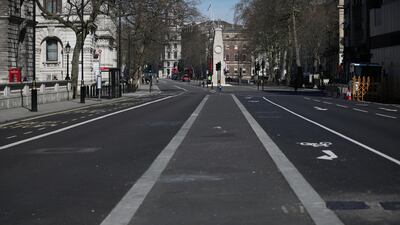
Empty streets in Trafalgar Square as the spread of the coronavirus disease (COVID-19) continues, in London. Reuters -
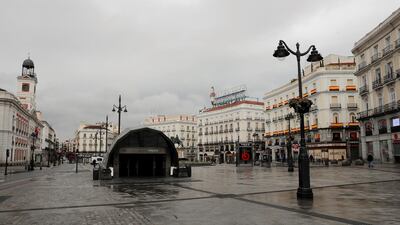
View of the empty Sol square in Madrid, Spain as lockdown continues in the Spanish capital. EPA -

The empty Neumarkt square in front of the Frauenkirche (Church of Our Lady) is seen during a partial lockdown in Dresden, Germany. Reuters -

Aerial view of the empty 9 de Julio avenue in Buenos Aires after the Argentine government ordered a "preventive and mandatory" isolation, effective until the end of the month. AFP -

A view of an empty square in downtown Wroclaw, western Poland. EPA -

The empty street facing the Ponte Vecchio in Florence during a strict lockdown put in place by Italian government to fight against the spread of the COVID-19. AFP -

A man walks along the empty Champs-Elysees in Paris. AFP -
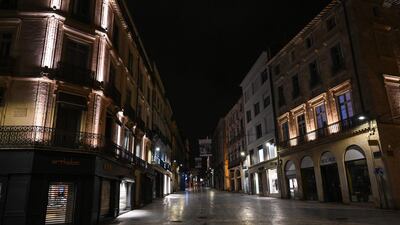
The empty Loge street in the city of Montpellier, southern France, on the seventh day of a lockdown. AFP -
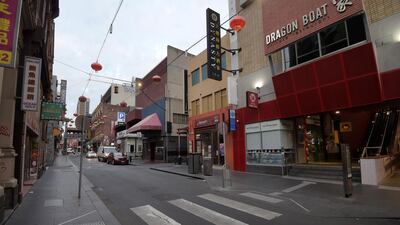
A street stands empty in the Chinatown area of Melbourne, Australia. The Australian government said it will enforce more stringent controls to slow the virus spread, closing pubs, casinos, restaurants and other venues after the number of infections surged. Bloomberg -

A man stands outside the Bondi Pavilion at a near-empty Bondi Beach in Sydney, Australia. Bloomberg -
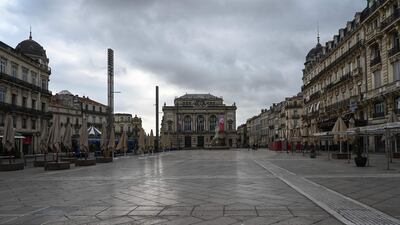
The empty "Place de la Comedie " in the city of Montpellier, southern France. AFP -
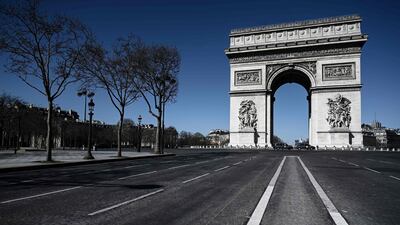
An empty street leading to the Arc de Triomphe in Paris. AFP -
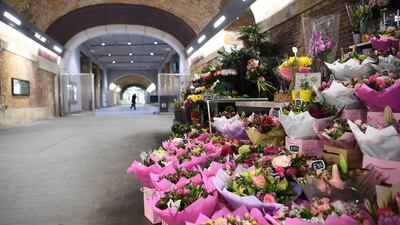
A florist stall at an empty London Bridge in London, Britain. EPA -

Pigeons gather outside the Metropolitan Cathedral of San Salvador during the 40th anniversay of San Oscar Arnulfo Romero (1917-1980) assassination. AFP -
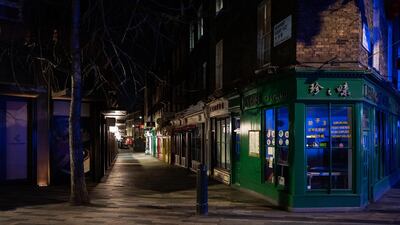
Empty streets and alleyways are seen around Chinatown at what would usually be a busy period of Friday night revelry in London, England. Getty Images -
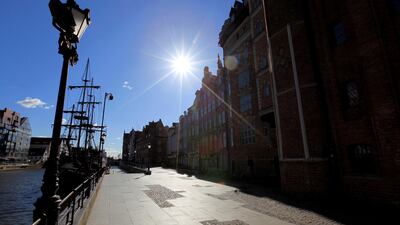
An empty street is seen in the usually crowded Main Town in Gdansk, during the spread of the coronavirus disease (COVID-19) in Poland. Reuters


“2020 will be remembered [...] as the year of great disruption," said Mohammad Al Gergawi, Minister of Cabinet Affairs – UAE and chairman of the World Government Summit Organisation.
"While the world was woefully unprepared for the velocity and voracity of the virus, 2021 needs to be the year that defines humanity’s future and reshapes societies to become stronger and more resilient," he said.
“With great change comes great opportunity. Valuable lessons emerged over the past year, which we must heed as we recover.
"The most important of those is our interconnectedness with one another and with nature. Our individual and collective actions as nations have important consequences, not only for us but for our children and the many generations to come after them – we must all be accountable to ourselves and to one another.”
The report identifies five critical areas that require the attention of the world's leaders: reimagining and reinforcing key public institutions; competing in a transformed economy; navigating a transformed geo-technical order; and, repairing the social fabric and securing the future.
“The world is clearly at a critical juncture in which we face both deep uncertainties and remarkable opportunities in many policy domains," said Rudolph Lohmeyer, partner at consultant company Kearney.
“For government leaders, the decisions made this year will have exceptionally long-term consequences. By taking anticipatory action on these 21 priorities, leaders have an opportunity to harness this transition in the service of their citizens through building societies that are more inclusive and innovative.”
The summit's dialogues event in March discussed climate change and how the pandemic was affecting the world.
David Nabarro, a special envoy on Covid-19 for the WHO, criticised an unfair balance where the rich snap up most of the vaccines. Two world-renowned scientists also described colonising Mars to escape the climate change problem on Earth as "unrealistic".
British astrophysicist Martin Rees and American astrophysicist Neil deGrasse Tyson disagreed with SpaceX founder Elon Musk and late physicist Stephen Hawking’s idea of using Mars as a backup planet.
The next World Government Summit will take place in October.
The 21 recommendations:
Reimagining and reinforcing key public institutions:
Alleviate fiscal overhangs
Reimagine the role of cities
Transform the national portfolio of capabilities
Compete in a transformed economy
Prepare for the coming regulatory shock:
Rebalance self-sufficiency and competitiveness
Drive radical, inclusive upskilling at scale
Reinvent the task structure of the workforce
Navigate a transformed geo-technical order
Navigate the global competition for allegiance:
Prepare to navigate a reordered technology market
Build deep data alliances
Prepare for the new multilateralism
Repair the social fabric
Reactivate critical global health initiatives on enduring threats:
Heal the mental health overhang
Protect the development of our youngest minds
Restore and expand the empowerment of women
Defend the sovereignty of citizens’ minds
Secure the future
Eliminate viral breeding grounds globally:
Adapt to the grey zone
Counter criminal exploitation of the crisis
Activate whole-of-society circular resilience
Harness “warp speed” policy approaches

