


Explained: UK traffic light system for travel
The UAE is likely to secure new quarantine-free travel corridors with the EU and the US before it comes off Britain's red list, the head of Dubai Airports has said.
Paul Griffiths said he did not expect the UAE to be removed from the UK's red list when London reviews it on June 3.
The UK has recently recorded a spike in cases of 3,000 a day, linked to the Indian variant.
"The problem of course is that in the UK the situation is not looking great," Mr Griffiths told CNN.
"They were looking so well in containing the spread of Covid-19, but of course recently that situation seems to be rather more challenging.
"So I am not sure that the UK's going to change the status of the UAE.
"We're obviously anticipating something happening at some stage in the future, but I think for the time being that the corridor we've agreed with Italy is a very positive step."
As of Tuesday, June 1, passengers can travel between UAE and Italy as long as they are fully vaccinated or if they present a negative PCR test before boarding and take a rapid antigen swab test on landing.
Mr Griffiths predicted similar deals with other nations would follow.
"And as further steps emerge, perhaps with the EU as a whole and with the USA over the next few weeks, perhaps that'll give the UK government the courage and conviction to allow flights to restart between the UAE and the UK," he said.
"The UK is an incredibly important market with London the biggest air travel route between the UAE and the UK. So we're all very, very keen to get those discussions under way."
Vaccine passport could replace testing
The airport boss said the UAE was moving forward with a vaccine passport system that he said was probably the "long term solution to travel corridors opening up again".
"And if that's the case then those that have got inoculated with the approved vaccines for Europe will be allowed to enter EU countries," he said.
"And I know there's similar system under way in the US. And those digital systems should enable people to travel without having any problems at the airport.
"Of course testing works, but it does require quite a lot of capacity for testing at the arrival airport.
"The vaccine passport system doesn't require a physical check so it's a more efficient way of travel."
Dubai International Airport recorded a 69 per cent slump in traffic in 2020 as global aviation was grounded.
Despite that, with 26 million passengers, it remained the busiest airport in the world.
With flights from India, Pakistan, Sri Lanka, Nepal and Bangladesh and other countries on hold, new destinations are now top of the charts.
"We are seeing markets such as Ethiopia, Croatia, Greece all surge to the front," he said.
"So it's unusual times and unusual traffic patterns, but we're hopeful that as soon as some of these major markets open up again, rather than being a trickle of recovery there will be a flood of demand.
"Because four billion people having been under lockdown over the last year are desperate to travel."
UAE vaccine campaign - in pictures
-
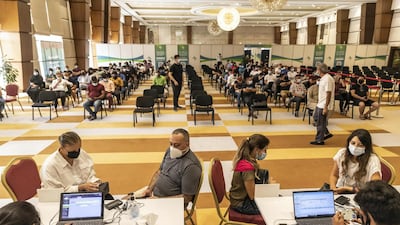
People wait to get vaccinated at Barsha Hall in Barsha, a suburb of Dubai. -
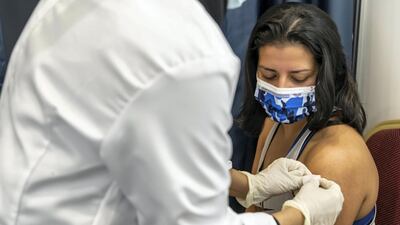
Irum Fatima Tapal gets vaccinated against Covid-19 at Barsha Hall in Dubai -
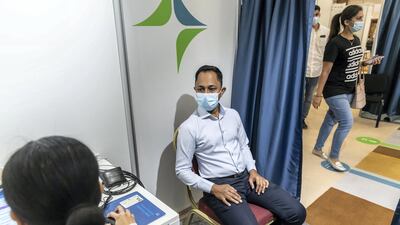
Lateef Painat receives the Pfizer BioNTech shot -
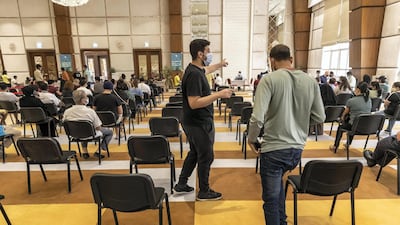
It was a busy first week at Barsha Hall, where 4,000 people can be vaccinated in a day -
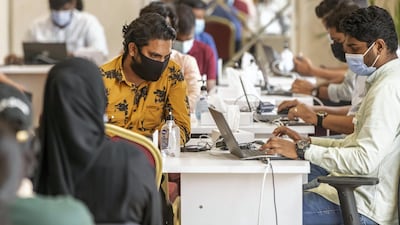
Barsha Hall has 20 check-in counters, 50 vaccination booths and five observation rooms -
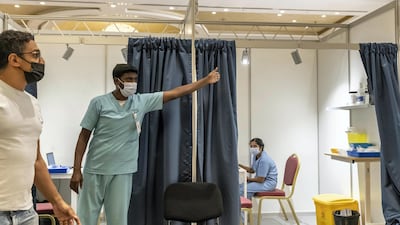
About 80 healthcare staff work at the site -
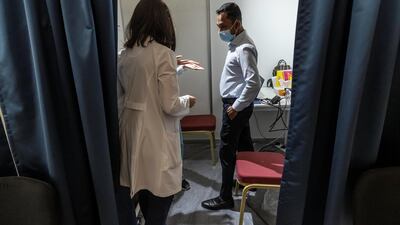
Lateef Painat, a Dubai resident, gets ready to be vaccinated at the newly opened Barsha Hall



