
A road safety review on the Palm Jumeirah is under way after residents complained about late-night street racing on the Golden Mile.
Developer Nakheel said it was working towards “a permanent solution” to stop performance cars racing along the lengths of the Palm's straight roads.
“The safety and well-being of residents and visitors at Palm Jumeirah is paramount,” a Nakheel spokeswoman said.
“We are aware of the situation and, working closely with the appropriate Dubai authorities and the stakeholders involved, are exploring options – such as traffic-calming measures – for a permanent solution.”
Briton Mandy Sanger has lived on the Palm for 18 months with her husband, 3-year-old daughter and four-month-old son.
“Every single night we are woken up,” said Ms Sanger.
“The cars are in competition, racing and revving their engines. It is driving us crazy.
“My husband is exhausted when he goes to work, and I’m getting no sleep either so it is affecting all of us."
Vehicle speeds on the island are limited to 80 kilometres per hour but, with no cameras acting as a deterrent along the trunk of the Palm, night racing has become a recurring issue.
Residents have been out recording cars to hand evidence to Dubai traffic police and the Roads and Transport Authority.
They have been told corrective measures are the responsibility of Nakheel.
Jordanian resident Mohammed Shanabla said his young daughter was often woken up by the noise.
He said that drivers frequently revved their engines as they approached a U-turn in the road, adding that "drivers are going so fast in this area".
____________________
Dubai's Palm Jumeirah at 20 - in pictures
-

Sand pictured being pumped onto Palm Jumeirah on September 9, 2005. Shallow areas of beach were formed using a ‘rainbowing’ technique where sand was deposited into the water from cannons on-board hopper suction dredger vessels. -

The View observation deck at the top of Palm Tower offers with 360 degrees of views of the Dubai skyline. Antonie Robertson / The National -
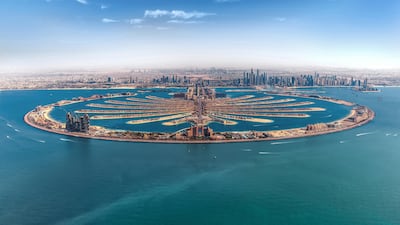
The world famous Palm Jumeirah, one of the few giant structures that can be seen from space with the naked eye. -

The first stage of creating the islands that can be seen today involved dredging large amounts of sea sand and transporting it considerable distances to deposit off the Dubai shoreline. The image shows a dredger barge pumping sand onto the sea bed 3 miles off the shore of Dubai in May 2002, with the Burj Al Arab and Jumeirah Beach hotels in the background. AFP -

An aerial view in November 2003 shows the 17 fronds of the palm tree-shaped resort island on land reclaimed from the sea that will be visible from the moon. AFP -

This NASA image, captured by the crew of the International Space Station in March, 2003, shows Palm Island along the coast of Dubai. NASA / AFP -

A row of luxury villas pictured under construction on Palm Jumeirah on February 2, 2005. AP -

Ongoing construction at Palm Jumeirah pictured on June 20, 2007. AFP -

Hamza Mustafa, an executive of Nakheel, shows British tennis player Tim Henman (R) the Palm Island project model in Dubai on February 21, 2005. Henman was in the UAE to participate in the Dubai Open. AFP -

A view of The Palm Jumeirah island on November 8, 2007, showing construction progress, with some residential homes completed. Reuters -

An aerial view of The Palm Jumeirah islands on November 8, 2007 shows progress being made with the outer crescent, which is connected to the spine of The Palm by an undersea tunnel. Reuters -

An aerial view of The Palm Jumeirah islands shows construction work under way with Atlantis The Palm in the foreground. Reuters -

A view from the Palm Monorail on May 6, 2008, after it opens for business, The fully automatic driverless train ferried passengers between Gateway Towers and Atlantis stations when it opened. Getty Images -

Construction continues on Palm Jumeirah on May 3, 2008, with cranes seen on buildings and Atlantis, The Palm visible on the breakwater of the Palm in the background. Reuters -

Villas are seen on The Palm, Jumeirah, with Atlantis, The Palm, under construction, on the breakwater on May 3, 2008. Reuters -

Atlantis, The Palm pictured under construction on May 3, 2008. The project was completed in September 2008. Reuters -

Overview of Palm Jumeirah in 2009 shows construction progress being made with the shoreline apartments. -

Overview of Palm Jumeirah in 2009 showing construction progress on the west crescent. -

A view of the villas on Palm Jumeirah's fronds from Nakheel's residential complex 'Marina Residences' on November 9, 2009. -

View looking down at the yet to be finished Palm Golden Mile in August 2009 from a penthouse at the Golden Mile development the Palm Jumeirah, Dubai. Callaghan Walsh / The National -

A view looking down at construction work on the The Palm from a penthouse at the Golden Mile development the Palm Jumeirah. Callaghan Walsh / The National -

An aerial view of the Palm Jumeirah on October 25, 2010. Reuters -
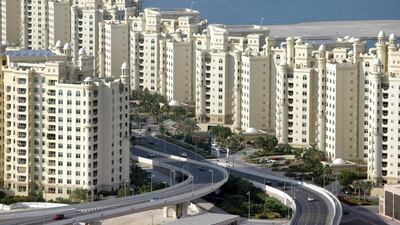
The shoreline apartments at the Palm Jumeirah pictured on January 5, 2011. Jaime Puebla / The National -

The Palm Jumeriah with the Atlantis hotel in the background as seen from the 97th floor of the Princess Tower in Dubai Marina on November 2, 2011. Jeff Topping / The National -

A general view of Atlantis resort in Dubai January 19, 2013. Reuters -

Construction taking place on a new walkway along the outer edge of Palm Jumeirah on March 7 2016. -

Dubai Marina, seen over the top of construction work on Palm Jumeirah on March 7, 2016. Alex Atack / The National. -

The Atlantis resort on Palm Jumeirah, pictured in January 2016. AFP -
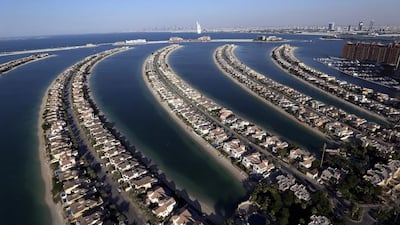
Palm Jumeirah villas pictured in May 2016. There are 1,500 villas spread across the island’s 17 fronds. Bloomberg -

Nakheel Mall under construction on Palm Jumeirah in 2016. Courtesy: Nakheel. -
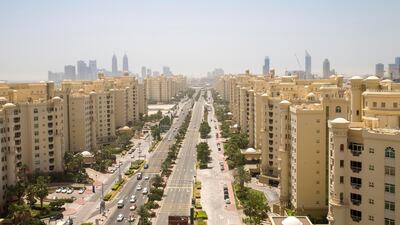
Shoreline Apartments are on the east side of the trunk of Palm Jumeirah -

Fireworks at The Palm Fountain, The Pointe Dubai on Palm Jumeirah. A Guinness World Record was set in 2020 when the 130,000 square metre Palm Fountain opened, becoming the world’s largest when it began dazzling displays from The Pointe waterfront. Chris Whiteoak / The National -
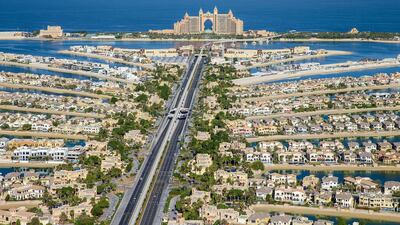
The Palm Jumeirah is home to 78,000 people of 70 different nationalities. -

Palm Jumeirah added 70 kilometres of beaches to the Dubai's coastline. Reem Mohammed / The National -
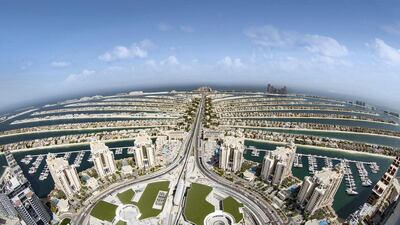
120 million cubic metres of sand and 7 million tonnes of rock were used to build Palm Jumeirah. -

Nakheel Mall on Palm Jumeirah opened to the public in November 2019. Courtesy: Nakheel. -

Atlantis, The Palm remains one of Dubai's most popular hotels. Courtesy: Atlantis -

The Royal Atlantis Residences & Resort is expected to open later this year. -

Palm Tower is the latest addition to Palm Jumeirah, which includes The View observation deck, which offers 360 degrees of views of the Dubai Skyline. Antonie Robertson / The National


____________________
Call for more speed cameras
For most of Dubai, the permitted noise level between 7am to 8pm is 40-50 decibels, while at night acceptable decibel levels are 30-40.
Passing cars typically produce around 50 decibels, but cars racing on the Golden Mile have been clocked by residents at 66 decibels at 1am.
Sophie Miller, from the UK, moved into the Shoreline apartments at the end of March.
“I know there have been a few close calls with accidents, but most of the racing happens at night,” she said.

“Some residents are taking matters into their own hands by blocking the road to stop cars racing.
“Hourly rental firms [for cars] should be stopped after midnight to limit racing at unsociable hours when people are trying to sleep.”
Supercar rentals are a booming business in Dubai.
Some short-term leasing companies offer a Ferrari Portofino for Dh1,200 an hour, while a Lamborghini Huracan can be rented for Dh1,000 an hour, or Dh2,700 per day.
The Five Palm Jumeirah hotel runs adjacent to the road where many vehicles speed. Chief executive Aloki Batra said more speed cameras would halt the problem.
“We know about the issue with supercars,” he said.
“The Palm is an ultra luxurious residential destination and people have these kind of cars."
There is a stretch of road between Five and the Golden Mile where speeding is a problem, he said.
“We have hotel rooms facing the street, so it is not something we are happy about either," Mr Batra said.
“It is not continuous, but there have been complaints.
"For the safety of people and to reduce noise pollution, cameras would deter people from these antics.”
Dubai police's fleet of supercars - in pictures
-
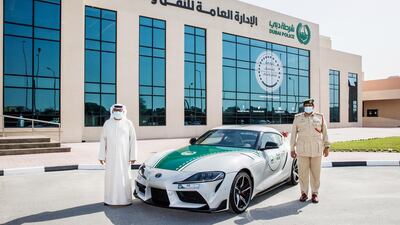
Dubai Police have recently acquired a Toyota Supra to add to their supercar fleet. Courtesy: Dubai Police -
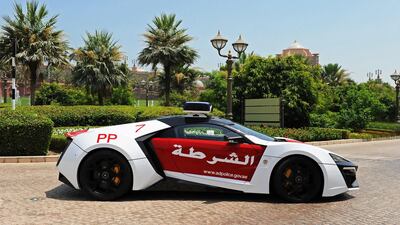
In 2015, Abu Dhabi Police displayed a liveried Lykan HyperSport by Dubai-based car maker W Motors. Security Media -
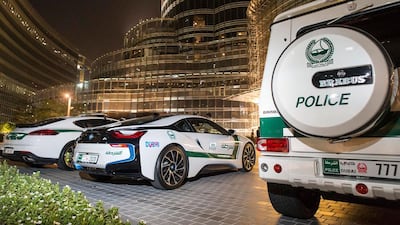
From left, a Porsche Panamera, BMW i8 hybrid sports car and a Brabus 700, all in the Dubai Police colours, pictured in 2015. Dubai Police -
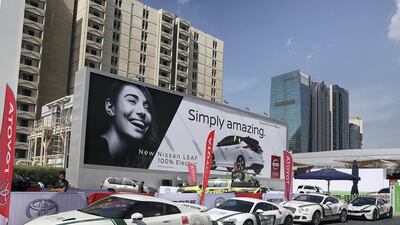
A few million dirhams of Dubai Police metal outside the Dubai International Motor Show in 2017: from left, a Nissan GT-R, an Audi R8, a Bentley Continental GT and a BMW i8. Satish Kumar for The National -
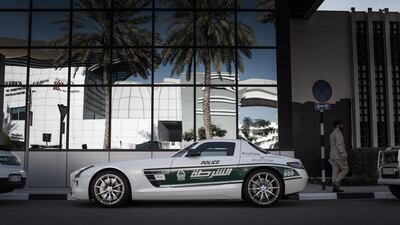
A Mercedes-Benz SLS-AMG on the Dubai Police fleet in 2015. WSF Creative -
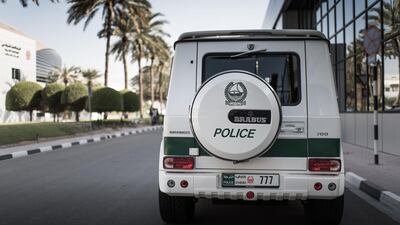
Dubai Police's Brabus 700, which is a Mercedes-Benz G 63 modified by German company Brabus. WSF Creative -

The Bugatti Veyron, once the fastest production car in the world, has been one of the most expensive cars in Dubai Police's collection. EPA -
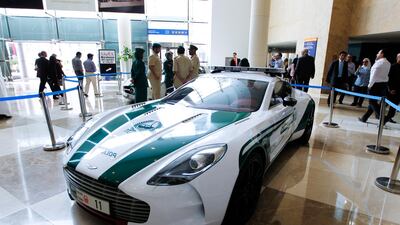
An Aston Martin One-77, one of a limited edition of 77 cars, in Dubai Police livery at the Arabian Travel Market in Dubai in 2013. Sarah Dea / The National -
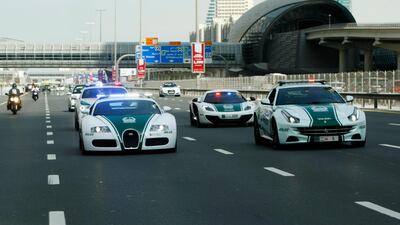
A fleet of Dubai Police supercars led the way during the fourth stage of the Dubai Tour cycling race in 2014. Christopher Pike / The National -

Dubai Police's Brabus 700 was unveiled at the Dubai International Motor Show in 2013. Pawan Singh / The National -
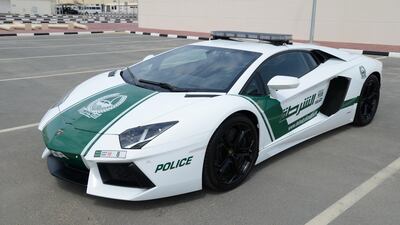
A Lamborghini Aventador in Dubai Police colours. Dubai Police -

A Bentley Continental GT from Dubai Police's fleet at the Arabian Travel Market in Dubai in 2013. AFP -
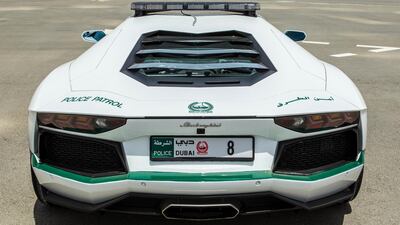
The Lamborghini Aventador is capable of speeds of up to 350 kilometres per hour. Dubai Police -
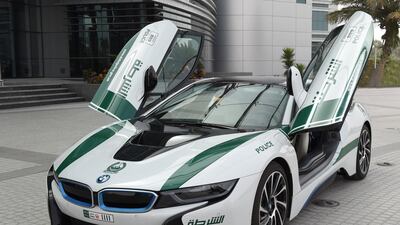
The BMW i8, which is a hybrid vehicle, adds an environmental edge to Dubai Police's glittering fleet. Dubai Police -
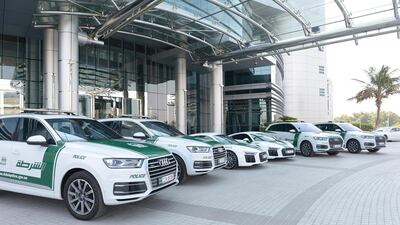
Two new Audi R8s, centre, were added to the Dubai Police roster in 2016. Grayling -
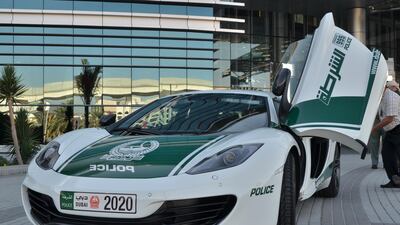
A McLaren MP4-12C was given the green-and-white treatment in 2013. Dubai Police -
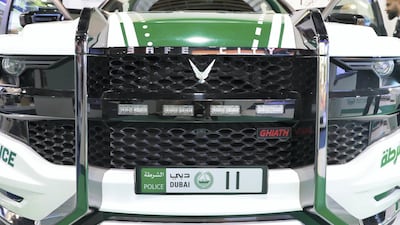
Dubai Police's Ghiath, aka the 'Beast Patrol', fights crime by using AI systems with facialrecognition technology. Victor Besa / The National -
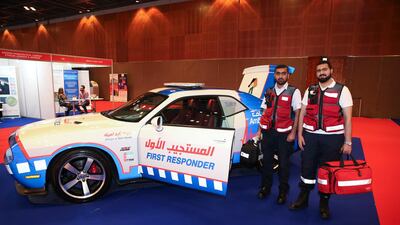
Dubai Ambulance's Ford Mustang. Courtesy: Aletihad -
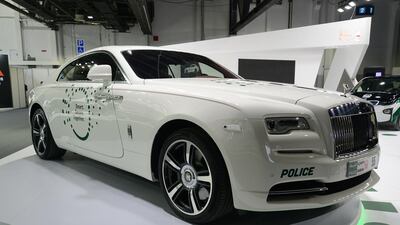
The Rolls-Royce Wraith is the most luxurious of Dubai Police's fleet. Courtesy: Dubai Police -
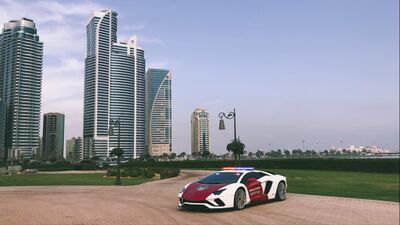
The Ministry of Interior's Lamborghini Aventador. Lamborghini -
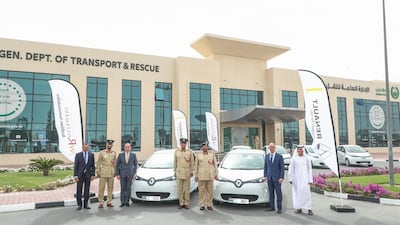
Dubai Police officers set to take to the road in a new fleet of Renault Zoe cars. -
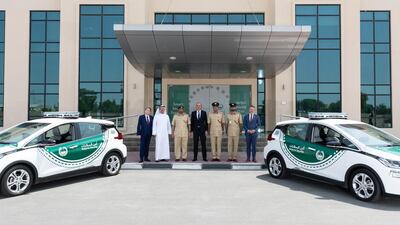
Eight Chevolet Bolt EV cars are now being used by Dubai Police. Courtesy: Chevrolet -
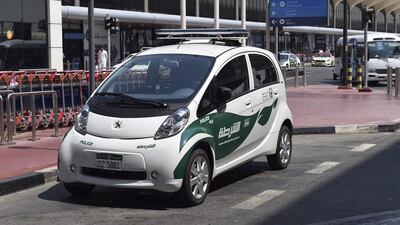
One of Dubai Police's new Peugeot electric cars that will be stationed at Dubai Airports. Dubai Media Office



