


US space agency Nasa has discovered water on the Moon’s surface.
The discovery was made by an airborne research station called Stratospheric Observatory for Infrared Astronomy, commonly known as Sofia, Nasa said on Monday.
Scientists find the discovery important because water signifies life. Past discoveries have only shown evidence of frozen water in the dark places of the lunar surfaces.
“We had indications that H2O – the familiar water we know – might be present on the sunlit side of the Moon,” said Paul Hertz, director of the Astrophysics Division in the Science Mission Directorate at Nasa.
“Now we know it is there. This discovery challenges our understanding of the lunar surface and raises intriguing questions about resources relevant for deep space exploration,” he said.
The quantity of water discovered is about 300 millilitres and was trapped in a cubic metre of soil spread across the lunar surface.
As of now, Nasa is unsure whether water found on the lunar surface could be used as a resource.
Using it as a resource could be useful for the US, as it plans to build a human base on the Moon under the Artemis project. Once established, Nasa will attempt to send astronauts to Mars from the Moon.
Nasa is also looking for ways to make space travel and exploration more sustainable. Using lunar surface resources is one possibility for them, including converting water on lunar surface into rocket fuel. This could ultimately make space travel more affordable.
The findings, published in the latest issue of Nature Astronomy, are built on years of studies and evidence collected by scientists that water could exist on the lunar surface.
“Prior to the Sofia observations, we knew there was some kind of hydration,” said Casey Honniball, lead author of the study.
“But we didn’t know how much, if any, was actually water molecules – like we drink every day – or something more like drain cleaner.”
Orbital and landing missions, over the past 20 years, have confirmed ice exists in the permanently shadowed craters around the Moon’s poles.
Previous missions by Nasa and other space agencies, including the Chandrayaan-1 mission by India, found evidence of hydration in sunnier regions on the surface.
However, the information that was lacking was whether the water was in liquid or ice form.
“Water is a valuable resource, for both scientific purposes and for use by our explorers,” said Jacob Bleacher, chief exploration scientist for Nasa’s Human Exploration and Operations Mission Directorate.
“If we can use the resources at the Moon, then we can carry less water and more equipment to help enable new scientific discoveries.”
Nasa has said there could be several reasons behind the presence of water on the lunar surface. One of the possibilities includes micrometeorites carrying small amounts of water that could have deposited traces of liquid water on to the surface after impact.
UAE's plans to send a lunar mission by 2024 – in pictures
-
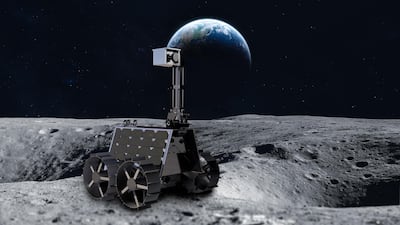
An artist's impression of the UAE's lunar rover called Rashid. -

Dr Hamad Al Marzooqi, project manager of the Emirates Lunar Mission at the Mohammed bin Rashid Space Centre. Chris Whiteoak / The National -
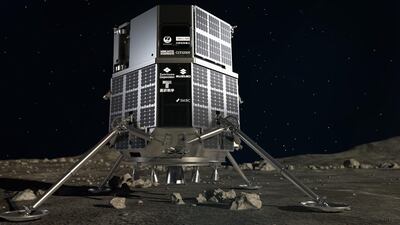
An artist's impression of iSpace's Hakuto-Reboot lunar lander. It will carry UAE's Rashid rover to the surface of the Moon in 2022. -
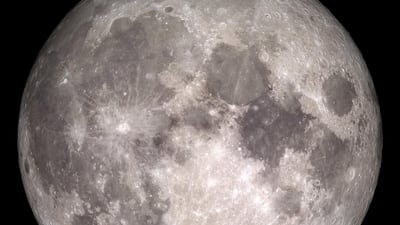
The UAE aims to land the Rashid rover on the near side of the Moon due to its smoother surface. -
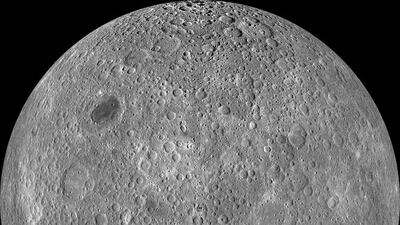
The far side of the Moon remains largely unexplored, but Nasa is turning its focus back to the lunar surface. -
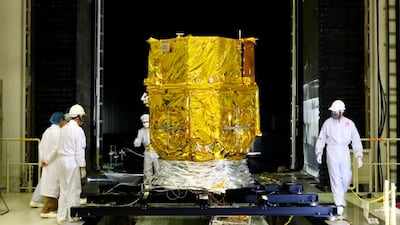
The HAKUTO-R lander, which will deliver the UAE's Rashid rover to the lunar surface in 2022, is now in final stages of assembly. -
The ispace team completed the assembly of the lander's structure thermal model in April. Courtesy: ispace -
The final assembly of the lander is being carried out in co-operation with the Ariane Group GmbH at the Ariane Group facility in Lampoldshausen, Germany. Courtesy: ispace -
Using a lander and rocket that is already available helps Emirati engineers and scientists get quicker and easier access to space. Courtesy: ispace -
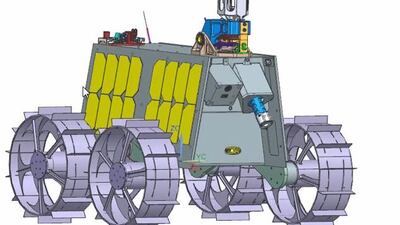
The initial concept design of the Rashid rover. Courtesy: MBRSC -
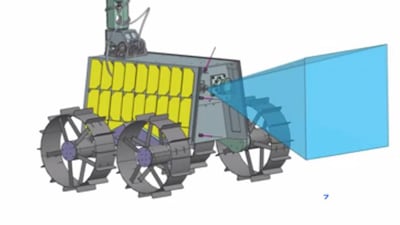
Rashid rover's thermal imager will analyse the Moon's properties through thermal energy. Courtesy: MBRSC -
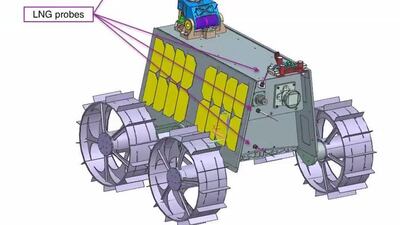
The Langmuir probes on the rover will analyse the lunar surface charge and electric fields. Courtesy: MBRSC -
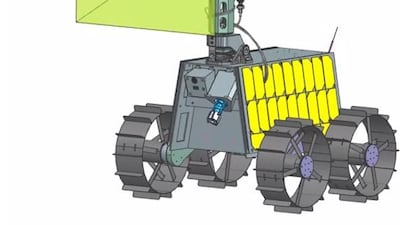
One of the rover's two high-resolution optical imagers that will take photos of the Moon. Courtesy: MBRSC



