The UAE recorded only 1.2 millimetres of rain in the first three months of the year, highlighting the importance of the government's long-term strategy to improve water security.
Official figures from the National Centre of Meteorology (NCM) showed that over the past six months the country had less than a fifth of the rainfall it would typically expect.
From October to March there was 7.73mm of rain, which is less than 19 per cent of the long-term average of about 41mm for Abu Dhabi in the same six-month period.
While there is no evidence that the recent drop in precipitation is the direct result of climate change, the figures tie in with a trend for reduced rainfall that researchers said will continue.
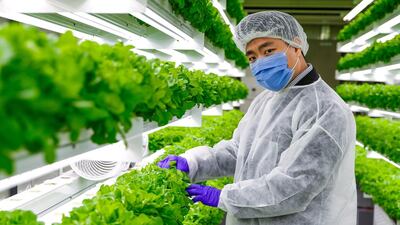
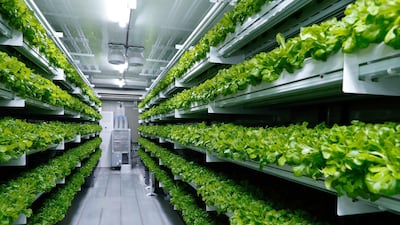
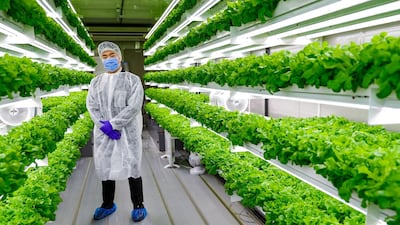
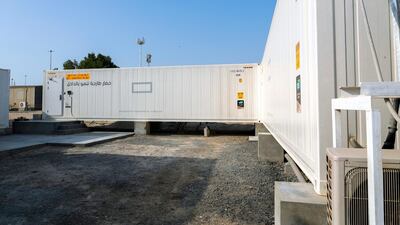
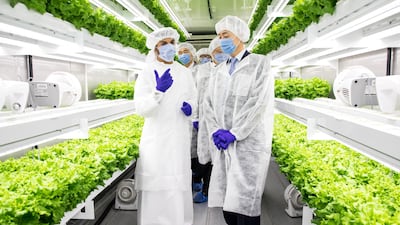
The figures demonstrate why the UAE is pushing ahead with plans to embrace new technologies – such as vertical farms – to reduce water dependence.
Norway-based climate expert Dr Nasser Karami said there was already evidence that rainfall levels in the region had fallen, a trend that threatened to put pressure on agriculture and water supplies.
“The rainfall in the Middle East and the Emirates will decrease and has decreased. But it will decrease further,” Dr Karami, who holds a doctorate in climatology, said.
'Agriculture has to change'
Dr Karami, a former associate professor at the Norwegian University of Science and Technology, who is writing a book on how climate change will affect parts of the region, said nations in the Middle East should accept that a drier future was “their destiny” and adapt accordingly.
“All of them will get more dry years,” he said. “Some countries, they have to accept they have to decrease their dependence on natural resources.”
One forecast, made by researchers in 2019, is that rainfall in the Middle East and North Africa between 2040 and 2069 will be 10 to 20 per cent less than what it was between 1961 and 1990.
“They have to adapt their life to water shortages … It will spread desertification, soil erosion. It will impact on, for example, sandstorms,” Dr Karami said.
“Agriculture has to change now in the Middle East – their cultivation pattern, their models of irrigation.”
Echoing this, Julien Jreissati, programme director for Greenpeace Mena, described the Middle East as “one of the most vulnerable regions to climate change” because of water scarcity and faster-than-average temperature increases.
“Agriculture will have to adjust to less water requirements,” he said. “You will have to change your crop types. The face of agriculture in the region will definitely change.”
About half the UAE’s water supply comes from groundwater, but extraction, particularly for agriculture, and lack of replenishment has caused the water table to fall.
At 550 litres per day, according to one report, the UAE’s per person water consumption is well above the global average of about 200 litres.
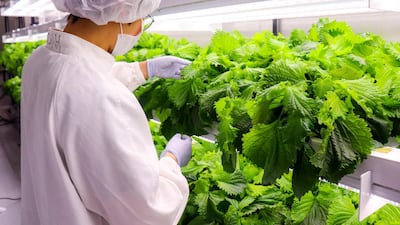
One suggestion from researchers is for further investments to be made in hydroponic agriculture, a way of growing crops without soil.
With some crops, such as lettuce, water use can be reduced by as much as 95 per cent.
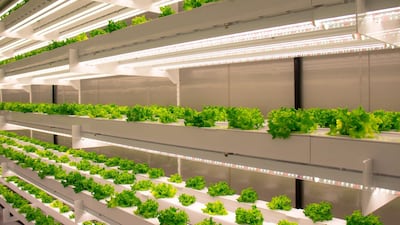
Racks of growing crops can be produced one on top of the other, so yields for a given area of land can be much greater, although lighting and climatic control mean that energy use increases.
In January 2020, the UAE was hit by flooding that led to school closures and residential damage that the then environment minister said was likely linked to climate change.
Despite such events, Dr Karami said the UAE was likely to become increasingly water stressed and would have to consider new ways to secure supplies that would not cause environmental harm to Gulf waters.
As well as groundwater, much of the country’s freshwater comes from desalination, but the process has been blamed for making the region's water increasingly salty. This also makes the desalination process more difficult.
“I don’t think they have another solution better than desalination, but they have to find a way that has less impact on, for example, the sea,” Dr Karami said.
UAE takes steps to bolster water security
Last year, Abu Dhabi Investment Office provided $100 million (Dh367m) to partner agricultural technology companies AeroFarms, Madar Farms, RNZ and RDI to build agritech research and development facilities, and production centres in Abu Dhabi.
Their aim is to explore how countries with an arid climate can benefit from these technologies.
"Agritech will help to increase our domestic food production while minimising the use of water, one of the scarcest resources in our region,” said Mariam Al Mheiri, Minister of State for Food Security.
The minister has stated that vertical farms were key to preserving water resources.
"Generally, vertical farming uses 90 per cent less water than traditional farming," Ms Al Mheiri said.
"Reducing water consumption through vertical farms can also have a very positive economic and environmental impact.
How the UAE is getting drier
The NCM's figures for rainfall in the UAE for the past six months:
October 2020: 2.43mm
November 2020: 2.8mm
December 2020: 1.3mm
January 2021: 0.9mm
February 2021: 0.3mm
March 2021: 0.0mm
Total for the six months: 7.73mm
These are the NCM's average figures for Abu Dhabi Corniche for 2003-2020, to the nearest quarter of a millimetre:
October: 0mm
November: 2.75mm
December: 12.75mm
January: 10.75mm
February: 4mm
March: 10.75mm
Total for the six months: 41mm

More from Neighbourhood Watch:
The specs
Engine: 2.9-litre twin-turbo V6
Power: 540hp at 6,500rpm
Torque: 600Nm at 2,500rpm
Transmission: Eight-speed auto
Kerb weight: 1580kg
Price: From Dh750k
On sale: via special order
David Haye record
Total fights: 32
Wins: 28
Wins by KO: 26
Losses: 4
'The Predator'
Dir: Shane Black
Starring: Olivia Munn, Boyd Holbrook, Keegan-Michael Key
Two and a half stars
COMPANY%20PROFILE
%3Cp%3E%3Cstrong%3ECompany%20name%3A%3C%2Fstrong%3E%20Sav%3Cbr%3E%3Cstrong%3EStarted%3A%3C%2Fstrong%3E%202021%3Cbr%3E%3Cstrong%3EFounder%3A%3C%2Fstrong%3E%20Purvi%20Munot%3Cbr%3E%3Cstrong%3EBased%3A%3C%2Fstrong%3E%20Dubai%3Cbr%3E%3Cstrong%3EIndustry%3A%3C%2Fstrong%3E%20FinTech%3Cbr%3E%3Cstrong%3EFunding%3A%3C%2Fstrong%3E%20%24750%2C000%20as%20of%20March%202023%3Cbr%3E%3Cstrong%3EInvestors%3A%3C%2Fstrong%3E%20Angel%20investors%3C%2Fp%3E%0A
Electric scooters: some rules to remember
- Riders must be 14-years-old or over
- Wear a protective helmet
- Park the electric scooter in designated parking lots (if any)
- Do not leave electric scooter in locations that obstruct traffic or pedestrians
- Solo riders only, no passengers allowed
- Do not drive outside designated lanes
Maestro
%3Cp%3E%3Cstrong%3EDirector%3A%20%3C%2Fstrong%3EBradley%20Cooper%3C%2Fp%3E%0A%3Cp%3E%3Cstrong%3EStarring%3A%20%3C%2Fstrong%3EBradley%20Cooper%2C%20Carey%20Mulligan%2C%20Maya%20Hawke%3C%2Fp%3E%0A%3Cp%3E%3Cstrong%3ERating%3A%3C%2Fstrong%3E%203%2F5%3C%2Fp%3E%0A
The specs
Engine: 2.0-litre 4cyl turbo
Power: 261hp at 5,500rpm
Torque: 405Nm at 1,750-3,500rpm
Transmission: 9-speed auto
Fuel consumption: 6.9L/100km
On sale: Now
Price: From Dh117,059
UAE squad v Australia
Rohan Mustafa (C), Ashfaq Ahmed, Chirag Suri, Rameez Shahzad, Fahad Nawaz, Amjed Gul, Shaiman Anwar, Ahmed Raza, Imran Haider, Muhammad Naveed, Amir Hayat, Ghulam Shabir (WK), Qadeer Ahmed, Tahir Latif, Zahoor Khan
Key figures in the life of the fort
Sheikh Dhiyab bin Isa (ruled 1761-1793) Built Qasr Al Hosn as a watchtower to guard over the only freshwater well on Abu Dhabi island.
Sheikh Shakhbut bin Dhiyab (ruled 1793-1816) Expanded the tower into a small fort and transferred his ruling place of residence from Liwa Oasis to the fort on the island.
Sheikh Tahnoon bin Shakhbut (ruled 1818-1833) Expanded Qasr Al Hosn further as Abu Dhabi grew from a small village of palm huts to a town of more than 5,000 inhabitants.
Sheikh Khalifa bin Shakhbut (ruled 1833-1845) Repaired and fortified the fort.
Sheikh Saeed bin Tahnoon (ruled 1845-1855) Turned Qasr Al Hosn into a strong two-storied structure.
Sheikh Zayed bin Khalifa (ruled 1855-1909) Expanded Qasr Al Hosn further to reflect the emirate's increasing prominence.
Sheikh Shakhbut bin Sultan (ruled 1928-1966) Renovated and enlarged Qasr Al Hosn, adding a decorative arch and two new villas.
Sheikh Zayed bin Sultan (ruled 1966-2004) Moved the royal residence to Al Manhal palace and kept his diwan at Qasr Al Hosn.
Sources: Jayanti Maitra, www.adach.ae
PRESIDENTS CUP
Draw for Presidents Cup fourball matches on Thursday (Internationals first mention). All times UAE:
02.32am (Thursday): Marc Leishman/Joaquin Niemann v Tiger Woods/Justin Thomas
02.47am (Thursday): Adam Hadwin/Im Sung-jae v Xander Schauffele/Patrick Cantlay
03.02am (Thursday): Adam Scott/An Byeong-hun v Bryson DeChambeau/Tony Finau
03.17am (Thursday): Hideki Matsuyama/CT Pan v Webb Simpson/Patrick Reed
03.32am (Thursday): Abraham Ancer/Louis Oosthuizen v Dustin Johnson/Gary Woodland
Countries recognising Palestine
France, UK, Canada, Australia, Portugal, Belgium, Malta, Luxembourg, San Marino and Andorra
More from Rashmee Roshan Lall
Real estate tokenisation project
Dubai launched the pilot phase of its real estate tokenisation project last month.
The initiative focuses on converting real estate assets into digital tokens recorded on blockchain technology and helps in streamlining the process of buying, selling and investing, the Dubai Land Department said.
Dubai’s real estate tokenisation market is projected to reach Dh60 billion ($16.33 billion) by 2033, representing 7 per cent of the emirate’s total property transactions, according to the DLD.
Infobox
Western Region Asia Cup Qualifier, Al Amerat, Oman
The two finalists advance to the next stage of qualifying, in Malaysia in August
Results
UAE beat Iran by 10 wickets
Kuwait beat Saudi Arabia by eight wickets
Oman beat Bahrain by nine wickets
Qatar beat Maldives by 106 runs
Monday fixtures
UAE v Kuwait, Iran v Saudi Arabia, Oman v Qatar, Maldives v Bahrain
KILLING OF QASSEM SULEIMANI
Infiniti QX80 specs
Engine: twin-turbocharged 3.5-liter V6
Power: 450hp
Torque: 700Nm
Price: From Dh450,000, Autograph model from Dh510,000
Available: Now
Company profile
Name: Thndr
Started: October 2020
Founders: Ahmad Hammouda and Seif Amr
Based: Cairo, Egypt
Sector: FinTech
Initial investment: pre-seed of $800,000
Funding stage: series A; $20 million
Investors: Tiger Global, Beco Capital, Prosus Ventures, Y Combinator, Global Ventures, Abdul Latif Jameel, Endure Capital, 4DX Ventures, Plus VC, Rabacap and MSA Capital
Mobile phone packages comparison
Final scores
18 under: Tyrrell Hatton (ENG)
- 14: Jason Scrivener (AUS)
-13: Rory McIlroy (NIR)
-12: Rafa Cabrera Bello (ESP)
-11: David Lipsky (USA), Marc Warren (SCO)
-10: Tommy Fleetwood (ENG), Chris Paisley (ENG), Matt Wallace (ENG), Fabrizio Zanotti (PAR)
Mercer, the investment consulting arm of US services company Marsh & McLennan, expects its wealth division to at least double its assets under management (AUM) in the Middle East as wealth in the region continues to grow despite economic headwinds, a company official said.
Mercer Wealth, which globally has $160 billion in AUM, plans to boost its AUM in the region to $2-$3bn in the next 2-3 years from the present $1bn, said Yasir AbuShaban, a Dubai-based principal with Mercer Wealth.
“Within the next two to three years, we are looking at reaching $2 to $3 billion as a conservative estimate and we do see an opportunity to do so,” said Mr AbuShaban.
Mercer does not directly make investments, but allocates clients’ money they have discretion to, to professional asset managers. They also provide advice to clients.
“We have buying power. We can negotiate on their (client’s) behalf with asset managers to provide them lower fees than they otherwise would have to get on their own,” he added.
Mercer Wealth’s clients include sovereign wealth funds, family offices, and insurance companies among others.
From its office in Dubai, Mercer also looks after Africa, India and Turkey, where they also see opportunity for growth.
Wealth creation in Middle East and Africa (MEA) grew 8.5 per cent to $8.1 trillion last year from $7.5tn in 2015, higher than last year’s global average of 6 per cent and the second-highest growth in a region after Asia-Pacific which grew 9.9 per cent, according to consultancy Boston Consulting Group (BCG). In the region, where wealth grew just 1.9 per cent in 2015 compared with 2014, a pickup in oil prices has helped in wealth generation.
BCG is forecasting MEA wealth will rise to $12tn by 2021, growing at an annual average of 8 per cent.
Drivers of wealth generation in the region will be split evenly between new wealth creation and growth of performance of existing assets, according to BCG.
Another general trend in the region is clients’ looking for a comprehensive approach to investing, according to Mr AbuShaban.
“Institutional investors or some of the families are seeing a slowdown in the available capital they have to invest and in that sense they are looking at optimizing the way they manage their portfolios and making sure they are not investing haphazardly and different parts of their investment are working together,” said Mr AbuShaban.
Some clients also have a higher appetite for risk, given the low interest-rate environment that does not provide enough yield for some institutional investors. These clients are keen to invest in illiquid assets, such as private equity and infrastructure.
“What we have seen is a desire for higher returns in what has been a low-return environment specifically in various fixed income or bonds,” he said.
“In this environment, we have seen a de facto increase in the risk that clients are taking in things like illiquid investments, private equity investments, infrastructure and private debt, those kind of investments were higher illiquidity results in incrementally higher returns.”
The Abu Dhabi Investment Authority, one of the largest sovereign wealth funds, said in its 2016 report that has gradually increased its exposure in direct private equity and private credit transactions, mainly in Asian markets and especially in China and India. The authority’s private equity department focused on structured equities owing to “their defensive characteristics.”
Who has lived at The Bishops Avenue?
- George Sainsbury of the supermarket dynasty, sugar magnate William Park Lyle and actress Dame Gracie Fields were residents in the 1930s when the street was only known as ‘Millionaires’ Row’.
- Then came the international super rich, including the last king of Greece, Constantine II, the Sultan of Brunei and Indian steel magnate Lakshmi Mittal who was at one point ranked the third richest person in the world.
- Turkish tycoon Halis Torprak sold his mansion for £50m in 2008 after spending just two days there. The House of Saud sold 10 properties on the road in 2013 for almost £80m.
- Other residents have included Iraqi businessman Nemir Kirdar, singer Ariana Grande, holiday camp impresario Sir Billy Butlin, businessman Asil Nadir, Paul McCartney’s former wife Heather Mills.
Hunting park to luxury living
- Land was originally the Bishop of London's hunting park, hence the name
- The road was laid out in the mid 19th Century, meandering through woodland and farmland
- Its earliest houses at the turn of the 20th Century were substantial detached properties with extensive grounds
Killing of Qassem Suleimani
If you go…
Emirates launched a new daily service to Mexico City this week, flying via Barcelona from Dh3,995.
Emirati citizens are among 67 nationalities who do not require a visa to Mexico. Entry is granted on arrival for stays of up to 180 days.
Jigra
Starring: Alia Bhatt, Vedang Raina, Manoj Pahwa, Harsh Singh
The specs: 2018 Harley-Davidson Fat Boy
Price, base / as tested Dh97,600
Engine 1,745cc Milwaukee-Eight v-twin engine
Transmission Six-speed gearbox
Power 78hp @ 5,250rpm
Torque 145Nm @ 3,000rpm
Fuel economy, combined 5.0L / 100km (estimate)
UAE v Gibraltar
What: International friendly
When: 7pm kick off
Where: Rugby Park, Dubai Sports City
Admission: Free
Online: The match will be broadcast live on Dubai Exiles’ Facebook page
UAE squad: Lucas Waddington (Dubai Exiles), Gio Fourie (Exiles), Craig Nutt (Abu Dhabi Harlequins), Phil Brady (Harlequins), Daniel Perry (Dubai Hurricanes), Esekaia Dranibota (Harlequins), Matt Mills (Exiles), Jaen Botes (Exiles), Kristian Stinson (Exiles), Murray Reason (Abu Dhabi Saracens), Dave Knight (Hurricanes), Ross Samson (Jebel Ali Dragons), DuRandt Gerber (Exiles), Saki Naisau (Dragons), Andrew Powell (Hurricanes), Emosi Vacanau (Harlequins), Niko Volavola (Dragons), Matt Richards (Dragons), Luke Stevenson (Harlequins), Josh Ives (Dubai Sports City Eagles), Sean Stevens (Saracens), Thinus Steyn (Exiles)