
It is the dream job that has captured the hearts and minds of millions of people around the world since humankind first launched into space.
But while the coveted role of an astronaut comes with plenty of glamour and grandeur and has inspired many a Hollywood script, great sacrifices must be made on the gruelling route to the top.
A new four-part National Geographic documentary, Reach for the Stars, is chronicling Hazza Al Mansouri's remarkable journey to the International Space Station last September.
The second episode in the series aired on Monday night, offering UAE viewers a unique insight into the intense demands placed on those seeking to soar into the skies.
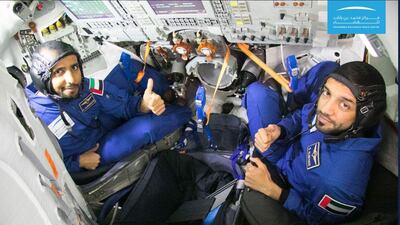
Maj Hazza Al Mansouri and Dr Sultan Al Neyadi, part of the back-up crew on the landmark mission, spent more than a year training in Russia, Houston and parts of Europe to prepare to become their country's first astronauts.
However, before even reaching the training stage, they had to navigate multiple interview rounds and rigorous medical and psychological exams in order to get selected.
Following Maj Al Mansouri’s historic achievements, more than 4,300 Emiratis are eager to follow in his footsteps and have applied to be part of the country’s astronaut corps.
The National explores what these candidates can expect in terms of tests and training as the next round of the selection process approaches.
Making a good first impression
A total of 4,305 people have applied, but only 300 will be selected for the next round by early June.
The candidate’s application and curriculum vitae are going to be thoroughly studied. This round’s selection is most likely going to be based on his or her educational and professional background. Other contributing factors could be age and special career or personal achievements.
Usually, there are a few preferred professions for human spaceflight programmes, such as pilots, engineers, mechanics, scientists, doctors and researchers.
However, Salem Al Marri, the head of the astronaut programme, had told The National they are open to "any background", especially teachers.
The person must be Emirati, over 18 and have a bachelor’s degree.
Maj Al Mansouri, 36, has a Bachelor of Aviation Science from Khalifa bin Zayed Air College. He is a former F-16 fighter jet pilot and had 14 years of flying experience when he applied to be an astronaut in 2017.
Dr Al Neyadi, 39, served in the UAE Armed Forces as a communications engineer and has a PhD in Information Technology, as well as a Master of Information and Network Security.
This year’s applications include 130 Emiratis with PhDs.
If chosen as part of the 300, applicants move on to a virtual interview and assessment round. The video sessions are a new addition because of the Covid-19 pandemic.
Several factors could be measured at this stage, including communication skills. In a National Geographic Abu Dhabi documentary that aired on Monday, Mr Al Marri said what impressed him about Maj Al Mansouri was his personality.
The applicant will likely be asked to speak about their educational and professional background in-depth and knowledge of space.
Passing the health and psychological tests
Being in great health is essential to be an astronaut, as there could be severe consequences if a person is not physically ready for the spaceflight and weightlessness.
Which is why the Mohammed bin Rashid Space Centre has health and psychological tests as part of the selection process.
The majority of Emiratis could not make it past this round in 2018 because of either having weak bones, acne, allergies or an unhealthy body mass index.
A total of 120 candidates will be chosen from the 300 later in June and will undergo a series of these tests.

This round could include medical questionnaires and health exams that measure an applicant’s and their family’s medical history, current health status, lifestyle habits and history of illnesses in the family.
Then, it will be psychological and psychometric tests to evaluate the person’s aptitude and mental state.
Space officials worldwide do not reveal what is asked in these tests, however, the European Space Agency had said they determine a person’s personality factors through a computer-based test or in a group setting.
It also helps measure if a person’s behaviour and mind-set matches to what is required of an astronaut, such as being extremely focused, following and understanding directions, decision-making skills and ability to work in a team.
In Russia, some astronauts are kept in isolation for 72 hours and are monitored by psychiatrists in order to see how they would hold up during long-duration space missions.
Out of the 120, only 80 will be shortlisted for the first interview panel scheduled for September.
More interviews before selection
The first interview panel will take place in September. Mr Al Marri said he hoped that face-to-face meetings could be possible by then, however, virtual interviews are also a possibility.
In this round, a panel comprised of 10 MBRSC officials will interview the remaining 80. Questions designed around measuring the candidate’s knowledge of space and decision-making skills could be asked.

Maj Al Mansouri said earlier this year that versatility is an important skillset for an astronaut, as there are multiple jobs to do on the International Space Station, such as maintenance, research and reporting.
Only 40 will make the cut and will move on to the second interview stage that will take place in November.
That number will continue to be narrowed down in the same month until the selection committee, which includes Maj Al Mansouri and Dr Al Neyadi, have made their decision.
By January, the names of the two new astronauts will be announced to the public.
Training starts for the astronaut corps
Because the UAE had already made a deal with Russia for the first space mission, the astronauts immediately travelled to Star City to start their training.
No such partnerships have been announced yet and it is not clear where the astronauts will be doing their training.
However, the training methods are similar in Russia, the US and Europe.

Maj Al Mansouri and Dr Al Neyadi spent one year at the Yuri Gagarin Cosmonaut Training Centre in Star City.
The astronauts and cosmonauts there are put through rigorous training and health checks to ensure they are mentally and physically ready.
UAE’s astronauts sat in the ‘rotating chair’ for 10 to 15 minutes multiple times a week, which helped build resistance against motion sickness.
They completed the centrifuge test twice. Strapped into a harness and swung around in a huge metal arm, they were subjected to eight times the force of gravity.
The astronauts also did the ‘tilting table test’ several times a week to measure their vestibular system. They were turned upside down and lowered or raised at different degrees to see how well they can handle blood rushing to their brain – a common occurrence in micro gravity.

Other requirements were fluency in the Russian language, carrying out harsh winter training in case they had to make an emergency landing in a remote area and spending hours in micro gravity and Soyuz simulators a few times each week.
Even after going through all of these tests, Maj Al Mansouri said the “toughest part” for him was being away from family.
For more information on the documentary, visit the National Geographic website

