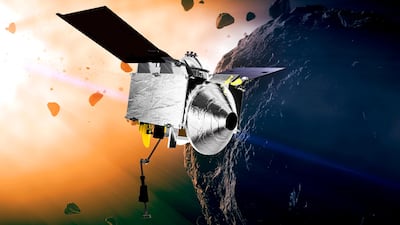
With rubble from an asteroid tucked inside, a Nasa spacecraft began the long journey back to Earth on Monday, leaving the ancient space rock in its rear-view mirror.
The trip home for US robotic prospector Osiris-Rex will take two years.
Launched in 2016, Osiris-Rex reached asteroid Bennu in 2018. It spent two years flying near and around it before collecting rubble from the surface last autumn.
The University of Arizona's Dante Lauretta, the project's principal scientist, estimates the spacecraft holds between 200 and 400 grams of mostly bite-size chunks. Either way, it easily exceeds the target of 60g.
It will be the biggest cosmic haul for the US since the Apollo moon rocks. While Nasa has returned comet dust and solar wind samples, this is the first time it has gone after pieces of an asteroid.
Japan has accomplished this twice, but in tiny quantities.
Scientists described Monday's departure from Bennu's vicinity as a bittersweet moment.
“I’ve been working on getting a sample back from an asteroid since my daughter was in diapers, and now she’s graduating from high school – so it’s been a long journey,” said Nasa project scientist Jason Dworkin.
"We have got used to being at Bennu and seeing new and exciting images and data coming back to us here on Earth," Mr Lauretta said.
Osiris-Rex was already 300 kilometres from Bennu when it fired its main engines on Monday afternoon.
Colorado-based flight controllers for spacecraft builder Lockheed Martin applauded when confirmation arrived of the spacecraft’s departure.
“We’re bringing the samples home,” announced a member of the flight control team over the public address system.
Scientists hope to uncover some of the solar system’s secrets from the samples vacuumed last October from Bennu’s dark, rough, carbon-rich surface. The asteroid is an estimated 490 meters wide and 4.5 billion years old.
Bennu – considered a broken chunk from a bigger asteroid – is believed to hold the preserved building blocks of the Solar System.
The returning pieces could shed light on how the planets formed and how life began on Earth. They also could improve Earth's odds against any incoming rocks.
-
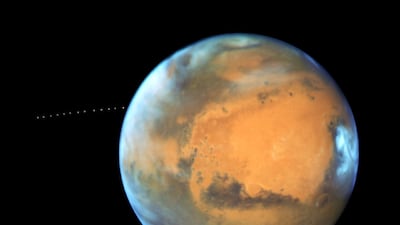
Nasa's Hubble Space Telescope captured the tiny moon Phobos during its orbital trek around Mars. Because the moon is so small, it appears star-like in the Hubble pictures. The Hubble observations were intended to photograph Mars, and the moon's cameo appearance was a bonus. Phobos is one of the smallest moons in the solar system. It is so tiny that it would fit comfortably inside the Washington, DC. Courtesy: Nasa -
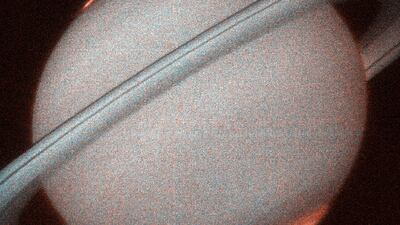
This is the first image of Saturn's ultraviolet aurora taken by the Space Telescope Imaging Spectrograph (STIS) on board the Hubble Space Telescope (HST) in October 1998, when Saturn was a distance of 810 million miles (1.3 billion km) from Earth. Courtesy: Nasa -
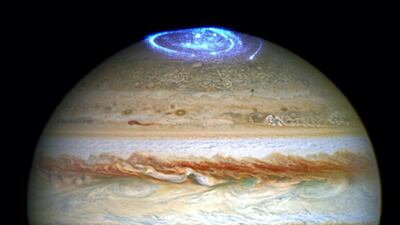
Astronomers are using the Nasa / ESA Hubble Space Telescope to study auroras — stunning light shows in a planet’s atmosphere — on the poles of the largest planet in the solar system, Jupiter. Courtesy: Nasa -
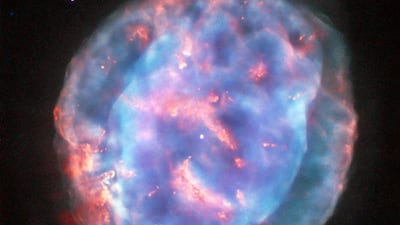
This colourful bubble is a planetary nebula called NGC 6818, also known as the Little Gem Nebula. It is located in the constellation of Sagittarius (The Archer), roughly 6000 light-years away from us. Courtesy: Nasa -
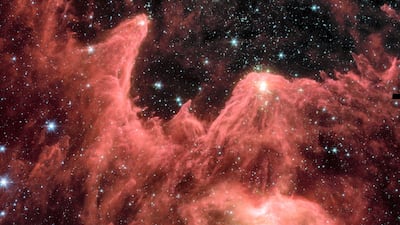
This majestic false-colour image from Nasa's Spitzer Space Telescope shows 'mountains' where stars are born. These towering pillars of cool gas and dust are illuminated at their tips with light from warm embryonic stars. Courtesy: Nasa -
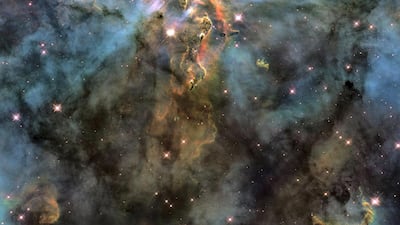
This Nasa Hubble Space Telescope photograph captures the chaotic activity atop a three-light-year-tall pillar of gas and dust that is being eaten away by the brilliant light from nearby bright stars. The pillar is also being assaulted from within, as infant stars buried inside it fire off jets of gas that can be seen streaming from towering peaks. This turbulent cosmic pinnacle lies within a tempestuous stellar nursery called the Carina Nebula, located 7,500 light-years away in the southern constellation Carina. Courtesy: Nasa -
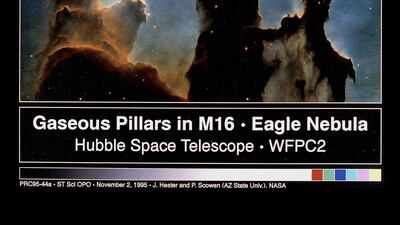
These eerie, dark, pillar-like structures are actually columns of cool interstellar hydrogen gas and dust that are also incubators for new stars. The pillars protrude from the interior wall of a dark molecular cloud like stalagmites from the floor of a cavern. They are part of the Eagle Nebula (also called M16), a nearby star-forming region 7,000 light-years away, in the constellation Serpens. Courtesy: Nasa -
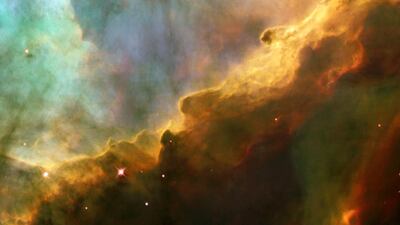
In this image provided by the Hubble Space Telescope (HST), the Omega Nebula (M17) resembles the fury of a raging sea, showing a bubbly ocean of glowing hydrogen gas and small amounts of other elements such as oxygen and sulphur. The nebula, also known as the Swan Nebula, is a hotbed of newly born stars residing 5,500 light-years away in the constellation Sagittarius. Courtesy: Nasa -
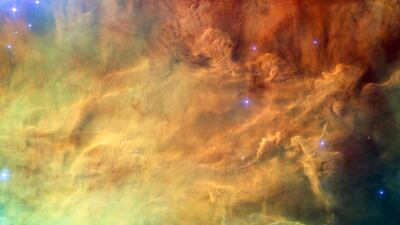
Nasa / ESA Hubble Space Telescope image reveals the heart of the Lagoon Nebula. Courtesy: Nasa -
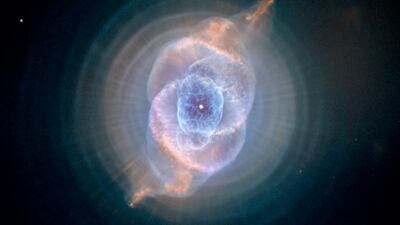
The Cat's Eye Nebula, one of the first planetary nebulae discovered, also has one of the most complex forms known to this kind of nebula. Eleven rings, or shells, of gas make up the Cat's Eye. Courtesy: Nasa -
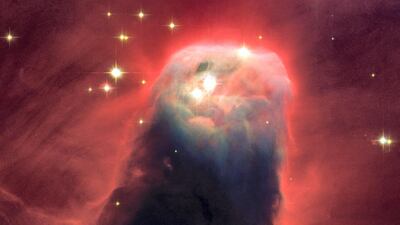
The Cone Nebula resides 2,500 light-years away in the constellation Monoceros. Radiation from hot, young stars (located beyond the top of the image) has slowly eroded the nebula over millions of years. Courtesy: Nasa -
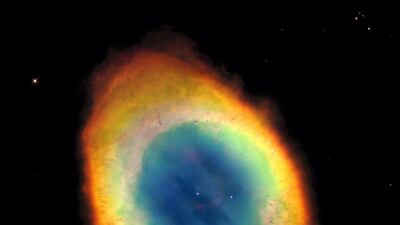
This planetary nebula's simple, graceful appearance is thought to be due to perspective: our view from Earth looking straight into what is actually a barrel-shaped cloud of gas shrugged off by a dying central star. Hot blue gas near the energising central star gives way to progressively cooler green and yellow gas at greater distances with the coolest red gas along the outer boundary. Courtesy: Nasa -
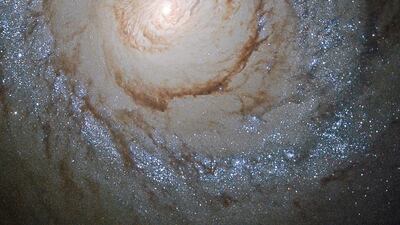
This image shows the galaxy Messier 94, which lies in the small northern constellation of the Hunting Dogs, about 16 million light-years away. Within the bright ring around Messier 94 new stars are forming at a high rate and many young, bright stars are present within it – thanks to this, this feature is called a starburst ring. The cause of this peculiarly shaped star-forming region is likely a pressure wave going outwards from the galactic centre, compressing the gas and dust in the outer region. Courtesy: Nasa


Although the asteroid is 287 million kilometres away, Osiris-Rex will put another 2.3 billion kilometres on its odometer to catch up with Earth.
The SUV-size spacecraft will circle the sun twice before delivering its small sample capsule to the desert floor of western US state Utah, on September 24, 2023, to end the $800 million mission.
The precious samples will be housed at a new lab under construction at Nasa's Johnson Space Centre in Houston, Texas, already home to hundreds of kilograms of lunar material collected by the 12 Apollo moonwalkers from 1969 to 1972.
Scientists initially thought the spacecraft had gathered one kilogram of asteroid rubble, but more recently revised their estimate downward.
They won’t know for certain how much is on board until the capsule is opened after touchdown.
"Every bit of sample is valuable," Mr Dworkin said. "We have to be patient."
Nasa has more asteroid projects planned.
Set to launch in October, a spacecraft named Lucy will fly past swarms of asteroids out near Jupiter, while Dart will blast off in November in an attempt to redirect an asteroid as part of a planetary protection test.
Then in 2022, the Psyche spacecraft will take off for an odd, metallic asteroid bearing the same name.
None of these missions, however, involve sample return.

