

People in East Asia may have been exposed to coronaviruses as far back as 25,000 years ago and their descendants may carry genetic traces today, a study suggested.
Researchers said their findings do not imply that East Asians are now better protected against today's novel coronavirus, although genes do influence how an individual's body responds to viral infections.
For the study, genetic variation in 26 populations around the world were analysed, but the effects of coronavirus exposure was detected only in East Asians.
“An arms race with an ancient coronavirus, or with a different virus that happened to use similar interactions as coronaviruses with human hosts, may thus have taken place in ancestral East Asian populations,” the researchers wrote.
Using publicly available genetics databases, the scientists analysed variation associated with genes coding for 420 virus-interacting proteins (VIPs), which are substances that may affect the way a person’s body reacts to an infection.
The proteins that were analysed were shown by earlier research to interact specifically with coronaviruses, leading researchers to name them CoV-VIPs.
Some may be involved in the immune response to infection, or they could be proteins used by viruses to hijack components of human cells after infection.
Only in the East Asian population did the researchers find patterns of genetic variation that suggested the CoV-VIPs had adapted to the presence of coronaviruses in the distant past.
The researchers think the effects began about 900 generations (or about 25,000 years) ago and lasted until about 200 generations (or 5,000 years) ago.
-

Young people wearing face masks ride bicycles at a park in Seoul. AP Photo -

Pedestrians wearing protective masks walk through the street in the Jongno district of Seoul, South Korea. South Korea will impose a “special quarantine period” for two weeks from February 2 in the run-up to the Lunar New Year holidays to prevent another wave of infections. Bloomberg -

South Korean President Moon Jae-in holds a vaccine vial during a visit to a plant of South Korean bio firm SK Bioscience Co. in the southeastern city of Andong, South Korea. EPA -

A woman wearing a face mask as a precaution against the coronavirus, walks in downtown Seoul, South Korea. AP Photo -

People wearing face masks wait for buses at a bus station in Goyang, South Korea. AP Photo -
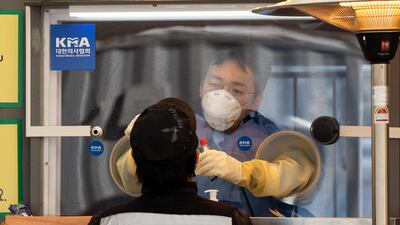
A healthcare worker standing inside a container collects a sample from a visitor at a temporary Covid-19 testing station outside Seoul City Hall in Seoul. Bloomberg -

Pedestrians walk along a sidewalk in the Jongno district of Seoul. Bloomberg -

Medical workers in a booth wait for people to come for tests at a coronavirus testing site in Seoul. AP Photo -

A South Korean official wearing a royal guard uniform and a face mask stands before the Royal Palace gates at Gyeongbokgung Palace in Seoul. EPA -

A lone woman takes the escalator down in Seoul. AP Photo -

Prime Minister Chung Sye-kyun speaks during a videoconference of the Central Disaster and Safety Countermeasures Headquarters about measures against the spread of the coronavirus. EPA -

Students in protective gear get on a bus to head to a makeshift clinic at an alternative school in Gwangju, as around 200 students at the school come down with Covid19 while lodging together. EPA -

Pedestrians cross an intersection road near Seoul City Hall in Seoul. Bloomberg


The findings could be of more than academic interest, as they may offer indications as to how humans will be affected by disease in future.
“By learning more about our ancient viral foes, our study highlights the promise of evolutionary information to better predict the pandemics of the future,” the researchers wrote.
The scientists, who are based at the University of Adelaide in Australia and the University of Arizona in the US, also said that identifying genetic differences between populations may help to develop drugs.
As the researchers noted, East Asia is where the current pandemic originated, yet the region has been notable for having been relatively less affected.
China, Japan and South Korea, which have a combined population of more than 1.5 billion, have suffered a total of about 16,000 deaths, according to official figures. Most other regions of the world have been much more heavily affected.
The researchers emphasised, though, that the results did not mean East Asians today have natural immunity to the coronavirus that causes Covid-19.
“Importantly, adaptation to ancient viral epidemics in specific human populations does not necessarily imply any difference in genetic susceptibility between different human populations, and the current evidence points toward an overwhelming impact of socioeconomic factors in the case of Covid-19,” they wrote.
Dr Andrew Freedman, specialist in infectious diseases at Cardiff University in Wales, who is not connected to the new study, said that an individual’s genetic make-up does, however, influence their response to viral infections.
For example, with HIV, the virus that causes Aids, a very small proportion of people are naturally better able to combat infection and can remain healthy for decades without treatment.
“That’s thought to be genetic – the genes control the immune response,” Dr Freedman said.
While he has not analysed the new study’s findings, Dr Freedman said that, because a person’s immune response is influenced by their genes, it was “certainly feasible” that particular populations were “better suited to combating Covid and other coronaviruses”.
The study was published online this year and presented this month at an annual meeting of the American Association of Physical Anthropologists.
It was released before being reviewed by other scientists, so its findings are considered preliminary.

