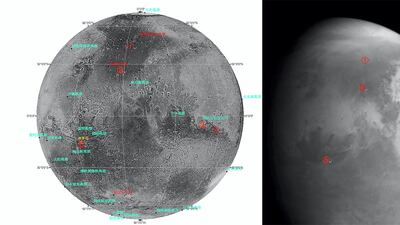

China’s Tianwen-1 Mars mission has beamed back its first image of the Red Planet, as it prepares to make its final approach.
The China National Space Administration released a grayscale image of Mars taken by the spacecraft, ahead of its orbit entry attempt on February 10.
The mission – which includes an orbiter, lander and a rover – was launched four days after the UAE's Hope probe was launched on July 19 last year.
US space agency Nasa also launched a rover to Mars at the end of July last year.
All were taking advantage of the narrow launch window that lasted between mid-July to early August.
The Hope probe is scheduled to be the first to arrive at the Red Planet on February 9, at 7.42pm Gulf Standard Time.
It is the Arab world’s first interplanetary mission.
The Tianwen-1 mission is China’s second attempt at reaching Mars.
It will study soil and rock composition, the planet's atmosphere and search for signs of buried water ice.
In 2011, a Russian rocket carrying a Chinese spacecraft meant for Mars ended in failure due to engine problems mid-flight.
Omran Sharaf, UAE's Mars mission director, wished the Chinese space agency good luck.
"At the end of the day for us, the more missions that reach Mars, the better it is," he told The National.
“We never looked at this mission, or even our space sector in general, as a competition.
"For us, it was never a competition – it has always been collaboration.
"We do care about the success of the Chinese mission, but we don't really care if they come before or after us.
"We are paying attention to whether it's going to be successful or not and we hope that it is. It will add more value to the global effort of data generation towards better understanding Mars."
The UAE is set to become the fifth nation to reach the Red Planet, if orbit entry is successful.
China would become the sixth.
China launches spacecraft to Mars - in pictures
-
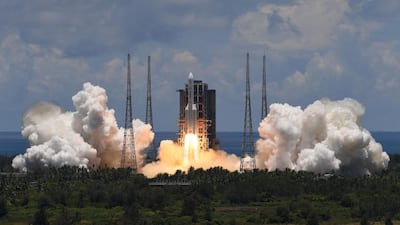
A Long March-5 rocket, carrying an orbiter, lander and rover as part of the Tianwen-1 mission to Mars, lifts off from the Wenchang Space Launch Centre in southern China's Hainan Province in 2020. AFP -
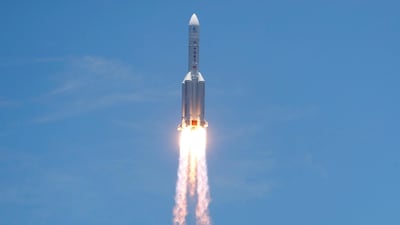
The Long March 5 Y-4 rocket, carrying an unmanned Mars probe of the Tianwen-1 mission, takes off from Wenchang Space Launch Center in Wenchang, Hainan Province, China. REUTERS -
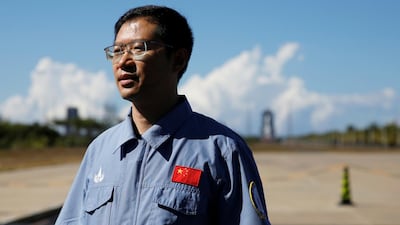
Liu Tongjie, spokesman for China's Mars exploration mission, talks to the media before the launch of Tianwen-1 Mars exploration mission by Long March 5 Y-4 rocket, at Wenchang Space Launch Center in Wenchang, Hainan Province, China. REUTERS -
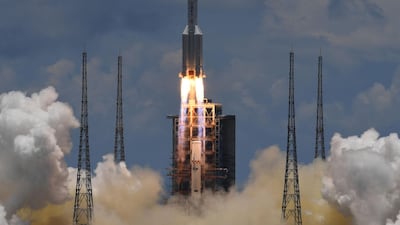
A Long March-5 rocket, carrying an orbiter, lander and rover as part of the Tianwen-1 mission to Mars, lifts off from the Wenchang Space Launch Centre in southern China's Hainan Province. AFP -
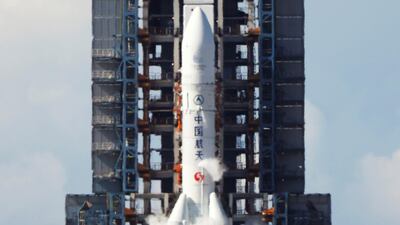
The Long March 5 Y-4 rocket, carrying an unmanned Mars probe of the Tianwen-1 mission, is seen before the launch at Wenchang Space Launch Center in Wenchang, Hainan Province, China. REUTERS -
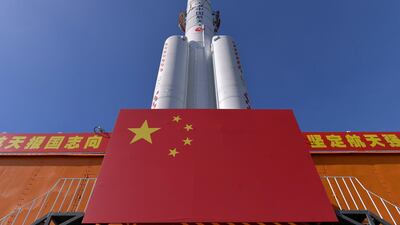
A Long March-5 rocket is seen at the Wenchang Space Launch Center in south China's Hainan Province, Friday, July 17, 2020. AP -
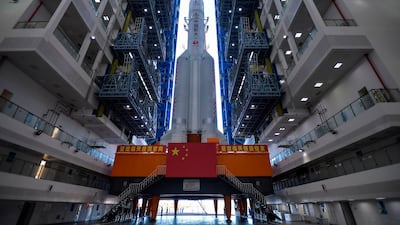
This photo taken on July 17, 2020 shows a Long March 5 rocket being transferred before a planned launch in Wenchang in China's southern Hainan province. AFP -
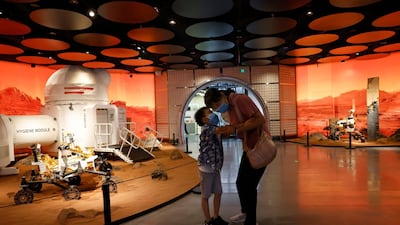
A child whispers to a woman as they visit an exhibition depicting rovers and bio-domes in Mars, in Beijing. AP Photo -
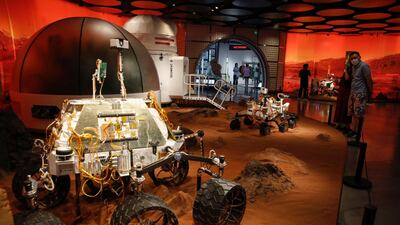
A replica of Mars lander and rovers on display at a shopping mall in Beijing, China. EPA



