
Related: Covid-19 has created global challenges similar to Second World War, says UAE minister
Wealthier nations are forcing poorer countries to fight it out for scraps of the world's vaccine supply, a World Health Organisation (WHO) official said.
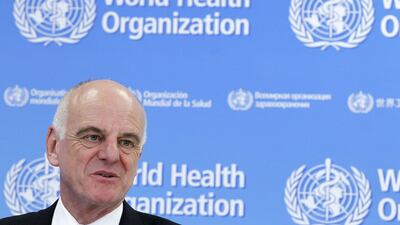
David Nabarro, a special envoy on Covid-19 for the WHO, criticised an unfair balance where the rich snap up most of the shots and leave developing nations struggling to emerge from the pandemic.
Speaking on the second day of the World Government Summit in Dubai, Mr Nabarro warned this approach to vaccinating the world's population was simply wrong.
Western nations have reserved nine billion available vaccines, yet comprise just 14 per cent of the world's population.
That dominance is putting worldwide immunisation against Covid-19 by 2022 under serious threat, the summit heard.
“The current situation on vaccine supply is not satisfactory,” said Mr Nabarro.
“A small number of nations are trying to outbid each other for the vaccines that are available and that approach does not work.
“Unless this is a global, co-ordinated programme we will be looking at each other in six months time and asking where did we go wrong?
“If there are a few countries taking the majority of vaccine supply while the rest of the world has to deal with the leftovers, that is not right.”
Vaccine supply issues were discussed at a virtual session called "will the earth’s population be vaccinated by 2021?" on day two of the annual event.
The summit is being staged online this year due to the pandemic.
Vaccines arrive in Sudan
-

The first shipment of the Oxford-AstraZeneca vaccine arrives at Khartoum airport in the Sudanese capital. The delivery comprises 828,000 doses. AFP -

More than 800,000 doses of the Oxford-AstraZeneca Covid-19 vaccine arrive in Sudan. Authorities will begin inoculating frontline medical staff next week. AFP -

Sudan is set to receive 3.4 million doses of the Oxford-AstraZeneca shot in the coming months through Covax, a UN-led initiative that provides vaccines to poor countries. AFP -

Workers from the UN children's fund supervise the arrival of the first batch of Oxford-AstraZeneca Covid-19 vaccine at Khartoum airport. AFP -

A World Health Organisation employee checks the shipment of more than 800,000 doses of Covid-19 vaccine after it arrives in Sudanese capital Khartoum. AFP -

Sudan will begin to vaccinate frontline medical staff against Covid-19 next week after receiving 828,000 doses of the Oxford-AstraZeneca shot. AFP -

Sudan is expected to receive 3.4 million doses of the Oxford-AstraZeneca vaccine through the UN's Covax initiative. AFP -

Unicef workers receive a briefing at Khartoum airport after the first shipment of Covid-19 vaccine arrives. AFP -

The first shipment of the Oxford-AstraZeneca vaccine arrives at Khartoum airport in the Sudanese capital. AFP


Senegal, for example, has only received a small fraction of the doses need to inoculate its eight million people.
Since mid-February, 65,000 people have been vaccinated, but the country plans to vaccinate just 3 per cent of its frontline workers in 2021.
The country hopes to eventually vaccinate 60 per cent of its population in collaboration with the African Union, but only has a grant to cover 20 per cent of Senegal.
The country is one of the beneficiaries of the WHO’s Covax programme, which aims to deliver two billion doses fairly to all nations by the end of 2021.
To aid developing countries like Senegal, Sultan Bin Sulayem, chief executive officer of DP World, called for a restructuring of debt among poorer nations to enable them to focus on vaccination programmes. “The economic effect on these nations is severe,” he said.
“There should be international help to deal with debts so they can restructure after the pandemic. “Otherwise, how can they distribute the vaccine?”
Mr bin Sulalyem said DP World is working with vaccine manufacturers in more than 90 countries, including Africa and Latin America, which are ideal distribution points for poorer nations.
The hold up is in manufacturing and availability, he said.
“With the availability of the vaccine, the pandemic as such is in the past,” he said.
“Now it is a matter of the distribution – it is the biggest challenge [we've faced] since World War II.
“This endeavour requires collaboration and many countries in Africa – landlocked countries – don’t have access.”

